

Cultural Theft or Legitimate Virtual Tourism?
Egyptian scholars aren’t happy about video games and movies referencing ancient culture
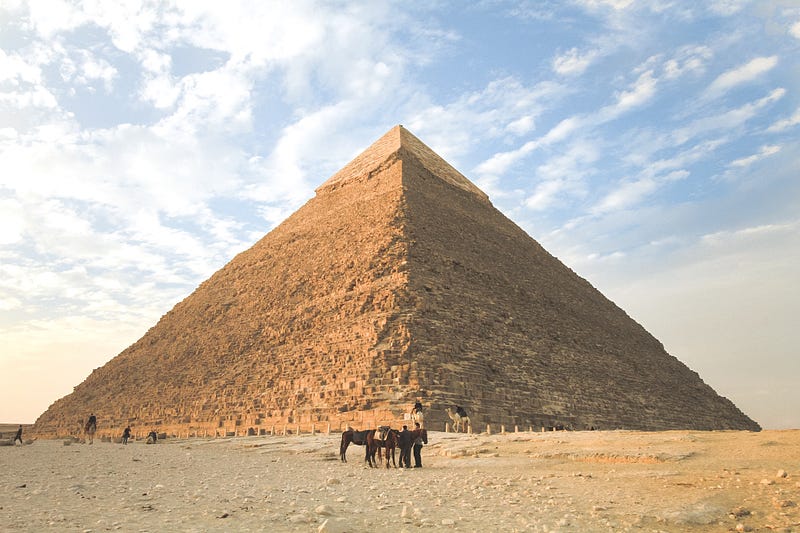
Years ago, I read an article about Egyptian scholars and archeologists trying to copyright the pyramids and other symbols of ancient Egyptian civilization. Their claim was simple: these symbols belong to Egypt, and any depictions by others outside the country— for example, via the Luxor Hotel & Casino in Las Vegas — is illegal (in the event, at least, that Egypt itself isn’t getting a cut from the revenues).
At the time, I thought the claim was ridiculous. I agree that ancient Egyptian cultural artefacts are part of Egypt’s civilization and national identity. But there’s no sense in which a modern restaurant or hotel can steal from an ancient civilization. In fact, it could be argued that modern representations of ancient Egypt act as tools of promotion more than anything else.
Last week I read a similar article on Al Jazeera. This time, though, archeologists and scholars weren’t going after physical hotels and resorts — they were instead targeting movies and video games. The main focus was on two video games in particular: PUBG Mobile and Assassin’s Creed Origins. I haven’t played PUBG, but I’ve definitely played and loved Assassin’s Creed Origins. I’m going to take a closer look at the latter in this feature.
Is Al Jazeera’s claim valid?
The original piece is in Arabic, but I’ll try to provide a summary here. The title is: Movies and Video Games Exploit Egyptian Culture While Making Billions — Egypt Makes Zero. The title itself is already positing a strong position, but it’s misleading, because it implies that movies and video games are going in with bad intentions toward Egyptian culture.
The article states that the movie and video game industries are worth billions of dollars. The argument is that many studios exploit ancient Egyptian culture — its works of art, its symbolism, and its many treasures — without any financial compensation to Egypt or the Egyptian people. Far from seeing these pop-cultural artefacts as tools of promotion, the view expressed here is that these works are distortions in part because they are filled with violence and all sorts of other horrors.
Further, the article claims that without the global popularity of ancient Egypt (particularly everything related to the great Pharoahs), these movie and game projects would have failed — or at least, that they would certainly not have been as popular as they are. The following games are listed: PUBG Mobile, Assassin’s Creed Origins, Pharoah: A New Era, and Lara Croft and the Temple of Osiris. There are plenty of movie examples too, of course: Exodus: Gods and Kings, The Mummy, and Gods of Egypt.
Setting aside any potential moral or ethical arguments for a moment, let’s start by considering the legal implications posed by Al Jazeera. The entire question of “what is legal” here is fundamentally related to the definition of intellectual property. Ancient civilizations are explicitly not the intellectual property of a person or entity; they are considered public domain. This position is specified in the WIPO treaty (World Intellectual Property Organization), signed on July 14, 1967.
In practice, this means that Osiris, Cleopatra, Horus, and Nefertiti (for example) are public domain names that anyone can use for their game or movie. On the other hand, Mickey Mouse, Altair, Bart Simpson, and Popeye are trademarks owned by companies and people; for this reason, they cannot be used without licensing or express permission from their owners. Egyptian scholars are aware of this argument, of course, and they contend that the treaty is fundamentally unfair — they are pushing for the Egyptian government to change the status quo.
Immersive virtual tourism
Assassin’s Creed has always attempted to carefully represent ancient worlds in games. This extends to lifestyles, occupations, and architecture. In Assassin’s Creed Origins, Ubisoft added — for the first time ever — a Discovery Mode as part of the “Discovery Tour” update.
The update included 70 tours for the player to take around ancient Egypt. These are purely educational tours that don’t involve any combat or in-game narrative. Ubisoft stated that they added the mode after being contacted by many university professors and teachers who wanted to see an educational component added to the game. Ubisoft also released the tours as standalone PC downloads, aimed specifically at students and teachers who wanted a way to explore ancient Egypt in a rich, interactive context.
Even before Origins, the Assassin’s Creed franchise has always provided some sort of educational piece. All games in the series offer some degree of realistic information about significant architecture, locations, and historical figures. Of course, the games were never shy about embellishing the details in an effort to create compelling fictional plots. The developers sought to find a balance between an entertaining game experience and a genuinely interesting educational one.
I’ve been here before
Funnily enough, in 2014, my wife and I travelled to Italy for our honeymoon. We visited many Italian cities including Venice and Rome. While walking in Venice, my wife would occasionally produce a town map to get our bearings. I, on the other hand, was walking through the streets with confidence. After all, I’d been there before.
Venice is a city that hasn’t changed very much between 1476 and 2014. I found myself navigating us through town toward major historical sites. This surprised my wife, who assumed I’d visited the city previously, given that I clearly knew where everything was (and that I was able to explain something of the sights as we went). When I told her that I had actually been to Venice — I’d criss-crossed rooftops as Ezio Auditore — she didn’t believe me. She couldn’t fathom that a video game could possibly be so accurate to a real place.
When we returned home, I launched the game and showed her Ubisoft’s work. We compared our travel photos to the in-game world, and found a stunning likeness between the two. It was remarkable, in fact, to see just how much attention to detail Ubisoft’s team had clearly invested in each location.
Link to the past
Assassin’s Creed has therefore offered more than just great games with interesting plots. The games also provided a remarkable virtual tourism experience. Players can roam enormous cities, admire their beautiful architecture, and soak up all sorts of historical information. Ubisoft did far more than simply build a series of video games here: they may have accidentally created the first truly immersive, virtual tourism experience.
After playing multiple games in the series, I learned a great deal about historical events and people that were otherwise unknown to me. I learned about the Borgias, the Vatican, the Ottomans, the Boston Tea Party, and many more. I’ll always be thankful to Assassin’s Creed and Ubisoft for bringing these places to life for me in a way that simply wouldn’t have been possible without, well…going back in time and existing in these physical locations.
While I can understand the motivations of Egyptian scholars and archeologists to a degree, I think they are failing to see the bigger picture. These pop culture experiences — particularly the Assassin’s Creed games — absolutely do not detract or distort the reality of ancient culture. Rather, they promote modern interest in the people and places that might otherwise be forgotten or ignored. Their value is in sharing the wonderful secrets of ancient civilizations with today’s global civilization — they are a unique tool that helps us bridge the massive gulf in time that separates us from our ancestors.
Walid Al Otaibi -WAO- is a top writer in Gaming. He works at an engineering company in Germany as a Project Manager. He comes from a multicultural background and is located in Germany since 2003. He is writing about Arab Culture, Multiculturalism, Finance, and Trending topics.


