
Cult of Chucky’s twist-ending takes a stab at queerness
The Child’s Play series’ 7th entry is now available for viewing on Netflix, and if you’re even a casual fan of the series, it’s different and wacky enough to warrant your attention. At the very least, check it out for Fiona Dourif’s performance alone as the new series lead. We’re going to be heading into some extreme spoiler territory for this discussion, so I’d rather you see the film before we talk about that finale and what it means from a queer perspective, and for the franchise as a whole.
A minor confession: Child’s Play has always been a guilty pleasure of mine. The weird mix of magic, dark campy comedy, and horror even from the first film always felt like it was on the verge of becoming a parody of itself and the genre as a whole. It’s likely why the previous best entry in the series Bride of Chucky is an unrepentant over-the-top parody that introduced new elements (Jennifer Tilly rules) and moved the tone from one-liner slasher villain, to outright Looney Tunes-ville.
Yes. I said previous-best. Cult of Chucky as far as I’m concerned is a brand new high for the series. It shakes up the old rules by turning them on their head to chart a bold new direction, while also building on even the silliest of foundations to create something bizarre and unique. It’s not a great movie, but it is a fun one.
A brief recap: following the events of Curse, Nica (Fiona Dourif) is charged with Chucky’s murders and is committed to a mental institution. Turns out nobody believes you when you blame a killer doll from the 80’s for murdering your entire family. After months of brainwashing and gaslighting from her therapist (we’ll get into him later) Nica believes herself to have been the killer and Chucky was little more than a schizophrenic hallucination. Obviously, this proves not to be the case, and soon there are multiple Chucky dolls running around, laughing maniacally and murdering the shit out of anyone they can.
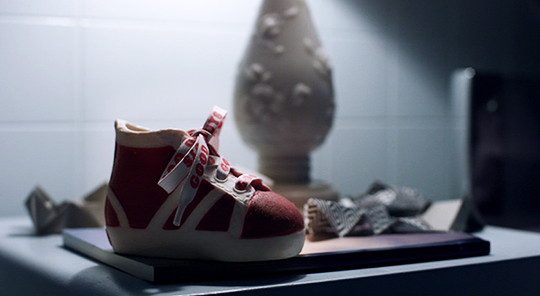
The plot-twists begin barreling in shortly after, one particularly sick one is that her therapist has been using hypnotist sessions to put her under while he violates her. Nothing is shown, just heavily implied through a non-consensual kiss, and a really gross and unsettling scene in which he is slipping a pair of ugly pair of red high-heels onto her feet like a scene out of Argento’s Tenebre. He has been abusing her, as he has with all of his other patients, furthering his agenda and reasons for silencing and belittling them when they came forwards with their stories of fear and victimization at the hands of a brutal killer.
The setting of a mental institution doesn’t completely shy away from ableist tropes that unfortunately plague the horror genre, but it does offer a more sympathetic glimpse towards the mentally ill, by showcasing their victimization at the hands of both society and their supposed caretakers. It’s still rather disempowering and doesn’t convey an entirely healthy message, but here it looks like the heart is in the right place, and is firmly on the side of the victims. Baby-steps, I guess.
Nica herself does get revenge on her abusive therapist, though not in the way one might expect. Throughout the film Chucky has been toying with her mind, encouraging her to violence. He doesn’t want to kill her. He wants her to be like him. He wants to be her, and finally, he succeeds.
The major plot-twist to the film and series is that Chucky is no longer limited by who he can possess. He can instead now copy his soul to any other occupant. He seems to prefer other Chucky dolls, as it’s a face he’s grown accustomed to wearing, but there’s something about Nica he particularly wants. It’s never explained, but I have a few theories.
When Nica becomes Chucky, she launches out of her wheelchair and breaks through her strait-jacket, turns on her therapist and in a new Chucky-style Brooklyn accent says, “This is for Nica.” She then stabs him repeatedly with the pointy end of the ugly high-heel.
Writer/Director Don Mancini says that he wanted the character of Nica to be sympathetic, even in her new role as a killer.
“At the same time, I wanted something interesting with the character, I wanted the audience to go on the ride with this character and be legitimately surprised with where she ended up. Because I think it’s a really weird mixture of sort of not tragedy, but defeat, but also self-empowerment in a weird, fucked up way. Just like, it leaves her, like I didn’t see that coming. I want to know what happens next to her.”
Nica’s Chucky isn’t entirely quite Chucky. She’s still gleefully sadistic, arrogant, and violent, but in a more self-assured, laid-back manner. It’s Nica having taken on some of Chucky’s mannerisms. My theory is that Chucky still imprints himself on the dolls, because this new spell of his isn’t perfect. It doesn’t eject the old soul out of the body, instead they look to be occupying the same form, maybe even blending together a little bit. When he occupies a doll, there’s no one else around. The only soul he’d even bother wanting to share a body with is the woman who so thoroughly kicked his ass back in Curse of Chucky, someone with an unbeatable will to survive — someone like Nica.
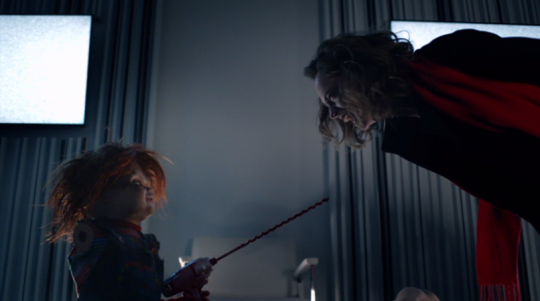
Chucky in this new-form is less of a literal person, less Charles Lee Ray, and now almost seems to be the darkness Nica has been fighting inside of her throughout the film. She sees Chucky in her nightmares as a shadow looming larger and larger in the back of her mind. Even before she becomes possessed, she has taken on a bitter ironic humor about the morbid comedy of her situation.
Nica’s defeat only comes so much in the form that she becomes tired of fighting this darkness and embraces it. She becomes the fiend who murdered her entire family and takes vengeance on the therapist who abused her. She walks through the halls of the institution that once imprisoned her, admiring her handiwork.
So now let’s get to the good stuff. Let’s get to the gay shit.
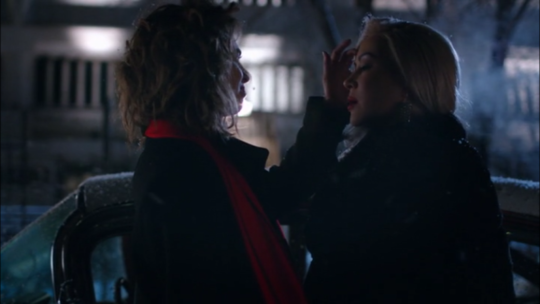
Throughout the film, Chucky’s girlfriend Tiffany (Jennifer Tilly) has been quietly menacing on the sidelines and acting as his agent on the outside. She returns for the finale to escort Chucky away from the hospital so they can resume their murderous adventures to freedom. When Nica/Chucky see her, they share a tender moment and kiss passionately.
One flaw I had with Bride of Chucky is that the romance between Chucky and Tiffany wasn’t quite believed. Yes, I believed that Tiffany at one point loved him before gradually seeing him for the monster he really was, but it never felt reciprocated. The love-story between them really was little more than a plot-device to introduce a delightful co-star and change up the dynamic of the series.
In Cult, it feels real. Fiona Dourif and Jennifer Tilly should really have had more scenes together as there is a remarkable chemistry between them. The tender touch, awkward blushes, and sweet kiss is a lesbian horror power couple dream come true.
Now, we really need to talk about the transgender element of this, cause it’s there, even if unintentional, and even if kinda awkward (but I also kind of love it?) Yes, this is a previously male serial killer now occupying the body of a woman making out with her girlfriend. That is explicitly what we are seeing on screen. That does not make Chucky or Nica trans, as there is a bunch of goofy horror hocus pocus going on to make this scene happen, but it is a narrative that feels trans.
I know many other trans people will feel mixed ways about this, myself included. We’ve been seeing ourselves portrayed as psychotic serial killers since Alfred Hitchcock’s Psycho and Sleepaway Camp. It’s never fun knowing that the only representation people have of you is as a psychosexual deviant murderer. And yes, that’s still at play here, even unintentionally, in Cult of Chucky.
There is also another problematic implication left by framing this as an empowerment narrative, which I’m going to have to take as intentional given Mancini’s statements and the way the cinematic language communicates this sequence. When Nica becomes possessed by Chucky, despite her being bound to a wheelchair for all of Curse and most of Cult, she suddenly becomes able to walk upright again. Her empowerment is framed as losing her physical disability. This is unfortunate, as one of the things I loved about Nica in both films is her framing as a powerful disabled woman, just as capable as any other survivor. Now that’s been taken away from us, and it’s implied that her disability was holding her back, that she needed to be “fixed.”
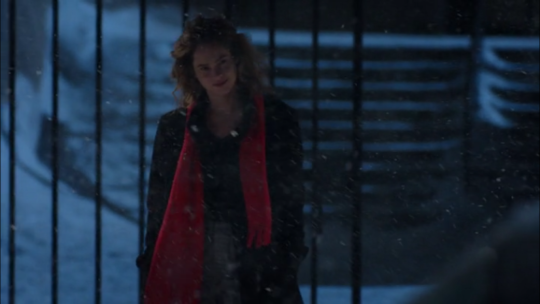
By itself though, I really fucking love this scene. I’m not against gay transgender villains, especially if they are as cool and powerful and suave as Fiona Dourif in a black long-coat and red scarf passionately kissing Jennifer Tilly in the snow outside the scene of a glorious massacre. I’ve said it before, but if you’re going to make queer people into your villains, at the very least let us wear something cool to the occasion.
The Child’s Play series isn’t entirely unaccustomed to its brushes with queerness and gender issues. Child’s Play 3 examined toxic masculinity and showcased the good aspects of male vulnerability and honesty. Bride of Chucky briefly featured a gay male character (who was sadly killed off) and a cameo by transgender actress Alexis Arquette. Seed of Chucky even had an entire scene in which the child of Chucky and Tiffany exclaim that they want to be both a boy and a girl, which may be the first genderqueer puppet I have ever seen in a movie.
These moments aren’t what I’d refer to as representation, or even good representation, they’re just noteworthy in a series that continuously seeks to subvert and parody common horror tropes. Horror has had a long-standing fascination with queer themes and queer identity, and some of the most famous and memorable works of horror have been by LGBT people using the genre to explore societal issues and how we cope with our marginalization. It makes sense that this same fascination would continuously crop up in a series that pokes fun at itself and the genre at large.
Cult of Chucky is not a great movie, and it’s full of problematic material that may understandably drive some away. That said, it may be one of the most inventive and weirdly funny horror movies of the year, and it is most certainly the gayest, and that makes it my personal favorite.
Dorian Dawes is the author of the queer horror anthology Harbinger Island. You can support their work at patreon.com/doriandawes