
Travel and Revolution
Cuba — Granma’s Story
The true story of a US motoryacht that enabled the Cuban revolution
And today she’s in a museum:
This is a story about Fidel Castro’s ‘Granma’.
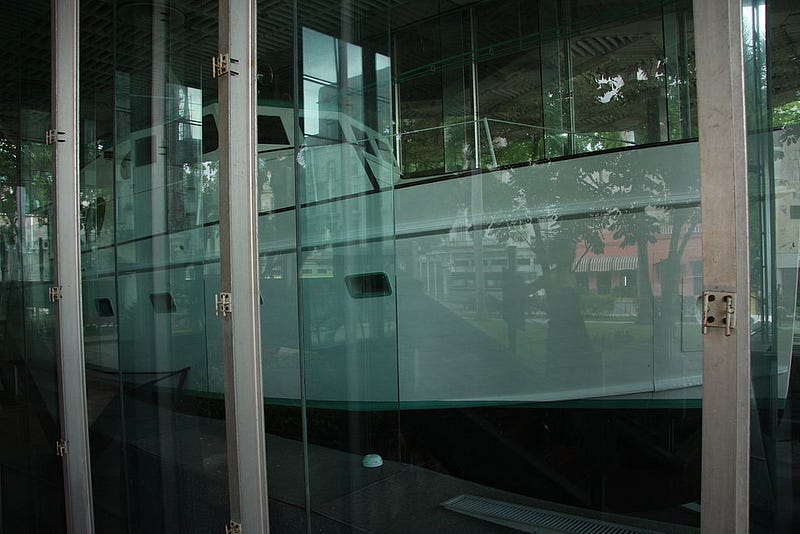
We met her in Havana just after Christmas in the Museum of the Revolution where she is sealed by glass walls from the public. We were there on a flying three-day visit to Havana having left our boat — our home — in Cayo Largo on Cuba’s south coast. We’d arrived there from Grenada via Bonaire and Jamaica, sailing west then north across the Caribbean Sea, 1300 nautical miles.
For me, one of the ‘must sees’ was the Museum of the Revolution. And ‘Granma’ — well, she’s a historical boat and I like to see them.
So far my list includes the Cutty Sark, SS Great Britain, and the Vasa in Stockholm. Here was one more to tick off.
Nowadays, not everyone knows about Fidel Castro, so here’s a quick heads-up.
Granma’s owner — a background
Castro was the illegitimate of a wealthy merchant and saw life from the perspective of his mother’s servitude. However, his father funded his education at a Jesuit school after which he qualified as a lawyer.
He became involved with revolutionary politics and in
1947 he was arrested and jailed for his involvement in an attack on the Moncada Barracks, a military stronghold in Santiago de Cuba. After Fidel’s release from prison in 1955, he went to Mexico where he met fellow revolutionary Ernesto “Che” Guevara.
A revolution was planned
In 1956, Fidel Castro, Che Guevara, and other revolutionaries planned to return to Cuba to launch the revolution again the corrupt regime of Batista.
After a failed attempt to buy a Catalina flying boat Castro settled for a more conventional boat.
A navy instead of an air force
‘Granma’ was an 18 metre-long diesel-powered vessel built-in 1943 by Wheeler Shipbuilding of Brooklyn NY as a light armoured target practice boat for the US Navy. Post-war it was converted to a leisure vessel to accommodate 12 people. The yacht is said to have been named in memory of the previous owner’s grandmother.
The pleasure yacht was purchased on 10 October 1956 US$15,000 from the United States-based Schuylkill Products Company, Inc., by a Mexican citizen (thought to have been a Mexico City gun dealer Antonio “The Friend” del Conde) acting as a frontman for Castro.
The vessel was not in the greatest condition, although seaworthy. The gearboxes were old and worn, preventing the vessel from achieving significant speed. The radio transceiver could only receive, so it was impossible for Castro to communicate directly with other rebels waiting in Cuba.
The cruiser was hopelessly overloaded with weapons, ammunition, and 82 revolutionaries squeezed in. To make matters worse, the boat’s tanks only held about 5,000 litres of fuel, not nearly enough to reach Cuba, so an extra 8,000 litres in cans were stored on deck and the main tanks had to be topped up at sea.
Departure
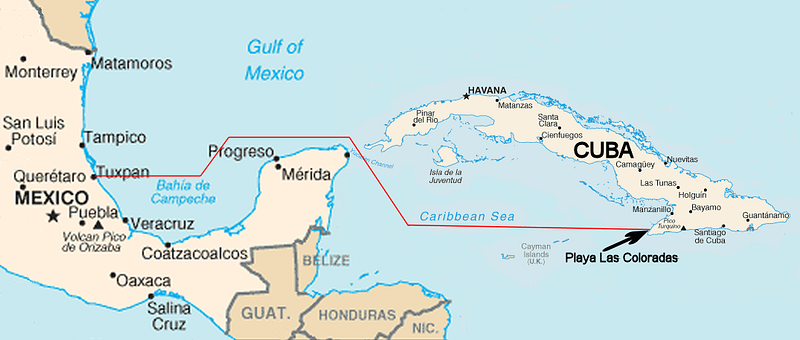
The Granma departed from Tuxpan, Veracruz, on November 25, 1956, at night with all lights out and only using one engine. The problems were compounded by the fact that the Mexican authorities were now pursuing Castro and his band.
The plan was to travel the route taken by José Martí in 1895 in order to start Cuba’s War of Independence. Niquero, a village in Oriente province, was the planned landing site. An assortment of vehicles, Jeeps, provisions, weapons and about 50 men were waiting for them there.
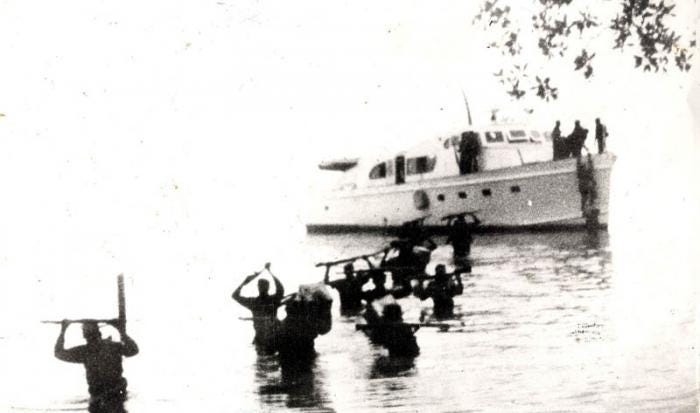
Granma was dangerously overloaded, carrying 82 men, including Fidel Castro and Che Guevara. The group landed in Cuba on December 2, 1956, in the province of Oriente. The landing was a disaster.
Landfall
The boat was leaking and the rebels were passing out with seasickness in bad weather when spotted by a Government helicopter. The plan had to change and Granma was beached near the small fishing village of “Las Coloradas” about fifteen miles south of the designated spot. Due to the muddy water and mangrove swamps, the rebels were unable to unload most of their weapons at the new landing site.
Then the march began.
Exactly 10 days after our departure from Mexico, during the early morning hours of December 5, following a night-long march interrupted by fainting and frequent rest periods, we reached a spot paradoxically known as Alegría de Pío (Rejoicing of the Pious). — Che Guevara
They were ambushed by Batista’s forces and many of the men were killed. Fidel, Che and ten others survived and escaped into the Sierra Maestra mountains. This group became known as “Los Barbudos” (the bearded ones). This marked the beginning of Fidel’s 26-Month War Against Batista.
Finale
In 1959, Fidel Castro finally overthrew Fulgencio Batista and took control of Cuba.
Granma was towed to Havana Bay and the skipper of the 1956 expedition, Norberto Collado Abreu, was given the job of caring for her.
One of Castro’s first official acts was to rename a part of the ‘Oriente’ province of Cuba as ‘Granma’, and so it remains today.
Fidel Castro died on November 25, 2016, at the age of 90.
Today
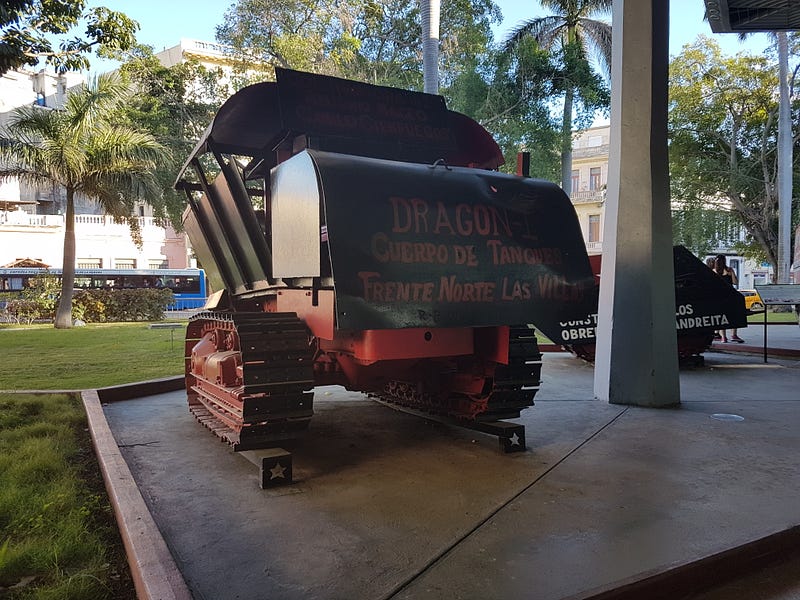
The Granma is now on display at the Museum of the Revolution in Havana. The memorial includes a museum with exhibits about Fidel Castro and the Cuban Revolution including pieces of a US U2 spy plane shot down over Cuba in 1962.
‘Granma’ is now a symbol of Fidel Castro’s legacy and the Cuban Revolution. Unlike many of the leading revolutionaries who are buried in the vast Colon Cemetery in Havana, Castro chose to be buried in the province of Santiago de Cuba, which embraces the region he named ‘ Granma’.
I enjoyed the history, learned a bit more about the Revolution — and some of its unfortunate consequences — and, of course, I met ‘Granma’. Immaculate and shining in her white paint, she did not disappoint.
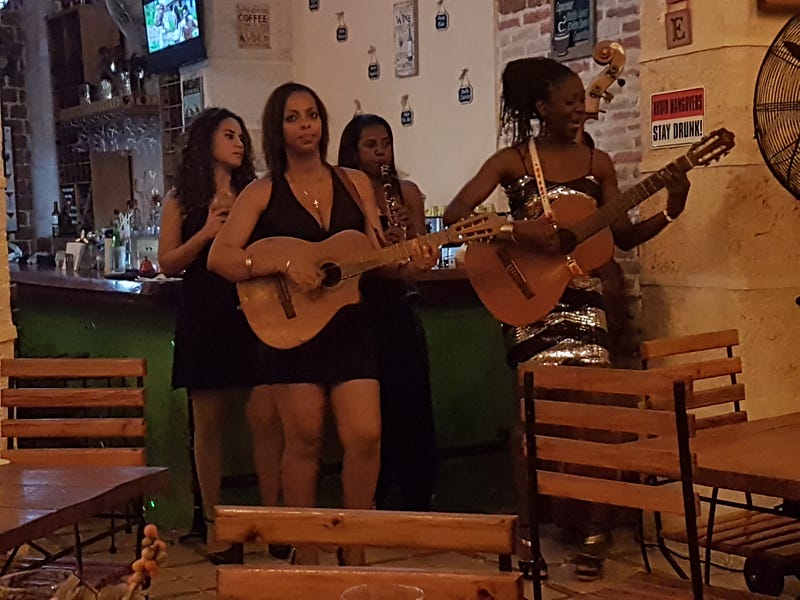
Nor did the music, but that’s another tale!
More stories about my time in Cuba:
About me: If you follow me I guarantee variety in your inbox! I write on a wide range of topics including humor, tech, and travel, together with daily news events and the minutiae of my daily life living on a boat. I also write techno-thrillers…and about…
…historical vessels
If you enjoy reading stories like these and want to support other writers and me, consider signing up to become a Medium member. It’s $5 a month, giving you unlimited access to incredible stories on Medium. If you sign up using my link below, I’ll earn a small commission at no extra cost to you.
You can follow me on Facebook Twitter @jamesmarinero . On Pinterest you will find many of my research photos from around the world. Check out my website where I occasionally have a free book on offer.


