CRYPTO TAXES: What you need to know to prepare! DeFi & LP Tokens discussed!
It’s almost time to start preparing your investment records to do your taxes! You will find a wide variety of opinions on crypto taxes. You will find some who believe that because crypto is untraceable, you don’t have to worry about it. That is NOT TRUE. You will find some who meticulously take notes throughout the year, organizing every crypto transaction so that they can accurately report their taxable income. That is not me, but I wish it were. The truth is, many people truly desire to accurately report their crypto tax income (or loss!) but the task is simply too overwhelming. So, they ignore it, and nervously await a letter from the IRS. This article will discuss what *I* do to prepare my crypto taxes. In good faith, it’s the best I can do to accurately report my crypto income. However, please understand that I am not a financial adviser. If your crypto taxes are overwhelming or complex, consult a qualified tax adviser!

Before DeFi became a popular avenue for crypto, centralized exchanges did a fair job of keeping track of crypto transactions. They sometimes even provided a 1099 report (although this is rare) that you could simply provide to your CPA or even TurboTax. And, in 2024, exchanges are going to be required to provide 1099 for many users. But, it remains to be seen exactly how that will be implemented. And, it doesn’t help you this year!
Guide:
- US tax law, a primer
- DeFi and Transaction Logs
- Finding the Price of LP tokens
- Tax Forms
First, a primer on US tax law regarding cryptocurrency
Cryptocurrency has become an increasingly popular form of investment in recent years, with more and more people looking to take advantage of its potential for high returns. However, as with any other form of investment, it’s important to understand the tax implications of buying and selling cryptocurrency. Let’s take a look at the current state of cryptocurrency taxes in the United States and offer some tips on how to stay on the right side of the law.
First and foremost, it’s important to note that the Internal Revenue Service (IRS) considers cryptocurrency to be property, rather than a currency. This means that it is subject to the same tax rules as other forms of property, such as stocks or real estate.
When it comes to buying and selling cryptocurrency, the IRS treats these transactions as capital gains or losses. If you sell your cryptocurrency for a profit, you’ll need to pay capital gains tax on the difference between the sale price and your original purchase price. On the other hand, if you sell your cryptocurrency for a loss, you can claim a capital loss on your tax return.
The amount of tax you’ll owe on your cryptocurrency transactions will depend on how long you held the cryptocurrency before selling it. If you held the cryptocurrency for less than a year, the profit or loss will be treated as a short-term capital gain or loss and will be taxed at your ordinary income tax rate. If you held the cryptocurrency for more than a year, the profit or loss will be treated as a long-term capital gain or loss and will be taxed at a lower rate.
In addition to capital gains tax, you may also be subject to other taxes on your cryptocurrency transactions. For example, if you receive cryptocurrency as payment for goods or services, you’ll need to report it as income on your tax return and pay the appropriate taxes. Similarly, if you use cryptocurrency to pay for goods or services, you may be subject to sales tax.
It’s important to keep detailed records of all your cryptocurrency transactions, including the date of the transaction, the amount of cryptocurrency involved, and the value of the transaction in U.S. dollars. This will make it easier to accurately report your cryptocurrency-related income and expenses on your tax return.
Cryptocurrency is subject to the same tax rules as other forms of property in the United States. If you buy and sell cryptocurrency, you’ll need to pay capital gains tax on any profits, and you may also be subject to other taxes depending on your specific circumstances. By keeping detailed records and staying up-to-date on the latest tax laws, you can ensure that you’re properly reporting and paying taxes on your cryptocurrency transactions.
DeFi and Transaction Logs
While centralized exchanges keep a fairly easy-to-access log of all your transactions, DeFi (smart contracts on Ethereum, Binance Smart Chain, Solana, or Fantom, etc) does not provide such logs. It can be extremely overwhelming to try to keep track of all of this. If you are involved in LP Tokens, Yield Farming, Reward tokens, ROI platforms, token swaps, and other aspects of DeFi, it can seem quite impossible to accurately keep track and report. You may find yourself wishing that you had kept a log of all your transactions all year and wondering how you can possible get back on track. There is hope!
First, your entire crypto DeFi history is stored on the blockchain. That means, it’s out there. This is good news with a warning. The good news is that if you know where to look, you can find what you need. The warning is that it is becoming increasingly important to make sure you do this, because there exists a future scenario where the IRS can simply scan your wallet with their future software and compare it to your reported taxes from a given year. Will this happen? Uncertain. Can it happen? Undoubtedly.
If you are using the Ethereum network for your DeFi, you can access your entire history by visiting Etherscan.io, enter your Ethereum wallet address, and you’ll see a list of transactions. At the bottom right, you’ll see “Download CSV Export”

This will allow you import your transaction log as a CSV into Microsoft Excel or GoogleSheets. Both of these programs will import your data as raw information, and you will need to do a fair amount of legwork (finding prices of coins on certain dates/times) to get accurate gains/losses. Simply, it’s not for the faint of heart, but it is free.
The same situation applies to Binance Smart Chain (bscscan.org), Solana (solscan.io), and Fantom (ftmscan.com). If you are a Do-It-Yourselfer, this is a viable option, if you know your way around a spreadsheet and you know how to look up the prices of tokens.
The Price of LP Tokens — the biggest challenge of your tax year
If you are adept at setting up a spreadsheet, and calculate your gains/losses, and can find coin prices when you need them, you will probably be fine. But, if you are involved in Yield Farming, you may find a rude awakening. You are going to find a LP token transactions in your wallet that simply all blend together.
I use Binance Smart Chain as my primary DeFi, so I will discuss the various ways to find the price of LP tokens. LP tokens actually are the pairing of TWO tokens together, and you can’t just take the average of the two token prices to find the price. The LP tokens have a value all of their own, which varies over time. LP tokens are designed to rise in value ever so slightly every day if the coin prices they represent stay exactly the same. And, if the coin prices change, they will vary in price dramatically. It can be very difficult to find the prices. Here’s what I do:
- Use CoinMarketCap.com to search the LP token. You can search by LP token name “i.e. ETH/BTCB”, but it’s better to use the LP token address. For ETH/BTCB, the token address is 0xd171b26e4484402de70e3ea256be5a2630d7e88d, which can be searched in CoinMarketCap search field. You’ll see these results:
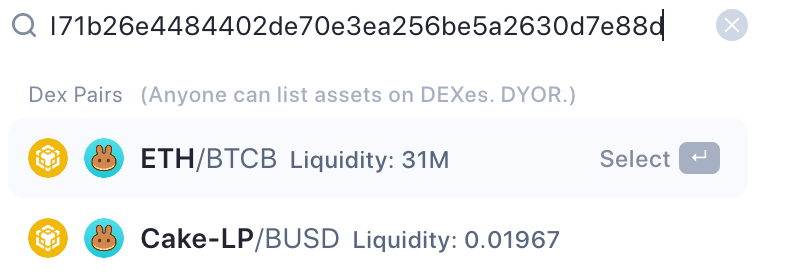
LP tokens are an asset, just like single coins. When they enter your wallet and leave your wallet, they are a taxable event. So, you have to keep track of the value.
When you create the LP token by pairing two tokens, it’s fairly easy to find the value of the two tokens on the day/time of the creation of the LP token. And, when you break an LP token back into its 2 coin pairs, you can also see how much of each coin you get, and find out their values.
The hard part comes when you move LP tokens around without breaking them. For example, when you have LP tokens in a yield farm on Pancakeswap, and then on a certain date later, you withdraw them from that farm and stake them on The Animal Farm to get a better APR. You have transactions of the LP tokens in your bscscan, but you don’t have a clear value. That’s where the CoinMarketCap search can be helpful. In the bscscan of the transaction, you will see the contract address of the LP token (in this case, it will be a “CAKE-LP” token), and you can search it on CoinMarketCap, then look at the chart for the day/time.
A challenge comes when the LP tokens don’t appear in CoinMarketCap. The most common LP tokens will, like ETH/BNB, ETH/BTCB, etc. But, the more obscure ones are much harder to find the price. Here are some tricks you can use:
- Community Telegrams. The DRIP/Animal Farm ecosystem has a Telegram for the prices of all the tokens and LP tokens. You can scroll back to the date/time of the transaction and find the LP value.
- Risky: Best guess. If you hold create an LP token on March 1, 2022, and you know its value is $100, and you break it on May 1, 2022, and its value is $200, you can make a guess that on April 1, 2022, its value was $150. It’s not exact, but if you unstaked it on April 1 and re-staked it somewhere else on April 1, you can be fairly certain that the value didn’t change between unstaking and restaking. Therefore, you don’t have a taxable consequence. Whether the value was $150 or $160, your tax shouldn’t change.
Finding the price of LP tokens will be a challenge. Personally, after last year, I began recording the value of every LP token that passed through my wallet without creating (like the above example of unstaking and restaking). But, that was because last year was so difficult.
How to get tax forms
If you do-it-yourself, you won’t get a tax form. You’ll need to do your best to provide your accountant with the best information you can, and they’ll need to enter it into the proper form. Or, if you use TurboTax or other tax software, there are fields for capital gains tax.
I use a service called Koinly.io ($20 discount code embedded). It allows you to sync all your exchange with API keys, CSV, and wallet syncs. It DOES require you to review and enter some missing information. It does not automatically find prices of less common tokens (last year, it found Ethereum, Cake, and Bitcoin just fine, but required that I input prices for DRIP, etc). And, it will require to find the price of all LP tokens. But, at the end, it’s a good interface and you will get IRS Forms 8949 and Schedule D, which you can use with TurboTax (there’s even a TurboTax option).
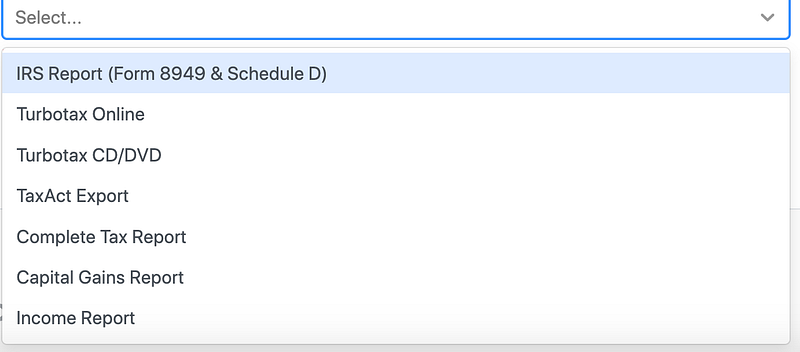
The service at Koinly is not free, but if you have a lot of transactions, I believe it’s worth it. You can get $20 if you use my referral code: https://koinly.io/?via=49E2C638&utm_source=friend
But, you can go to koinly.io if you wish and not use my referral code.
In conclusion, taxes are more complex when you do crypto. We all know this. But, it doesn’t have to be a nightmare, and you certainly shouldn’t just ignore it. I am not a financial adviser, but I have been through this.
I wish you luck in the stressful reporting. It will likely feel pretty darn good to have done your best to accurately report! And, if you took a crypto loss in 2022, like a lot of people did, you can claim that loss on your taxes if you report it correctly!
If you like this article, please follow me on Medium, leave a clap, or leave a comment. Better yet, do all three!
New to trading? Try crypto trading bots or copy trading


