
Cryptocurrencies / Investing
Crypto-Index-Funds Are a Thing Now — Here’s Why You Might Want To Keep Your Hands off Them
5 issues with the new asset

You might know index funds from the world of stocks.
Such a fund invests in a stock index. Investors pay money into the fund, which then buys the shares in the index. This is a simple, diversified, and safe way to invest in stocks.
Now let’s talk about what this has to do with cryptocurrencies.
The market for cryptos is booming.
Besides Bitcoin, thousands of other currencies have also seen strong growth. But which cryptocurrency will prevail? Could there be more than one at the same time? Is it possible to get to know all of them?
While asking these questions, another one came to mind — why not invest in multiple cryptocurrencies simultaneously?
That’s what seems to be more accessible than ever before. Crypto index investing makes it possible.
Platforms like BitPanda already offer it. You deposit money, and it is automatically invested — in different cryptos.
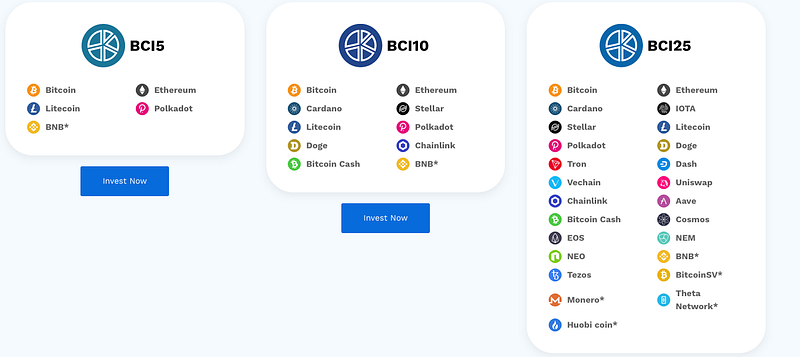
At first glance, this sounds like a fantastic idea. Then, however, I noticed a few possible points of criticism. Let’s talk about five critical issues.
Does simultaneous investing even make sense?
What do you think is the purpose of cryptocurrencies?
Well, first and foremost, they are a means of payment. Some cryptos and their ecosystem also enable smart contracts and NFTs, but essentially the purpose of most cryptocurrencies overlaps.
To understand this, let’s take a look at classic index investing.
In a stock index, there are companies like Apple, Shell & General Electric. If Apple has a bad day, Shell can still have a good one — they are companies from different industries. With cryptos, such a scenario is not guaranteed.
The extreme case would be that a single cryptocurrency displaces all others. If that happens, a crypto index would be pretty bad off: the dominant cryptocurrency is only a tiny part of the fund (if at all), so the gain becomes small or even negative.
More closely related than you think
Another point that could make a crypto index fund pretty redundant: Cryptocurrencies are very highly correlated with each other.
This means that the price trends are very similar. You may have noticed it before: When Bitcoin goes up, it triggers a little hype. Other cryptos also start to rise significantly.
As an example, the price trend of Bitcoin (above) and Ether (below) in the last seven days:
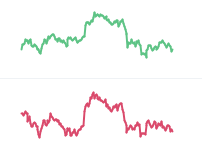
To profit from the crypto trend, you don’t have to invest in many different cryptos. It can be enough to invest in just one — which brings us to our next point.
A matter of taxes
Crypto index funds are a relatively new product. This article refers to this asset class in general, not specifically to BitPanda’s product.
This novelty has several disadvantages — one of them is the unclear situation with taxes.
Classical funds, shares, ETFs, and even individual cryptocurrencies are very well regulated in most countries. Here in Germany, the situation is clear — cryptocurrencies can be sold after one year of ownership, even without taxes. In some other countries, this is also the case.
But what exactly is a crypto index fund? Depending on the country, this is to be judged differently when it comes to tax law.
If you can sell individual cryptocurrencies tax-free or at least very cheaply, a crypto fund doesn’t make much sense. After all, it may be that such a fund is viewed differently in terms of tax.
Additional costs
Buying cryptocurrencies usually costs fees. Of course, these also occur when the Fund buys cryptocurrencies for its investors.
It is essential to understand that the Fund does not buy the cryptos just once — it buys several at once to maintain diversification. Compared to buying one crypto, this is much more expensive.
On top of that, there are management fees. The provider of the fund wants to make a profit.
Insofar as you want to invest in multiple cryptocurrencies on a one-time basis, a fund is not a good option.
The costs of running it are ongoing and are usually taken from your return.
With a one-time investment on your own, there are also one-time fees. However, these costs are small compared to the total.
Why not do it on your own?
Instead of investing in stock index funds or ETFs, you could also buy all the stocks yourself. Unfortunately, this is not easy — there is a crucial difference between cryptos and stocks.
You can’t buy pieces of stocks. Cryptos can — the smallest unit of a cryptocurrency is often only in the cent range or even lower. Stocks, like Tesla, though, require a significant investment for just one share.
I just mentioned the costs of buying cryptos. Since these are relatively low, and the investment sum is very freely selectable, nothing keeps you from buying different cryptos on your own.
You can choose which ones you want. Hundreds of different cryptocurrencies are available at exchanges like Binance — so even building a crypto index is no problem.
Summing up
I’m keeping my hands off crypto index funds for now.
In the future, they may be an excellent product, but that remains to be seen.
From a tax perspective alone, I don’t want to gamble away the paradisiacal conditions here in Germany — investing in a fund could only make things unnecessarily complicated for me. Also, I prefer to choose for myself in which cryptos I invest and in which not.
In BitPanda’s offer, for example, Algorand is missing, in my opinion.
Thank you for reading!