


Crypto Basics: A Beginner’s Guide to Digital Currencies — Part 8: Cashing Out Your Funds
🌟For non-paying members to access the full story, click here🌟🔓
Welcome back to “Crypto Basics”! So far, we’ve explored the ins and outs of blockchain, purchasing cryptocurrencies, and setting up non-custodial wallets. Now, we’ll focus on how to securely cash out your funds, using Coinbase as our example, similar to how we approached buying cryptocurrencies.
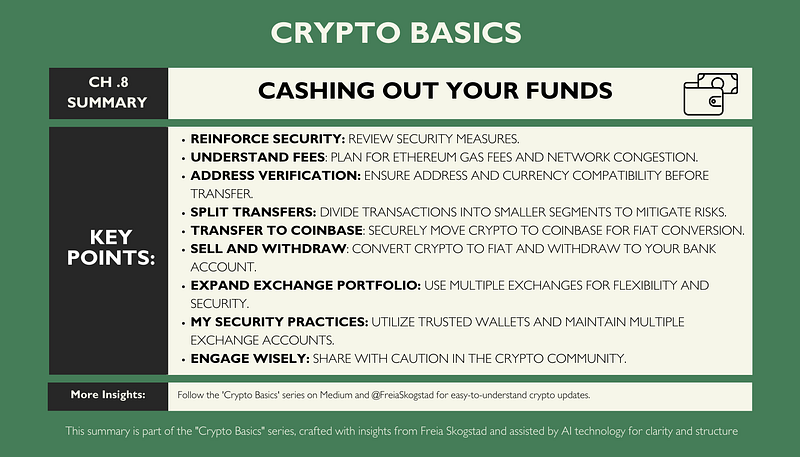
Before You Begin: Reinforcing Security Measures
Before diving into cashing out, let’s underscore the importance of security:
✅Revisit Security Best Practices: Ensure a solid understanding of our security guidance (Crypto Basics Series, Chapters 4 and 5).
✅Seed Phrases: These are your wallet’s lifeline. Store them securely and never share them (Crypto Basics Series, Chapters 3 and 4).
✅Private Keys and Public Addresses: Keep your private keys secret. Share your public address with care to avoid privacy breaches (Crypto Basics Series, Chapters 3 and 4).
Understanding Fees and Network Congestion
Cashing out involves transaction fees, which vary depending on network congestion.
- Ethereum’s Gas Fees: These can fluctuate significantly. The gas fee you need to pay increases as the network gets more crowded. Planning your transactions during off-peak times, like late nights or weekends, can help minimize costs. Tools and websites track real-time network congestion and average fee rates, such as Etherscan Gas Tracker for Ethereum. Using these can help you decide the best time to make a transaction.
Tips for Managing Transfers
Consider splitting your transfer into smaller segments. This strategy helps mitigate risks. Begin with a test transaction to ensure everything is set up correctly, then proceed with larger amounts.
Cashing Out Step-by-Step with Purpose
Prepare for Transfer: Careful Address Matching
- Log Into Coinbase: Start by logging into your Coinbase account to access your wallet.
- Find the Right Address: Within Coinbase, navigate to the ‘Receive’ section and select the specific cryptocurrency you’re planning to transfer, such as Ethereum. Copy the Ethereum receiving address to use for the transfer.
- Double-Check Addresses: Accuracy is Key
Before you finalize the transfer, it’s critical to double-check two key aspects of the receiving address:
- Correct Currency Match: Verify that the receiving address is compatible with the cryptocurrency you’re sending. For instance, if you’re sending Ethereum (ETH), the receiving address must specifically be for Ethereum. Sending coins via the wrong network can also lead to lost funds.
- Intended Recipient Verification: Confirm that the address you’ve copied belongs to the correct recipient—in this case, your account on Coinbase or another exchange. This step is crucial to prevent sending your assets to an incorrect or unintended address.
To do this effectively:
- Cross-Verify: Compare the address you’ve copied with the one displayed in your Coinbase account, ensuring every character matches exactly. Even a small discrepancy could direct your funds to a different destination.
Tutorial Guidance: Viewing tutorials like “How to receive cryptocurrency on Coinbase” can guide you through safely copying and verifying the receiving address within your Coinbase account, providing an added layer of security to your transactions.
By taking these steps, you safeguard your transaction against common mistakes, ensuring your cryptocurrencies reach their intended destination securely.
Transfer to Coinbase
Move your cryptocurrency from your non-custodial wallet to Coinbase. This transfer is essential for converting your digital assets into fiat currency (like USD, EUR, etc.) on a platform that facilitates such exchanges securely.
Why It Matters: Ensuring the transfer is smooth and secure is paramount. Starting with a small test transaction can help verify that everything works as expected, minimizing risks.
Sell Cryptocurrency
Once your crypto is in Coinbase, sell it for your preferred fiat currency. This step is where your investment potentially turns into tangible profits that you can withdraw to your bank account.
Tutorial Suggestion: “How to cash out your funds” offers step-by-step guidance on converting your crypto into fiat currency on Coinbase.
Withdraw Funds
Complete the cash-out process by withdrawing the fiat currency to your bank account. This final step actualizes your crypto investments into spendable, physical currency.
Why It’s Important: Following the correct withdrawal procedure is vital to successfully access your funds. The tutorial mentioned above includes details on withdrawing your money, ensuring you can confidently navigate this process.
Expanding Your Exchange Portfolio
Having accounts on multiple exchanges like Binance and Kraken, alongside Coinbase, offers flexibility and an added layer of security. It allows you to adapt to market changes, access a broader range of cryptocurrencies, and provide alternatives in case one exchange experiences issues. Consider each platform’s reputation, user-friendliness, security, supported cryptocurrencies, and fees.
Why Diversify: Multiple accounts act as a safety net, ensuring you always have a platform available for your trading and cashing out needs, especially during exchange-specific outages.
My Security Practices and Preferences
I use exchanges like Coinbase for transactions, quickly moving assets to my Ledger Nano S for secure storage. For daily transactions, Aurox and Internet Money Wallet are my go-to’s. I maintain multiple exchange accounts, including Coinbase, Binance, Kucoin, and a few smaller platforms, and I’m planning to expand to Kraken soon. Additionally, I use COAST, a non-custodial on-and-off-ramp service, for direct access to Pulsechain’s PLS, PLSX, and HEX.
Final Thoughts on Engagement and Security
As we wrap up this chapter, remember the importance of engaging with the crypto community wisely. Sharing experiences is valuable, but safeguarding your privacy and security should always come first. Prioritize careful sharing, especially when it involves transaction details or holdings.
Conclusion
We’ve now covered the complete cycle from buying to securely cashing out your cryptocurrencies. This foundation empowers you to navigate the crypto space with confidence, making informed decisions about managing your digital assets.
Stay tuned for more from the “Crypto Basics” series as we continue to navigate the world of cryptocurrencies together.
Trusted Resources:
Here’s a list of trusted resources, including affiliate links:
- Ledger Nano S — Hardware Wallet (Affiliate Link)
- Aurox — Crypto Wallet Service (Affiliate Link)
- COAST Platform — Non-Custodial On-Ramp and Off-Ramp Service (Affiliate Link)
Direct Links to Services and Cryptocurrencies:
- Coinbase — Exchange Service
- Binance — Exchange Service
- Kraken — Exchange Service
- Kucoin — Exchange Service
- Internet Money Wallet — Crypto Wallet Service
- MetaMask — Crypto Wallet Service
- Ethereum (ETH) Official Website
- Etherscan Gas Tracker — Real-Time Ethereum Gas Fee Estimates
- Pulsechain (PLS) Official Website
- PulseX (PLSX) Official Website
- Hex (HEX) Official Website
Explore My Crypto Journey
Discover my cryptocurrency journey, from challenges to insights, for a unique perspective.
Stay Connected
Interested in cryptocurrency? Subscribe on Medium for more insights. Your support helps keep the exploration going.
Follow for Insights
For updates on my cryptocurrency journey, follow me on Twitter and Pinterest as @FreiaSkogstad. Find reflections and observations for a closer look at my experiences.
Discover Unique Crypto-Inspired Art
Explore the intersection of finance and art at my Redbubble store, PixelChain. Discover visual art and merchandise inspired by the world of cryptocurrency, from thought-provoking decor to crypto-themed apparel. Visit PixelChain on Redbubble for unique finds tailored to enthusiasts.
A Collaborative Effort: Crafted with the help of OpenAI’s language model, this story combines AI-enhanced structuring with my original ideas and experiences.