
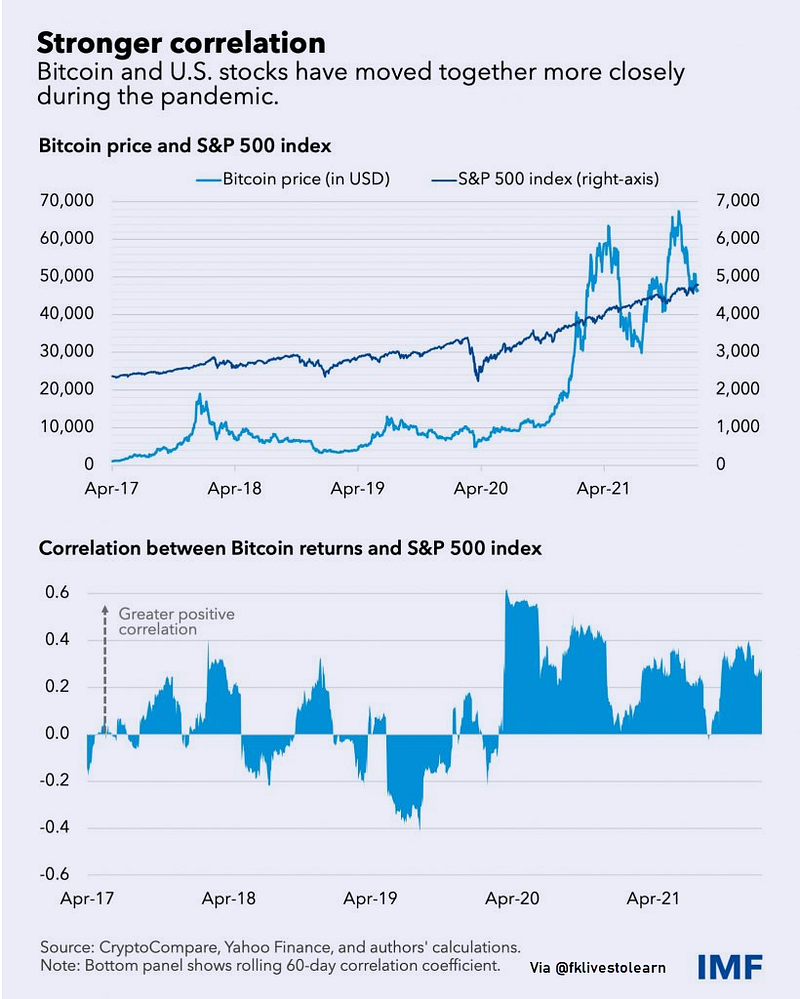
CRYPTO-STOCKS CORRELATION
Crypto assets have recently shown a stronger correlation with U.S stocks
The pandemic seems to have changed the dynamic of digital assets like Bitcoin which are now moving in lockstep with U.S stocks
Last year was a really good one for crypto-assets as the cumulative market cap of the digital assets crossed the $3 trillion mark. That’s a fivefold increase from $620 billion in 2017 when Bitcoin last peaked at around $20k. Maturing crypto market space along with the introduction of Decentralized Finance (DeFi) sent their popularity soaring among retail and institutional investors alike. And despite a significant weakness into the new year, the market cap of cryptocurrencies ($2T) is still up 4x from the 2017 level.
During the first boom and the following correction in crypto assets like Bitcoin & Ethereum showed little correlation with major stock indices. The reason was that the former was considered a hedge against risk other asset classes like U.S stocks. This was pretty evident in the 2017–19 period when the U.S benchmark stock index S&P 500 had little directional symmetry with Bitcoin.
During this time, The correlation coefficient of their daily moves was just 0.01. But the same metric jumped to 0.36 for the pandemic years of 2020–21 (chart above). Ultra accommodative monetary policies giving way to easy money stoked investor appetite as they went on a shopping spree — buying both risky stocks and cryptocurrencies. Another reason could be the ballooning institutional investment in Bitcoin.
According to the research conducted by IMF, this trend of a stronger association between stocks and cryptos is also apparent in emerging economies. For example, the correlation between returns on the MSCI emerging markets index and Bitcoin was 0.34 in 2020–21, a 17-fold increase from the preceding years.
So what does this mean? If you trade cryptos and/or stocks, you might have noticed that the former has started to act more like a risky asset rather than a hedge against it. More recently, cryptos have fallen in tandem with U.S stocks and risen when equities exhibited a strong risk appetite. It remains to be seen whether this relationship would hold but keep an eye out for this relationship to play out, especially if you are used to betting one against the other.
IMF analysis suggests that increased and sizeable co-movement and spillovers between crypto and equity markets indicate a growing interconnectedness between the two asset classes that permits the transmission of shocks that can destabilize financial markets. Also, high volatility and lofty valuations of cryptocurrencies could pose risks for financial stability in countries where there is widespread crypto adoption.
A Global regulatory framework that is comprehensive, consistent, and coordinated could mitigate such financial stability risks stemming from the crypto ecosystem. For now, most of these policies look fragmented and inconsistent.
➱➱➱➱➱➱➱➱➱➱➱➱➱➱➱➱➱➱➱➱➱➱➱➱➱➱➱➱➱
Read more stories like this and others by Faisal Khan on Medium.
Stay informed with the content that matters — Join my weekly Newsletter.
➱➱➱➱➱➱➱➱➱➱➱➱➱➱➱➱➱➱➱➱➱➱➱➱➱➱➱➱➱