
CRITICAL RACE THEORY
Critical Race Theory is Coming to a School Near You
Let’s break down the theory white conservatives love to hate
Next time a white person claims they oppose critical race theory, ask them which tenets they disagree with and why. Chances are, they could not list any of them. As I wrote before, White People’s Fear of Critical Race Theory is Based on Ignorance. Most oppose the theory at face value, calling it Marxist, racist, and divisive. However, how can you call it any of those things when you obviously couldn’t pick Critical Race Theory out of a lineup?
Some white people view race as the problem instead of racism. That’s like regarding Judaism as the problem instead of anti-semitism or viewing sex as a problem instead of sexism. America is plagued with a dangerous both-siderism. Rather than admit that white colonists, and yes, the founding fathers were straight-up wrong for enslaving Black people, they want to pretend none of that happened.
Critical race theory is a legal theory, and, for the record, the tenets are not actually being taught in schools. However, educators are filling in the gaps present in the white-washed curriculum. They are evaluating the curriculum from a critical race theory lens. So, yes, CRT is coming to a school near you in different shapes and forms because Black and Indigenous history are inseparable from American history.
Oklahoma schools did not initially teach students about The Tulsa Race Massacre. However, that event had a significant impact on their state. Not teaching events unfavorable to white Americans is an unreasonable stance. Imagine not teaching high school students about WWII because it makes Nazi Germans look bad. If they had won, the truth might face the same type of opposition. History only told by the winners is not education at all — it’s indoctrination.
White conservatives have a jaw-smackingly obvious goal. They do not want their children to learn about America’s racist roots. If white children learned about white supremacy's role in oppressing minorities, they fear these children would hate themselves. However, critical race theory does not teach anyone to hate white people.
Once again, America finds itself in a knock-down-drag-out fight. Both sides seem to be shouting over one another, but here’s the sticking point — both sides are not wrong. Racism and anti-racism are not equivalent points.
A culture built upon a false racial hierarchy can only be maintained through lies, force and duplicity — all of which are on full display in the asinine attempts to ban critical race theory. Those who are threatened by any systemic analysis of racism and its underpinnings reveal exactly where they stand on white supremacy (Perry, 2021).
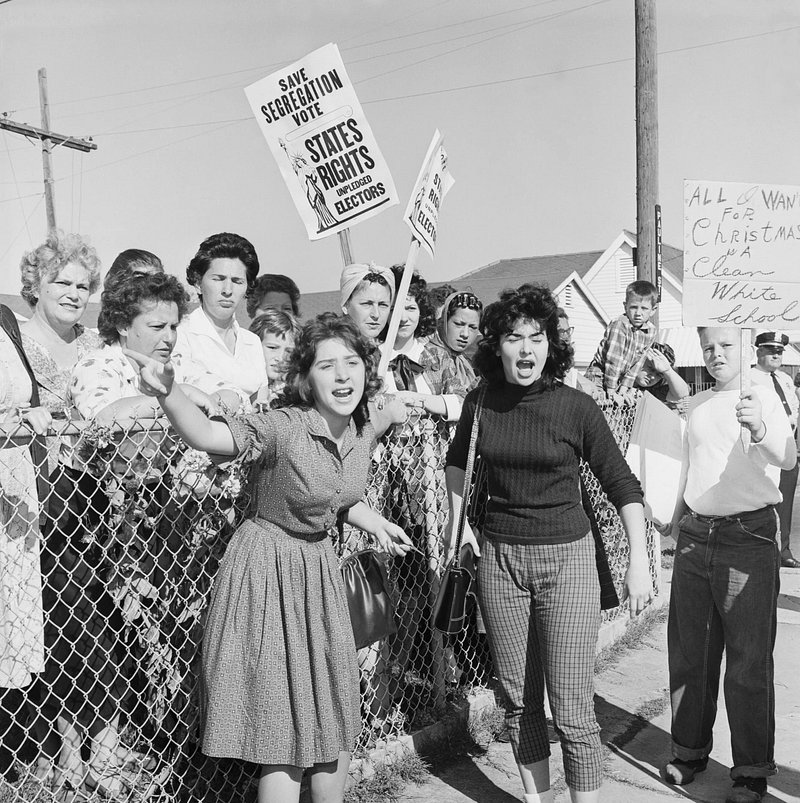
Take a moment to look at the picture at the top of this article. These white women in New Orleans did not want Black students to go to school with their children. A young white boy holds a sign which declares, “All I Want For Christmas is a Clean, White School.” Parents fighting against critical race theory are no better than the mom who indoctrinated that young white boy. The goal is the same — keep Black people, their history, and their experiences outside the classroom. “White” and “Clean,” say it all.
But, I do not expect you to believe me, dear reader. Let’s review the main tenets of critical race theory so you can decide for yourself.
Here are the two tenets that all critical race theorists agree on:
“The first is to understand how a regime of white supremacy and its subordination of people of color have been created and maintained in America, and, in particular, to examine the relationship between that social structure and professed ideals such as “the rule of law” and “equal protection.” The second is a desire not merely to understand the vexed bond between law and racial power but to change it (Crenshaw et al., 1995).”
America isn’t soft and lovely; it’s hard and rough around the edges. Get to know her, and you will see historical truth speaks louder than conservative pundits and critics ever could.“The white ‘race’ was invented by rich Virginians in 1676.” Wealthy white people literally created a racial caste system and now claim it is divisive to discuss their Frankenstein.
White Americans today are descendants and benefactors of that system. This fact should not make white people hate themselves — that’s not the point. And if the truth makes them feel that way, then what does that say about America and our forefathers?
It says that America is not a land defined by white heroes when we take off the rose-colored glasses. But rather, a nation that put white religious and political freedom above Black liberty at every turn. Slavery is America’s original sin. However, when white people defend the white-dominated system their ancestors created, they take on their wrongdoing.
Critical race theorists agree that America’s legal system should provide equal protection under the law. They also believe that it is important to move past knowing that and actually act on what we know. Check it. Black people are not asking for supremacy. Pursuing equality is the natural follow-up to realizing America uses a racial caste system. So far, I do not see any Marxism. Do you?
In addition to the two tenets critical race theorists agree on, various tenets fall under the critical race theory umbrella: the centrality and intersectionality of race and racism, challenge the dominant ideology, commitment to social justice, experimental knowledge, counter storytelling, and interdisciplinary perspectives.
(1) The centrality and intersectionality of race and racism
Many critical race theorists evaluate legal theory through the lens of intersectionality. Racial identity is only one trait that shapes someone’s lived experience. Black women, for example, experience racism and sexism, a phenomenon referred to as misogynoir.
“I argue that Black women are sometimes excluded from feminist theory and antiracist policy discourse because both are predicated on a discrete set of experiences that often does not accurately reflect the intersection of race and gender,” Kimberlé Crenshaw wrote in an essay entitled, Demarginalizing the Intersection of Race and Sex: A Black Feminist Critique of Antidiscrimination Doctrine, Feminist Theory, and Antiracist Policies.
In America, Black girls are pushed out of schools more than any other group of students. Understanding intersectionality is the only way to untangle why these inequities exist or to chart a path forward. Understanding how identity impacts our experiences comes from a place of empathy and also, logic. A system that refuses to acknowledge the intersectionality of misogynoir greenlights mistreatment of Black girls and women.
(2) Challenge to the dominant ideology
While white people are not to blame for policies that began before they were born, they are still benefiting from them at the — often grave — expense of Black Americans(Gleig, 2020).
White people founded America and implemented a dominant ideology. Teaching Black history in schools challenges the notion of their dominance. America is nearly 245 years old, and when our nation was born, Black people did not have the right to vote, own land, or live freely. Yet, somehow, white conservatives claim that aspect of our history is irrelevant.
White privilege is the product of inheriting the fruits of a racist system. Racism is the why. It is why white people have disproportionately more leadership positions in Congress, judicial appointments, and the private sector than any other racial group. Critical race theory is a way of looking at the world that challenges the dominant ideology.
(3) Commitment to social justice
In any civilized society, it is every citizen’s responsibility to obey just laws. But at the same time, it is every citizen’s responsibility to disobey unjust laws — Dr. Martin Luther King, Jr.
Since critical race theory is a legal theory, it’s important to understand its application within the court system. According to Dr. Martin Luther King Jr., civilized societies understand the necessity of disobeying unjust laws. The Civil Rights Movement leaders, including Malcolm X, Fannie Lou Hamer, and Baynard Rustin, encouraged civil disobedience.
Critical race theory prioritizes equality. When the law is incongruent with egalitarian principles, scholars demonstrate a commitment to social justice. Keep in mind; teachers are not telling children to disobey unjust laws, though a diligent student may find King's words and feel inspired. Instead, teachers who present the 1619 Project, for example, are teaching the raw facts of our nation’s history. What students do and feel with that is on them.
It seems that white people fear the potential empathy white students may have towards Black people. Instead of acknowledging slavery, Jim Crow, red-lining, mass incarceration, and police brutality are symptoms of a system run by white supremacy; they want to turn the other cheek. There lies the problem. White people were not the victims of the unjust system and therefore should not have the right to silence those who were and still are impacted.
Students confronted with the truth about Jim Crow, for example, should decide what kind of country they want to live in. Failure to teach Black History just runs from the point. Why not let white children have the necessary information to decide for themselves if they want to commit to social justice?
(4) Experiential knowledge and counterstorytelling
A critical race methodology offers space to conduct and present research grounded in the experiences and knowledge of people of color. As they describe how they compose counter-stories, the authors discuss how the stories can be used as theoretical, methodological, and pedagogical tools to challenge racism, sexism, and classism and work toward social justice (Solórzano et al., 2002).
Students who receive an education in America’s public schools are confronted with white-dominated curriculums. However, when students only hear about white experiences, which portray them as endless protagonists, they will not have the opportunity to critically think about the experiences of Black people and other racial groups.
Adding Fredrick Douglas, Gwendolyn Brooks, and Langston Hughes to required reading lists could be an excellent starting point. However, many contemporary Black authors could provide counterstorytelling. In the absence of their stories, white educators continue to maintain white dominance. Critical race theory attempts to challenge the dominant ideology, which is impossible when white parents fight to keep their children ignorant of varied perspectives.
Once again, this strategic opposition to critical race theory is a blatant attempt to keep Black people marginalized. White students who think of Black history negatively may not be willing to evaluate how white supremacy threatens a multicultural democracy once they leave school.
(5) Interdisciplinary perspectives
The last tenet under the critical race theory umbrella is interdisciplinary perspectives. Critical race theory began as a legal theory. However, modern research insists that applicable theories apply across disciplines. White people who want to keep critical race theory out of schools seem to think they can pick and choose which parts of American history to evaluate, which dates students should remember, and which heroes they should have. However, that is a dishonest way of teaching students.
Over 25 states have passed legislation to restrict teachers’ ability to implement critical race theory. However, one teachers’ union president “calls for educators to teach the truth’ and include critical race theory in curriculum.” Interdisciplinary perspectives are common when it comes to math and science. Why not incorporate critical race theory into English, History, and Civics?
Conservative white people have a theory; they think that teaching America’s children the truth will create self-hate and division. However, what evidence have they provided to prove this? None.
Where do we go from here?
Conservatives want to get rid of critical race theory. As I said, they think it is Marxist, racist, and divisive. However, none of the tenets encouraged Marxism, racism, or division. Instead, critical race theories refuse to ignore the injustices brought about through white supremacy. They commit to social justice. If America is a country that honors the freedom of everyone, then challenging the dominant culture should be welcomed, not shunned.
Florida Gov. Ron DeSantis (R) banned critical race theory, and students’ are fighting against this blockade. One student, Uma Menon, said it best in an interview with The Washington Post:
I was introduced to the 1619 Project by a high school teacher, and it opened my eyes to an entirely new perspective that I had never been taught despite studying the founding of America year after year.
In already Eurocentric curriculums, students of color and children of immigrants like myself are denied the opportunity to learn about their histories, instead forced to listen to the greatness of slave-owning Founding Fathers nearly every year of our schooling.
Critical race theory is not a big, bad woof coming to blow America’s house down. Instead, it is a way of looking at our nation that critically analyzes how white supremacy negatively impacted our history and continues to harm our lives, our families, and our communities. Critical race theory is coming to a school near you. As The Hechinger Report says, If you don’t want critical race theory to exist, stop being racist.
Reference
Gleig, A. (2020, November 27). Waking Up to Whiteness and White Privilege. University of Central Florida News | UCF Today. https://www.ucf.edu/news/waking-up-to-whiteness-and-white-privilege/.
Perry, A. (2021, May 12). If you don’t want critical race theory to exist, stop being racist. The Hechinger Report. https://hechingerreport.org/column-if-you-dont-want-critical-race-theory-to-exist-stop-being-racist/.
Solórzano, D. G., & Yosso, T. J. (2002). Critical Race Methodology: Counter-Storytelling as an Analytical Framework for Education Research. Qualitative Inquiry, 8(1), 23–44. https://doi.org/10.1177/107780040200800103