
The Dark Side of the Countryside
Both picturesque and horrifying, the countryside reflects a growing unease about our place in the world.
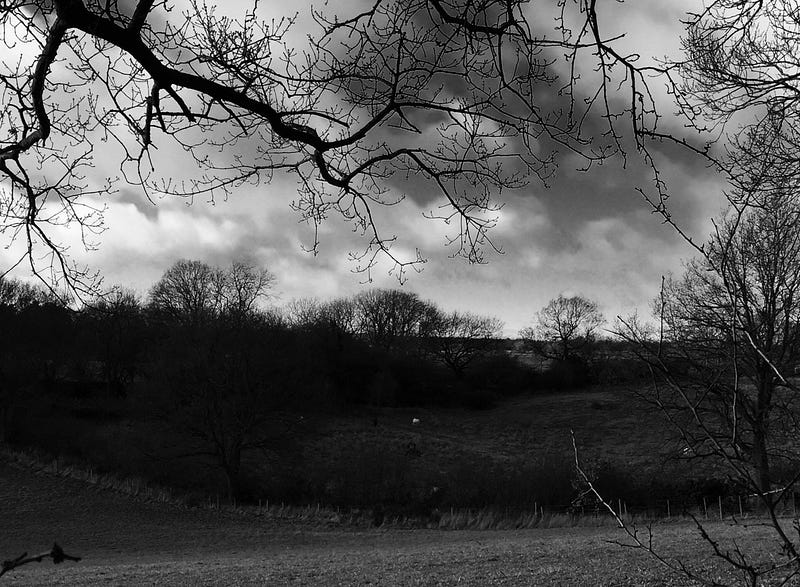
Our relationship with the places we inhabit was magnified during the national lockdowns. Told to stay at home wherever possible, every time we took a step outside our front door it was an adventure as our senses became overloaded with the sights, sounds, smells and feelings of a different space. These heightened sensations are something I am very familiar after many years of working to overcome agoraphobia — it is the sensory search to feel grounded and convince yourself that you are safe.
When we step outside, millions of years of human instincts kick in scanning for anything that could threaten our survival. Our ancestors learned the dangers of the land and these fears have been left in our DNA.
In open fields, we are vulnerable to predators and stay near the edges; in the woods, we cannot easily detect predators or people who mean us harm; in caves, we could be surrounded and trapped; in marshes, we could sink without a trace; in the lakes or sea, we could drown or be attacked; and in the mountains, we could fall or injure ourselves.
Over time humans have created our own places, free from the threats of nature — the pubs, shopping malls, motorways, airports, and cinemas. While many of these places closed during the lockdowns, our parks and rural places remained open. Many of us re-discovered the countryside and took up walking, hiking, and biking through spaces where the door to nature has been left open.
Putting aside the strangeness that the pandemic brought into our lives, the rural countryside was already entering the realm of the uncanny due to the alienation caused by urban living. In 1801, the proportion of people in England and Wales living in towns and cities was around 17%. Today, only around 16% of the UK population live in rural areas and since the 1960s, our rural population has shrunk by 360,000 while our urban population has exploded with an additional 14.81 million people. (1)
This means that for most of us, the unique smells, sights, and sounds of the rural are completely unknown. In 2010, it led the National Trust Director-General, Dame Fiona Reynolds, to say that: ‘Today’s generation runs the risk of being terrified of the countryside.’(2) Reynolds described the differences that people growing up in a city might notice in the countryside — fewer buildings, darkness and silence, the risk of getting lost or being unable to follow a map.
Right now, there are a specific set of cultural undercurrents that cannot be fully repressed and are seeping into our nightmares. One such tension lies between rural communities and ‘outsiders’ from the cities. An example of this can be seen in France, where parliament has now passed a law that protects countryside noises and smells as national heritage. This followed a series of well-publicised cases in French rural villages where local ways of life such as the smell of manure, roosters crowing, and early morning tractors caused complaints from people on holiday, second homers, or those who had moved from the cities. Back in Britain, you can see echoes of this tension through the leveling up political agenda, and the re-balancing of the needs of London and the home counties with the rest of the UK.
Britain also has its fair share of laws protecting its heritage. What has become more noticeable is the sense of holding on and preserving the old ways of living — a looking back rather than a looking forward. The preservation process turns everyday items into ‘relics’ to be revered. The tides of time cast a sense of awe that we can touch something today which our ancestors held centuries ago. With this reverence comes a sense of our mortality — that the things we make with our hands can last longer than we do.
Many of the relics and evidence of the past are buried underneath the ground we walk on, and it is no surprise that this unearthing of the past has become a common trope in horror literature and films. Nature writer, Robert Macfarlane, described this unearthing as a fascination that artists and writers have with revealing ‘the skull beneath the skin of the countryside’. (3) Macfarlane observes that artists have moved away from the bucolic and pastoral images of the countryside to the eerie, which is not easily defined or explained — it is the quiet sense of unease — unlike the horrific it does not reveal its monstrosity to us.
It is not surprising that the images of the rural are penetrating our culture with repressed fears about the global climate crisis coming to the surface. In Britain alone, we have become more aware of the human impact on nature. Almost a quarter of mammals and half of bird species in the UK are under the threat of extinction6, and 97% of our wildflower meadows have been lost since the 1930s. (4)
This awareness of what we are losing in our countryside has led to the movement of ‘rewilding’ our lands. This moves against the instincts of our ancestors who feared the wilderness and strived to tame the land through farming, enclosures, deforestation and at the same time, taking away places where any natural predators of humans could thrive.
This growing fear about our environment has intertwined with hauntology where our past hopes and visions of the future were so much better than the reality we now face of the climate crisis, global pandemics, and the rise of nationalism.
It is the tensions between these cultural undercurrents that are fuelling the current revival in folk horror literature and film. This horror sub-genre takes our romanticised ideas of a rural idyll along with our past hopes for a better future and sets an incendiary torch to it. The landscapes of folk horror show us the savage still living inside each of us and the inescapable viciousness of the cycle of life.
Ultimately, nature is emotionless, staring back at us with an unflinching gaze. It thrives, it survives, and it returns. It was here before us and will outlive us. Our decaying bodies in the earth feed it. There is an eeriness when we look at pictures of abandoned buildings or structures slowly being taken back by nature. We are reminded that nature will adapt and do what it takes to continue — even if that means the expulsion of the human species.
None of this should detract from us enjoying the unquestionable benefits of nature for our mental and physical health. Like everything else though, the countryside casts its own shadow reflecting the human histories of violence and tragedy it has witnessed. In these places, healing can turn into trauma, and beauty into horror.
Sources: 1. Statista: Urban and rural population of the United Kingdom (UK) from 1960 to 2019. 2. The Guardian: Britons ‘terrified’ of the countryside, National Trust warns. 3. The Guardian: The eeriness of the English countryside. 4. RSPB: The State of Nature 2019.