
Credit Suisse’s Largest Investor Can’t Provide More Financial Assistance, Stock Drops by a Record 24%
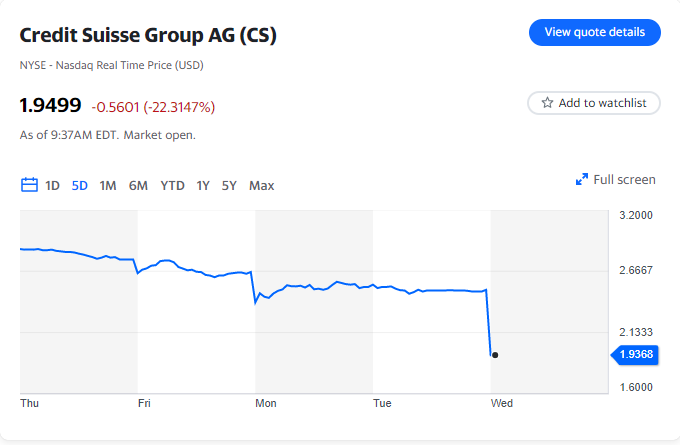
Credit Suisse’s stock plunged nearly 24% to a record low on Wednesday after its largest investor, Saudi National Bank, said it couldn’t provide the Swiss bank with more financial assistance due to regulatory issues.
The Saudi lender acquired a stake of almost 10% last year after taking part in Credit Suisse’s capital raising and committed to investing up to 1.5 billion Swiss francs ($1.5 billion).
Broader equity markets fell sharply, reversing earlier gains, as Credit Suisse’s drop re-ignited some of the jitters among investors about the resilience of the global banking system after the collapse of Silicon Valley Bank.
Credit Suisse on Tuesday published its annual report for 2022, admitting that the bank had identified “material weaknesses” in controls over financial reporting and not yet stemmed customer outflows. Switzerland’s second-biggest bank is seeking to recover from a string of scandals that have undermined the confidence of investors and clients. Customer outflows in the fourth quarter rose to more than 110 billion Swiss francs ($120 billion).
The cost of insuring the company’s bonds against default shot up. Five-year credit default swaps on Credit Suisse debt widened to 574 basis points from 549 bps at the last close, according to data from S&P Global Market Intelligence, marking a new record high.
UBS, Credit Suisse’s Swiss rival, benefited from recent market turmoil and saw money inflows. Its CEO, Ralph Hamers, stated that the inflows in the last few days were due to a flight to safety, but he cautioned that “three days don’t make a trend.”
As Credit Suisse continues to face challenges, investors will keep a close eye on the bank’s efforts to recover and rebuild confidence among clients and investors.
We will keep you updated on any developments in the coming weeks.