Creativity Plus Innovation and the Change They Create in Organizations
The Connection Between Creativity, Innovation and the Eventual Change that Must Follow

Understanding the Process of Creativity, Innovation and Change
Why is it important to understand the process of creativity, innovation and change? Today’s reality dictates that only those organizations that embrace creativity and innovation management will achieve sustainable competitive advantage in the market place. Peter Drucker, a great management thinker said; “I have continued to stress over the years that organizations that do not innovate will not survive.”
Successful innovations, on the other hand, create change in the marketplace and in society. Just think of innovatively disruptive companies such as Uber, Airbnb, Facebook, and many others. In fact, it can be said that innovation isn’t about creating new products. “Innovation is really about changing behavior.” (Thomas Koulopoulos).
However, merely aiming to create change is not enough. Businesses must make the “right” change by choosing the right ideas, create the right products, develop processes that will improve performance, create services that add value and create products that consumers want.
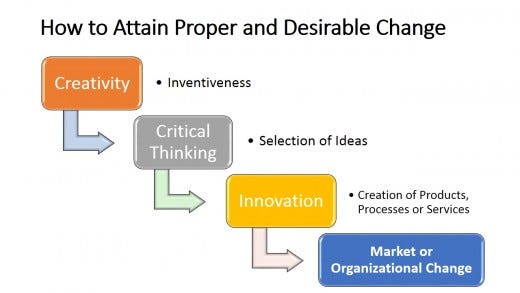
The above statement begs the question; what steps must we take to attain proper change?
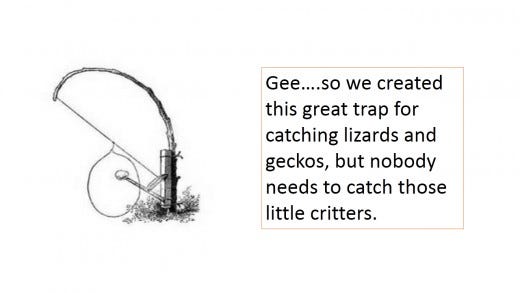
What Happens When Critical Thinking is Not Used? The Result is Innovation-Fail
Four Steps that Lead to Proper Change
The chart above shows that first we start out with creativity. We create and invent new ideas and new concepts. We let our imaginations go wild. Whether we use divergent thinking, improvisation or an aleatory technique, the methodology used is up to the inventor. However, ideas are only the raw material for innovation and change. Ideas do not by themselves guarantee desired change or transformation.
The next step is to embark on a process of critical thinking. We must select the creative ideas that we feel are worthwhile. After we select an idea, we feel strongly about, we begin the process of turning that bit of creativity into a product, a service or a process.
If the product, service or process that has been created engenders change in the market place, then and only then can we say we have been successful. A successful innovation is always tied to the question of how markets behave.
“When Apple created iTunes it didn’t just create a faster, cheaper, better digital format for music, it altered the very nature of the relationship between music and people. eBay did not just create a platform for auctions; it changed the way we look at the experience of shopping and how community plays a role in the experience.” (Thomas Koulopoulos 2012)
What do we understand by the term ‘creativity’?
Creativity is a process that sparks emotions. It produces effective surprise and shock of recognition in the creative person.
It often puts old things in a new way or new things in an old way. Creativity has the capacity of forming associative elements into new patterns or combinations that add value, scientifically, aesthetically, socially, etc.
It solves an existing problem or satisfies an existing need. It is the generation of new and useful ideas.
“A product is creative when it is (a) novel and (b) appropriate. A novel product is original not predictable. The bigger the concept and the more the product stimulates further work and ideas, the more the product is creative.” — Sternberg & Lubart, Defying the Crowd
How to Achieve Creative Thinking
Very simply stated, creativity is the bringing into being of something which did not exist before. This could be as basic as a thought, or as complicated as mapping the human genome. In business it is about creating a product, a service, or a process that brings about change. In our daily lives we exhibit creativity when we come up with a new recipe in our kitchen, or we figure out a way to fix our broken vacuum cleaner with limited tools.
However, achieving creative thinking requires certain conditions. One or more of the following conditions must be present in order to achieve creative thinking
- The output of thinking adds value in a new way or from a new perspective.
- The thinking is unconventional. It must modify or reject formerly accepted ideas.
- The output from creative thinking is the result of studying and/or researching reality. (Creative discoveries do not emerge full blown, divorced from any prior knowledge.)
- The creative output sparks debate or challenges existing preconceptions.
- Require high level of motivation and persistence, either over a long period of time, or at high intensity.
- It frees oneself from one’s own conventional thinking, in order to have a deeper and clearer view of the situation that the individual is trying to understand.
- Must be problem-solving. The more vague, ill-defined and difficult the problem, the greater the creative output.
- Ideas must be acted upon. (If you don’t act on them, you are imaginative but not creative.)
The Four Stages of Creativity
Neurosciences no longer back the notion that there is some sort of magical or seminal Eureka moment from which a creative idea is born. Additionally, the old fashion notion that left-brain thinkers have strong math and logic skills, while right-brain people are more on the creative side of things, has been totally debunked by science. As it turns out, more parts of our brain are involved in creativity than previously believed. More stages are needed to go from zero ideas to a fully executable creative thoughts.
According to scientists there are four stages of creativity which give us a very explicit explanation of how creativity works.
- Preparation: Creativity does not happen in a vacuum. Information needs to be fed into your brain in the form of refine goals and overall direction. This is the time when research is conducted and the brain learns as much information as possible. Your brain uses attention, reasoning and planning before moving on to the next stage.
- Incubation: This is the stage when subconscious data processing takes place. In this stage it is preferable to let go and let your mind wonder. It is also a stage where experimentation happens. Often time’s new ideas are generated in this stage.
- Illumination: This is the stage where the proverbial Eureka! moment happens. This is when your brain becomes aware of the answer to the problem. This is also the time at which you use a logical thought process to turn the sudden insight into a valuable solution.
- Verification/Implementation: In this stage you verify results and do the actual “packaging” of your creative idea. You can now implement your idea into a final product.
Myths surrounding creativity
There are a great deal of myths surrounding creativity. These are some of those myths:
- You have to be smart to be creative.
The myth that the smarter you are the more creative you are is incorrect. While the creative process requires a certain level of intelligence, the truth is that beyond this low threshold level there is little evidence of any significant connection between the two.
Most of the research in this field concludes anyone with normal intelligence is capable of creative output. Creativity depends on various factors: experience, knowledge and technical skills, ability to think in new ways, possessing a “do not quit attitude”, and intrinsic motivation (loving and being turned on by the work you do).
“To be an innovator, it’s better to be social rather than smart. There’s no doubt that there are variations in people’s raw skills, but what predicts the difference between a Steve Jobs and a Joe Bloggs is actually their exposure to new ideas that are wonderful and different. If you want to be more creative, the best thing you can do is to talk to people who disagree with you.” (Michael Muthukrishna 2015)
- Creativity exists outside of time and circumstances.
This is the notion that creativity is something magical and extraterrestrial. However, this not only negates the creative process, but has been scientifically proven to be incorrect. There is nothing magical about creativity. We all have the capacity to be and act creatively. It is part of being human and there is nothing magical about being human as far as we know.
- Creative People are high-risk takers.
Some people erroneously consider creative people to be high risk-takers. While the willingness to take calculated risks and the ability to think in non-traditional ways do figure into creativity, the truth is that you do not have to be a high risk taker in order to think or act creatively.
Perhaps the confusion between being a high risk takers and being a creative person comes in when those people that want to launch a creative career quit their jobs or borrow money to start a business or set up a studio. The truth is that this adventurist approach to launch your career has nothing to do with the creative process itself. The creative process has more to do with calculated risks than big risks.
- Creativity is effortless.
The notion that the creative act is essentially effortless is another common myth. This notion emphasizes the “illumination stage” or the famous “Eureka moment” and downplays trial and error, dead ends and the creative process, just to name a few.
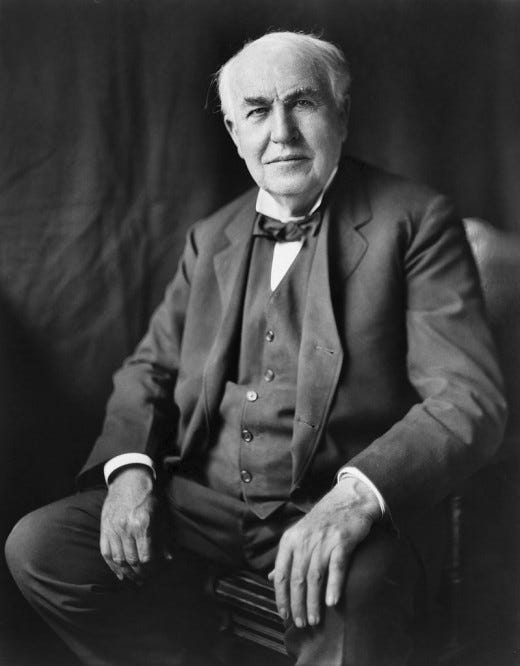
Thomas Edison, the most prolific inventor of all time, said genius is not at all built on an effortless ability. Edison described genius as 1% inspiration and 99% perspiration. Which is why he also said: “Opportunity is missed by many because it wears overalls and looks like work.”
In his writings Edison identified fifteen ingredients to creativity and inventiveness. They are pretty self-explanatory:
- Curiosity
- Entrepreneurship
- Luck
- Value
- Knowledge & skill
- Collaboration
- Diligence
- Relaxation
- Imagination
- Combinations or making unfamiliar combinations of familiar ideas.
- Trial and error
- Associations
- Productivity
- Conviction
- Persistence

- In order to be creative, you have to be an eccentric.
The idea that creativity derives only from eccentric personalities which perhaps has been adopted by many due to the glamorization by Hollywood of people like Picasso, Andy Warhol, and Oscar Wilde is not entirely true. In this view creativity is tied to a specific personality which is incorrect. If being eccentric for you means thinking in an unconventional fashion, then by all means, be as eccentric as you want to be. However, if eccentricity is not a personality trait you identify with, keep in mind that you can still be creative.
The fact is that creative people come in all types and forms. What we do know about creative people is that they have a remarkable ability to adapt to almost any situation and to make do with whatever is at hand to reach their goals.
- Creativity exists in the arts only
Also the idea that creativity exists in the arts only, is obviously totally incorrect. Creativity is not exclusive to literature, music, art, performing arts, etc. Creativity happens in management consulting, scientific and technical discovery, product development, government and war.
People that are not painters, sculptors or novelist are also creative. The mere action of coming up with different ways to put together a dinner recipe proves that you are creative. Being able to carry an interesting conversation shows your creativity being manifested through human relationships. Writing in a blog about a subject you like is an excellent way to express creative output.
- Coming up with new ideas is the most difficult part of creativity.
The fact is that there are many well-known techniques that aid in the creation of new ideas. The difficult part of creativity is not coming up with new ideas but rather to identify those ideas that have value and are realizable.
In as far as techniques that help in creative output, the following are a few:
Aleatory techniques (Randomness)
Improvisation
Creative Problem Solving Process (CPS)
Lateral thinking process
Six Thinking Hats
Method Herrmann — right-brain / left-brain
Brainstorming and Brainwriting
Think outside the box
Business war games, for the resolution of competitive problems
SWOT analysis
Convergent creativity
Thought experiment
- Creative output is always good
This notion is totally incorrect. Ideas can also be applied to evil and destructive ends. Hitler, Stalin, Mao, Pol and many more are examples of world leaders who were actually quite creative. There are many other examples of business leaders, and just regular everyday people whose creative ideas have led to destructive or negative ends.
Innovation
While creativity is the generation and development of new and useful ideas, innovation is the realization and implementation of those ideas. In other words, if a scientist has a number of ideas on how to build a household robot, this scientist is being creative. However, once the scientist applies those ideas to build that household robot, that is when innovation is employed. The scientist is now an innovator.
Understanding the various levels of innovation, will allow us to some degree predict the degree to which our product, service or process will have an impact on the market place, even on society.
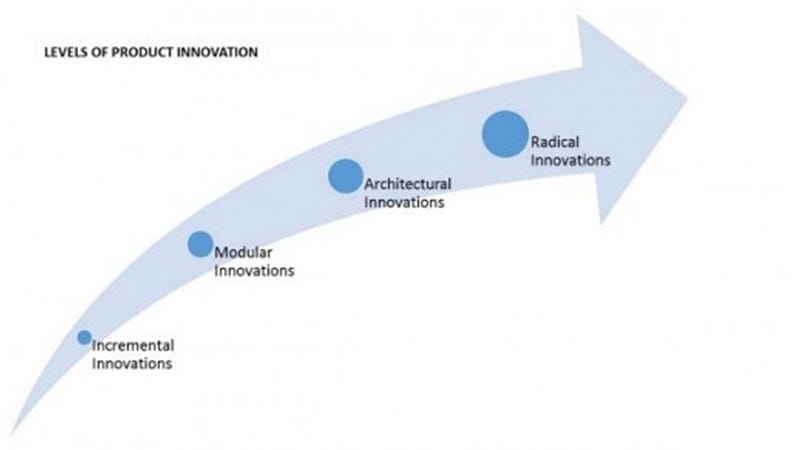
In a broad perspective, we can define four levels of innovation based on the degree to which value and newness is added to the product, service or process. These levels of innovation are:
Levels of Innovation
Incremental innovations: • Small changes generally based on established knowledge. • Refinements and modifications to existing products, processes or services. i.e. improvements to television picture qualities. Modular innovations: • Middle-range innovations more significant than simple improvements. i.e. going from black-and-white to color televisions. Architectural innovations: • Changes the nature of interactions between core components, while reinforcing the core design concepts. • Changes in the ways different things are put together into a whole system. Radical innovations: • New technologies replace old existing technology. i.e., Fax machines replacing telex machines. Email replacing fax machines. Radical innovations are for the most part new inventions that can be market disruptive.
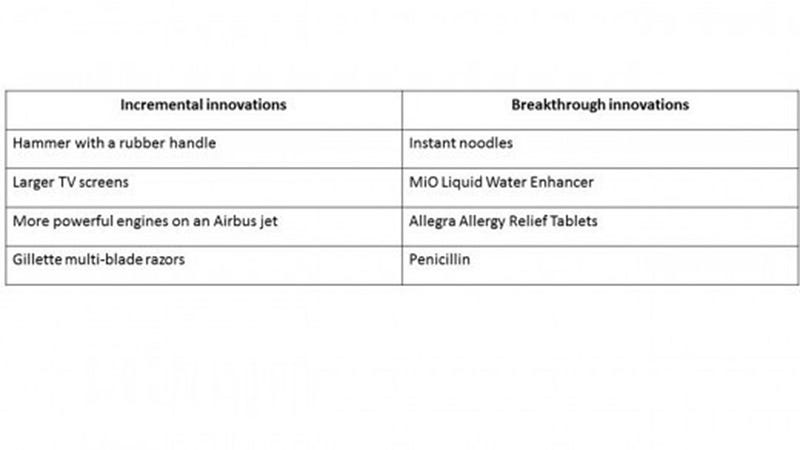
Examples of Incremental and Breakthrough Innovations
Types of Innovation
While manufacturing organizations think of innovation as improving or creating a new product, those in the service industry, think in terms of the services they offer. However, there are other areas in the public or private sectors where innovation can take place to create or improve offerings. The following are different types of innovation:
Product innovations • Consumer, commercial and industrial products of all types.
Service innovations · Hotels and other places of lodging · Personal services (including dry cleaning, tax preparation, and hair cutting) · Business services (including temporary agencies and business software developers) · Automotive services · Miscellaneous repairs · Amusements and recreation · Healthcare · Legal services · Private education · Social services · Membership organizations (including houses of worship and clubs)
Process innovations • Just-in-time inventory management. • New organizational structures. • New ways of performing work. • Business entity • Corporate governance • Finance and accounting • Management innovations • Changes in management structures. • Project management • Personnel
Market or position innovations • Product life cycle management • New markets development • Market positioning
Zones of Innovation
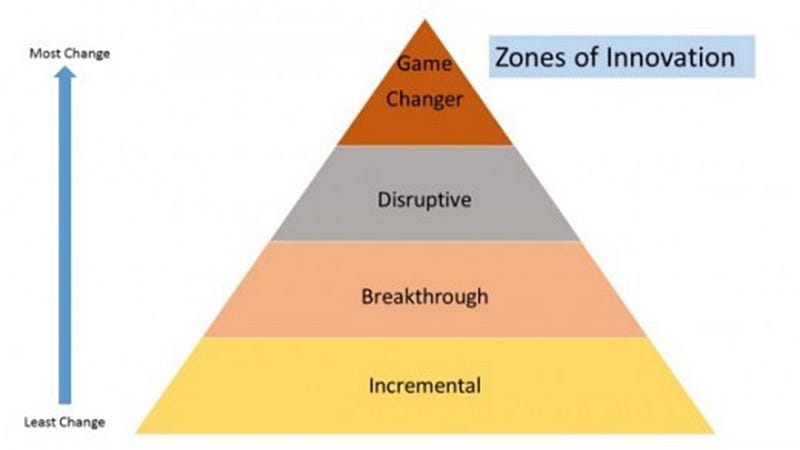
We can also view innovation from the perspective of how they affect change. This view is particularly useful today with the advent of disruptive technologies and companies such as Uber, Airbnb, and others.
Incremental innovations involve modest changes to existing products and services. These are enhancements that keep a business competitive, such as new product features and service improvements.
Breakthrough innovation refers to large technological advances that propel an existing product or service ahead of competitors. This is often the result of research and development labs (R&D), who are striving for the next patentable formula, device and technology.
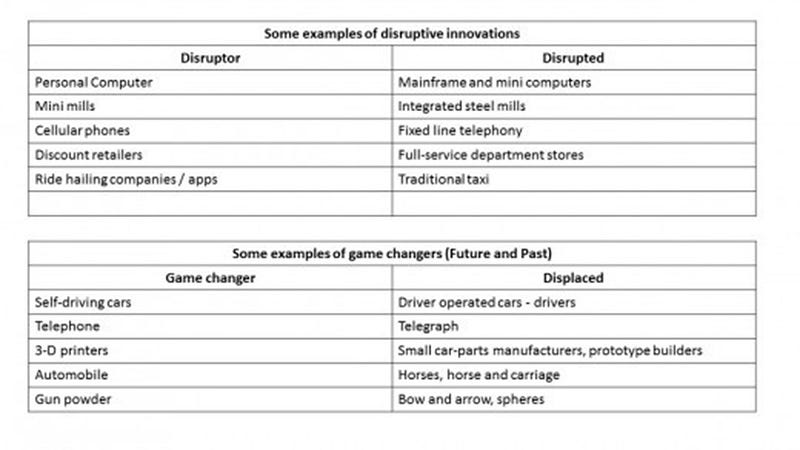
Disruptive innovation is a term coined by Clayton Christensen in his best-selling book The Innovator’s Dilemma, in which he shows that disruptive innovations “result is worse product performance, at least in the near-term. [They] bring to a market a very different value proposition than had been available previously” It describes a process by which a product or service takes root initially in simple applications at the bottom of a market and then relentlessly moves up market, eventually displacing established competitors.
Game-changing innovation transforms markets and even society. These innovations have a radical impact on how humans act, think and feel in some way. Innovations that reach this level are always able to define a new category and fulfill an essential unmet wish or need consumers have.
Examples of Disruptive Innovations