
Creativity Is Just Copying Other People
And why you are a merciless idea thief
It was the first sunny, relaxing day of the year. I decided to leave my plans unfinished, put my favorite jacket on, and went out for a walk with my friend. The weather was perfect and calm, my quarantine-grown hair was fluttering on a slight wind. We were having a conversation about filmmakers borrowing ideas from each other, as we were crossing the river on a sky-blue bridge. Our discussion eventually led to a question: “What is creativity?”.
Creativity can be different. You can use it in various fields, from music and filmmaking to cooking and science. We can use it in writing, as I did in a previous paragraph. In business, by taking a creative marketing approach. But where does creativity come from?
Here I will prove that stealing ideas is all there is to creativity.
For me, creativity is a collection of ideas in my head. Our brains do a great job to mix them all to come up with something never seen before. That’s why I don’t think that it’s correct to call an idea uniquely yours. It’s just a combination of others’. I love Steve Jobs’ thoughts on creativity:
Creativity is just connecting things. When you ask creative people how they did something, they feel a little guilty because they didn’t really do it, they just saw something. It seemed obvious to them after a while. That’s because they were able to connect experiences they’ve had and synthesize new things. — Steve Jobs
Copying Ideas
We can often hear that some successful person was influenced by someone else. Van Neistat and Tom Sachs inspired Casey Neistat’s video style. It led to other YouTubers like Matt D’Avella being inspired by Casey, and so on. It’s an endless chain of people being inspired by each other. Just Google “Influences of X person” or “Influenced by X person”.
But how do you make anything different and stand out if you didn’t come up with it yourself? Focus on what is uniquely yours. It's impossible to copy your dedication, charisma, or unique background. These three things differentiate you from others. Which helps you build your own style. Authentic style is formed when you make at least minor changes to an idea you borrowed from another person.
There are three stages of creativity: copying, combining, and transforming ideas. Every artist uses these techniques to come up with anything.
Let’s imagine that Ernest Hemingway’s story inspired me and my friend Chris. We start to write our own stories but somewhat similar to Heminway’s. We add our own touches and rewrite it ourselves. I can be inspired by a character from Steven King’s novel, so I add him. Chris liked the jokes from a TV-show he watched as a kid, so he adds them. After writing a novel, we compare Hemingway’s work, mine, and Chris’s.
It turns out that we just made our own novels that don’t match the one we took as a basis. Because there was our personal touch- we copied, combined, and transformed initial ideas. Now it’s hard to say if I copied Hemingway’s work. Of course, it is entirely possible to make a too similar story and readers will complain about it.
Amateurs copy, Artists steal.
That’s why you have to steal the idea. I can’t call it creativity if you just copy-paste a character from another novel to yours (it’s also called plagiarism). But if you apply some changes to the character, that would be something unique. This is stealing, you stole the idea, and changed it so you could fit in your story. Changes you apply to an idea you stole are stolen too. You are a merciless idea thief; you just don’t know it yet. Your brain is good at stealing, you know what it’s even better at? At making combinations, cocktails from all the ideas you took from others. Sometimes, you do all of this unconsciously. This builds up a unique style that other people will steal too. That’s creativity.
Famous Examples of Stealing
And there is nothing wrong with that, we can see a ton of movies and TV-shows inspired by one another. Let’s take “Stranger Things” as an example. Its third season is full of classical movie references the directors were inspired by. A Russian guy who was following the kids is inspired by Arnold Schwarzenegger’s Terminator. Back To The Future’s Twin Pines Mall inspired the Starcourt Mall and some scenes with it.
- The Oscar-nominated “Joker” was inspired by Taxi Driver.
- One of my favorite movies of all time, “La-La Land” was also built around an iconic Hollywood culture. Here are the movies Damien Chazelle was inspired by to make this picture.
- This is a list of films that influenced every Quentin Tarantino movie.
- George Lucas stole ideas from “Flash Gordon” (1936), “Hidden Fortress” (1958), “Yojimbo” (1961), “Sanjuro” (1962), and others to make the most recognized franchise in the world with the biggest fan base ever- Star Wars.
I bet if you watch any fashion designer’s interview, you will hear that they are mostly inspired by fashion trends from the past. A lot of designers have their favorite eras that they are most likely to steal from. “New” ideas in fashion are just a combination of past trends. There’s a Russian expression that perfectly represents the current state of creativity in some industries: “Everything new is actually well-forgotten old”.
Did you know that almost all Hollywood blockbusters are the same stories, just in a different wrap? Christopher Vogler is a Hollywood consultant who helped to produce the legendary “Lion King”. He made a simple 12-stage structure that shows what almost every blockbuster movie looks like at its core:
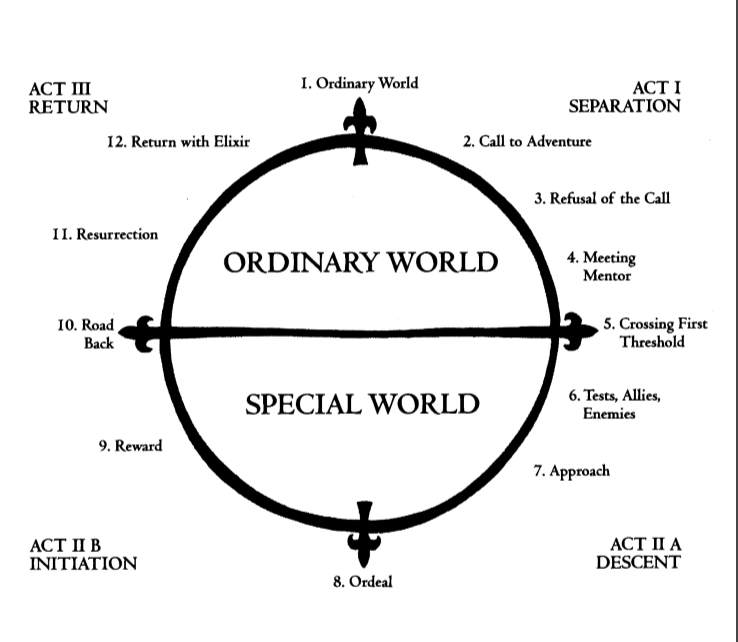
We see this in a lot of iconic movies, from “Star Wars: A New Hope” to “Iron Man” And “Lord of The Rings” (the list of 35 most popular movies based on this structure). This shows us how similar all these movies actually are. You may be wondering how this could be used in such a variety of pictures and it’s still interesting to watch for most of us. Just think of all the faces you saw in your life. Every single one is different, even though all human faces are based on the same skull structure. There is a documentary full of examples like these: Everything is a Remix.
“To create is divine, to reproduce is human.” — Man Ray
School Kills Creativity
It is no longer a surprise that our school system is very outdated. It can also kill creativity, here is a funny and insightful TED talk about this problem. As a high school student, I can entirely relate to this. Schools only favor those who are good in subjects that involve maths or science. I think that anyone can learn math if they try hard enough, but it is different for every student.
I believe that I am a creative person, that’s why I really love concepts we study in physics class. But it becomes harder to concentrate once we start solving equations with numbers. The online school showed me the subjects that I truly like. Once I get a task where I can use some creativity, I go for it. In an environment like home, you are constantly distracted by everything around you. Your brain chooses distractions more often because they are easier to consume. But imagine how strong the passion should be to choose completing a school task rather than browse memes on your phone. I believe that schools don’t have enough tasks to improve students’ creativity muscles. Expressing ourselves is our nature. Education systems should encourage it, not do otherwise.
What to Do If People Copy You
We tend to justify it when we steal ideas from others. However, when it comes to other people we criticize them for doing the same thing. Of course, it’s always upsetting when someone takes your entire work and claims that it’s done by them. If people imitate or copy something from you, I think you should accept it and take it as a genuine compliment. People who copy you view you as their role model or a leader. Industry standards, quotes, parodies, or borrowing ideas is not plagiarism and you shouldn’t complain if people do this with your work. Instead, accept it as an appreciation of your craft. People love it so much that they want to imitate you and make it a part of their personality.
The Science of Creativity
As I was completing a course called Learning How To Learn by best-selling author Barbara Oakley, I learned about the concept of chunking. Chunks are basically blocks of information (networks of neurons) that are formed when you fully understand a concept you learn. It then can be easily applied to any field. Chunks help us apply a creative approach to anything because they can be easily recalled from memory.
Creativity itself is a way to apply ideas from other fields to the one you are working with. For example, circulatory-system researchers might find their knowledge useful in city traffic-engineering. Because blood traveling through blood vessels in our body is similar to road traffic. Or if I have a chunk that was formed while I was learning to play guitar, it can be useful when I am learning to play the piano. It’s not an entirely different field, but you get the idea.
Here is an article with research by Harvard Business Review that talks about innovative ideas coming from outside the industry:
Bringing in ideas from analogous fields turns out to be a potential source of radical innovation. When you’re working on a problem and you pool insights from analogous areas, you’re likely to get significantly greater novelty in the proposed solutions, for two reasons: People versed in analogous fields can draw on different pools of knowledge, and they’re not mentally constrained by existing, “known” solutions to the problem in the target field. The greater the distance between the problem and the analogous field, the greater the novelty of the solutions.
That’s why we can see that mostly young people with fresh perspectives bring the changes to the field. It’s getting harder and harder to think outside the industry standards to those who were working in it for their whole life. People who take an untraditional approach to their work can change the industry forever.
When you’ve faced innovation problems, consider mining distant, analogous fields. Look for creative people who aren’t constrained by the assumed limitations and mental schemas of your own professional world. These are people who, although they know little of your field, may be more likely to come up with breakthrough thinking; indeed, they may be carrying around, in their heads, the germ of the solution you’ve been searching for all along.
I’ve done some research to understand how our brain comes up with creative ideas and found out that our brain has several thinking modes. The most important mode in our brain is the Diffuse, or Default mode (there are also Focused and Salience modes). When the Diffuse Network of neurons in our brain is activated, we get our most creative ideas. The Diffuse mode enables your brain to analyze everything and make connections between various thoughts, fields or chunks, that you wouldn’t be able to make otherwise.
How do you get into this mode? You should just do nothing, or at least not be focused on a task that you are performing. Your brain is basically doing all the work for you, combining all the experiences, phrases, sounds, smells, pictures, and other things that cultivated in your head for years. Did you ever get a shower thought? It happens because you are left alone with your thoughts, and the brain does its work of coming up with new ideas.
The greatest minds, like Thomas Edison, or Salvador Dali used this mode to come up with innovative ideas. If a hard task challenged Edison, he would sit in a chair and place his hand holding metal balls above a pan on the floor. Then he would take a nap to enter the Diffuse mode. As he entered a deep stage of sleep, his palm would relax dropping metal balls on the pan and the noise would wake him up. Then he would get back to work with a problem solution that his brain kindly generated for him. Salvador Dali used a similar method, but he used keys instead of metal balls.
How to Boost Your Creativity
So how do we become more creative or generate more ideas? Well, firstly we need to take advantage of our diffuse mode. It’s really hard today because we don’t have time to do nothing. If I don’t have anything to do, I usually take my phone and scroll through Twitter so I don’t get bored. But it only gives more work to my brain.
Try to spend more time not being focused on anything. I struggle with this a lot, sometimes I just want to be entertained so I listen to YouTube videos while I am in the shower. But it’s better to not give your brain new information when you have an option. Running, walking, or napping for 10 minutes will help your brain get into diffuse mode. Meditation will also help you. It might not give you ideas, because you will be likely concentrated on your breath, but you will learn to just sit and do nothing.
Secondly, seek new experiences. As Steve Jobs said, people who struggle with creativity don’t have enough dots to connect. Meet new people, challenge your current views, find a new way to your home from work, watch movies, read a book genre you didn't read before. If you find out about new fields, you will have more chunks in your neural structure. It will help you recognize patterns you never noticed before.
I am heavily inspired by everything I watch, hear, and read. This article is likely a combination of thoughts from different sources that accumulated through the years, but still, it is unique. I try to remember the valuable information I learned because it can help me with creativity. It’s important not to fall into the trap of mindless consumption. Sometimes I watch several YouTube videos but I can’t recall what was in them. If I notice that I am likely forgetting useful information, I take out my journal and write key takeaways from whatever I’ve read, watched, or listened to. This integrates new information into my long-term memory which helps to form new chunks.
Conclusion
Ideas don’t come from nothing, they come from unique circumstances that you went through. When you start as an artist, you have several influences that you try to imitate. After some time you become an established specialist that other people steal from. Copying is a fundamental part of learning. Musicians, painters or filmmakers often recreate something from the past to understand how it works- fake it until you make it. Our brains are designed to copy.
Creativity is like playing with Lego. Imagine that you bought a new box of Lego, it’s a big castle. You build a set and it becomes identical to other children’s around the world. But then you take out a box with your own bricks and mini-figures. You start rebuilding or adding unique features to the castle with your own bricks. And that personal touch just made your castle unlike any other on Earth. No one thought about making this castle Batman’s cave. So go out there and steal some castles. Rebuild or transform them with bricks from your personal collection, merge them with other castles and create something unique.
It’s impossible to explain creativity. It’s like asking a bird, ‘How do you fly?’ You just do. — Eric Jerome Dickey


