
The Evening Muse │Inspiration │Creativity
Creativity and Inspiration: To Sit and Think Awhile is a Wise Way to Spark Creative Flow
Lorraine Hansberry encouraged us to “never be afraid to sit awhile and think.” Is it possible that in such moments of stillness and contemplation, we are inspired to create our best works?
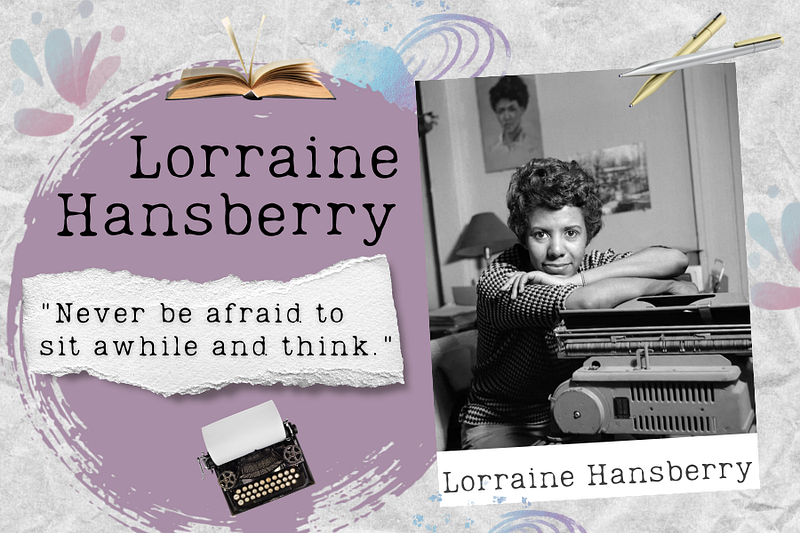
Can you imagine sitting and contemplating a quote on contemplation? Well, you never know what can arouse inspiration as you flip through an old journal and sip a delicious blend of ginger, apple, lemon, and cucumber juice.
Of course, hydration and contemplation go together like beans and rice. Staring at the purple ink on graph paper, I’m transported back to the moment I eagerly wrote down the quote by Lorraine Hansberry…
“Never be afraid to sit awhile and think.”
I don’t know if Lorraine Hansberry, a brilliant storyteller, and playwright, knew many were afraid to sit in silence or if she just wanted to share her experience with creating through contemplation.
Either way, the critically acclaimed playwright of A Raisin in the Sun, The Crystal Stair, The Sign in Sidney Brustein Window, and To Be Young, Gifted, and Black, words are gold.
In a similar view, the Greek Philosopher Plato thought that through contemplation…
..the soul may ascend to knowledge of the Form of the Good or other Divine Forms.
In Plato’s work contemplation meant “existing outside space and time” where the changeless and eternal Good abides.
To Sit in Silence and Think
As a writer, storyteller, and poet, I’ve learned to love contemplation and to sit in silence and think. For me, the writer’s life requires stillness to tune into the higher facets and realms of the imagination.
Though Coltrane (Alice or John) provides a fluid ambiance for me as I write, it is during a moment of pure silence and contemplation, I can experience a powerful stream of consciousness.
Yes, it is stillness with a purpose.
Contemplation helps to slow down Beta brainwaves (13–38 Hz). Beta brain waves are small, faster brainwaves associated with a state of mental, and intellectual activity and outwardly focused concentration.
When one slows down in a state of contemplation the brain goes into an Alpha state. Alpha brainwaves (8–12 Hz.) are slower and larger.
Contrary to Beta brainwaves, Alpha brainwaves allow one to experience a state of relaxation as the brain shifts into an idling gear, waiting to respond when needed.
If you close your eyes and visualize a peaceful picture in your mind, there is an increase in alpha brainwaves. The same happens in contemplation. When we contemplate happiness, joy, peace, and compassion, our thinking shifts.
We may feel we aren’t thinking at all, but when we are ready to respond to our visualizations as writers, creators, artists, and makers a well of inspiration and creativity is open to us and through us.
Unfortunately many fear silence and contemplation
The stillness we can reach when the waves of the mind are calmed can be frightening for many.
Our minds are so used to the hustle, the grind, and getting as much stuff done as possible we are afraid to stop.
You see, silence and contemplation compel us to stop, “sit and think awhile.” The idea of stopping is so terrifying for many because they are afraid they won’t be able to start up again.
Remember, in Alpha State, brainwaves may be in idle gear, but Alpha brainwaves are waiting to respond when needed.
As a result, we have mentally shifted to a different type of energy and intelligence.
“Wisdom comes with the ability to be still. Just look and just listen. No more is needed. Being still, looking, and listening activates the non-conceptual intelligence within you. Let stillness direct your words and actions.” ― Eckhart Tolle, Stillness Speaks
Wisdom and The Non-Conceptual Intelligence
To understand Non-Conceptual Intelligence, we must understand it begins with non-conceptual information.
The notion of nonconceptual information was explicitly introduced into analytical philosophy by Gareth Evans.
Evans argues that nonconceptual information is initially unconscious because as you are practicing stillness and contemplation it is not about forming an opinion, observations, or judgment.
And yet, it becomes conscious when it serves as input to a thinking, concept-applying, and reasoning system. Yes, the stuff we call wisdom.
Accordingly, we return to what Plato means when he purports that in contemplation we exist outside of time and space. Contemplation allows us to exist in that eternalness for just a while as we unconsciously and without judgment gather pearls of wisdom.
So, next time, your space is quiet whether deliberate or unintentional, don’t run to turn on the television or plug in your earbuds, instead, simply sit in silence and think awhile.
Fam, I’m curious. Do you enjoy moments of silence, stillness, and contemplation or does the internal noise in your mind prevent such moments? Is your day-to-day life so active, that you have to steal moments for stillness and contemplation?
Please share your thoughts and perspectives in the comments.
Today is just one of the many days you can enjoy premium and thought-provoking stories published on Medium. As a Medium Member, for just $5 a month, you can read unlimited stories you can read right now with your membership or add them to your reading list:
➡️ How Adversity Can Teach You to Grow and Solve Problems by Pene Hodge
➡️ Do You Need Complete Silence For Your Creative Process? by Sara Burdick
➡️ Woodworking, Sand Art, Homemade Ghosts, and More Carnivorous Plants by Amanda Laughtland
➡️ Intuition Is My Superpower Yana Bostongirl
➡️Feeling Stuck? These Phrases Will Lift You Out of Mental Fog and Inspire You to Change Ayodeji Awosika
➡️ Four Months Later: Why Did My Article Suddenly Get So Popular? EllenEastwood
➡️ Give Readers an Intriguing Glimpse of Who You Are In Your Title/Subtitle Art Bram


