
Creatives and Marketers Are Under Threat From Software and AI, Too
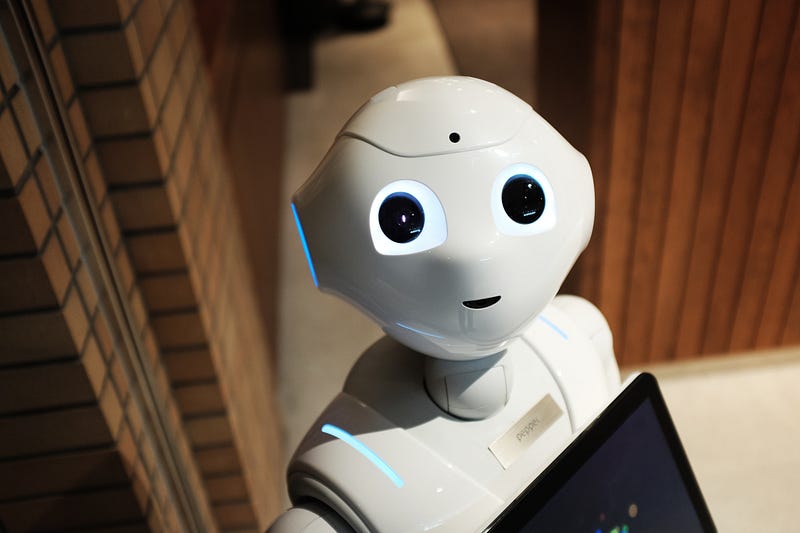
The rising capabilities and widespread adoption of software and artificial intelligence (AI) have been spoken about for many years. Fuelled by both optimism and sci-fi-inspired fears, debates have raged over how bright the future looks and how the dystopian movies will become our realities when the robots take over. Amongst it all has been a truth acknowledged by both sides: the robots are coming for our jobs.
And within this truth has been another agreement: those most at risk are the so-called unskilled jobs, and we already see self-checkouts regularly in shops.
Yet there’s another truth. One that’s been overlooked at the very same time as we all obliviously use the tools that create the issue in the first place: creatives and marketers are also at risk.
In this article, I’m going to demonstrate these risks, and also share my opinion on how we can protect ourselves from them.
True threats and inaccurate perceptions
The discussion of what robots will do has largely been focused on physical tasks. With perhaps a degree of arrogance, it’s been tacitly accepted that jobs relying on our minds are safer. Robots can replace what we do with our hands, but not what we do with our brains.
And yet, creative roles have already come under attack from web applications and software. They allow everyday users to build and create, without the technical knowhow or battling complex information. It’s now commonplace to build no-code websites on Webflow, Wordpress, Wix, and Squarespace without hiring a developer. The work that remains for developers is largely confined to the upper end of the market, for clients with larger demands.
To envision the future, take the above paragraph and apply it to every other area of marketing.
What once required hiring an expensive branding agency or graphic designer can now be done almost immediately, for free or cheap.
With qualifications and years of experience, you’re probably thinking “No software can do what I can do.” And you might well be right. The problem, though, is the perception that the technology is as good or better than you.
Is Canva as good as a professional graphic designer? No. In no small part because the quality of Canva’s output is directly linked to the creativity of the person using it. Nonetheless, Canva is used by freelancers, small businesses and in-house marketing teams around the world instead of hiring a designer.
Therefore, anyone who dismisses this conversation on the rationale that these tools possibly aren’t as good as humans is missing the point. There are already people using these tools who, until recently, had to hire somebody.
The software also introduced another threat: cheaper competitors. A small business owner might not want to learn Wordpress, but they can pay someone £50 to build them a basic Wordpress site. The barrier to entry is so low that almost anyone can start a business providing reduced-rate marketing services. Social media posts can be created and published for next to nothing. Websites can be made for cheap. Logos, brand names, colour palettes, and imagery can be created almost instantly.
And while I admit that the human touch yields better results, many decisions-makers disagree. As a case in point, I have spoken to independent authors who no longer have their manuscripts edited by professionals. Instead, they just run them through Grammarly. Of course, Grammarly is woefully inappropriate for this task, and the results prove it. But the authors perceive otherwise, and their former editors are now out of pocket.
Similarly, an agency I previously worked at charges clients if they want a background removed from an image. A graphic designer is tasked with removing it, using their dedicated software. Depending on their workload, the client may have to wait hours to receive it. For a long time, that was the only meaningful option. Now, though, clients can do it themselves, immediately and for free thanks to tools such as remove.bg.
When a business needed a brand identity, such as logo, name, and colour palette, a specialist agency would get the call. Now? Businesses can use companies like Coloors and Namelix for instance, free options.
So, yes, you may well offer a better service. But can you generate enough awareness of that fact to persuade businesses to hire you? There is no shortage of highly skilled people who are out of work and unable to land clients, simply because they’re unknown.
Who is at risk?
Let’s do a quick rundown.
I’ve already mentioned web designers, graphic designers, and branding agencies, so I’ll skip those here.
Writers: I used to think, “What software could replace the ability to craft compelling copy?” To bring Amazon up again, in its fairly early days it tested the human editorial team against AI-created descriptions, and the result was the editorial team being laid off.
Hemingway and Grammarly won’t turn anyone into Charles Dickens, but the perception is they’re good enough for non-writers to get off the ground. Or for in-house team members to use to make the output good enough to not require hiring a copywriter.
Then there are tools like Copy.AI, which offer a glimpse of a future in which very capable writing can indeed be generated by computers. In mere seconds it generates high-quality audience-focused ideas that humans can then refine and finesse into the finished product. Perhaps the most compelling benefit is that it eradicates the hours spent brainstorming ideas and angles — it spits them out immediately.
Marketers: Hootsuite, Hubspot, AgoraPulse, Buffer, Lately — there is no shortage of free and cheap tools that allow business owners to take full control of their social media presence. Coupled with Canva, it’s a frighteningly powerful option.
Even the stalwart of traditionalism — PR — has been revolutionized. Help A Reporter Out (HARO) has made it possible to communicate directly with journalists in your niche, while the #journorequest and #prrequest hashtags on Twitter are widely used by journalists seeking information, stories, and quotes.
SEO might be the most vulnerable with regards to perception. Barely a week goes by without me seeing a small business owner say they won’t pay for SEO services because “they’re a scam, I just use Yoast SEO.”
Isn’t that remarkable? Yoast is a good product, but it’s a very incomplete SEO tool. Useful for on-page actions, it provides nothing for off-page SEO. Yet there are many people who believe it to be a complete-enough tool to make paying a professional totally unnecessary.
Photographers and videographers are still required for original work, but Unsplash and its equivalents give free (or affordable) access to vast libraries of pictures, videos, and even audio recordings.
Virtual assistants, too, are at risk. While the work provided may be indispensable, the person doing it isn’t. Tools like Calendly, Zapier, Google Docs and so on can be used to automate processes in the background, giving the relevant person all the information they need at exactly the moment they need it.
In-house members of staff. Sorry, I said it. “Real jobs” have long been lauded for their “stability” but let’s be honest, redundancies happen every day. Staff are kept for only as long as they are needed and financially viable — two things that technology is making increasingly less certain.
When will this happen? Now.
The human mind defaults to comfort, staying put, and rationalising inaction. Generally, we find it hard to envision large change. But change is the only constant. People said computers wouldn’t catch on, now they almost run our lives. It was said that cars wouldn’t catch on, and now we’re entering a reality where they will drive themselves.
So if you’re reading this thinking it’s going to take years before the technology becomes meaningful competition, consider this:
- The tools already exist and are already being widely used — and they’re only going to grow in sophistication and popularity.
- When Amazon first released the Kindle, the CEO of Barnes & Noble said the e-reader market was small and would stay small for a few more years. “When the market is there, we’ll be there.” Famous last words. By the time the market had grown, Amazon had captured it and had established itself as the only serious game in town. The lesson is inaction is not a viable strategy. Protecting yourself in the future requires a strategy now.
- This is already happening. We see it daily. We use the tools daily. The ball is rolling and gaining momentum.
How to flourish in a software-dominant world
Technology is advancing rapidly, and my conviction is its continued adoption will make it increasingly difficult for certain people to find work.
I expect this will hit freelancers particularly hard, but I also believe that employees are particularly vulnerable, especially with remote work now widely adopted. For the first time, managers are realising that productivity isn’t tied to a presence in an office, and adopting remote work is just a short step from having a satellite team or outsourcing overseas. If that day comes, the faithful employee will be let go and now competing with the software and all the other employees and freelancers who can’t find work.
The solution is simple: You need to be elite.
There will always be people who want to hire human talent, but they will be fewer in the future. And they will have particular demands — they’ll want things that the software doesn’t provide. Most likely, these people will understand the expertise and nuance humans bring to projects, and also want the personal attention. Every other business will opt for the technological solution and save some cash.
Thus, the businesses that hire real people will demand an elite service. Hiring human talent at a time of plentiful options means they aren’t expecting amateurs.
So the bottom line is simple and stark: you need to be exceptional at your job, and able to prove it.
In particular:
- Work on your skills, with a focus on being world-class
- Build your portfolio to demonstrate your abilities and output
- Develop interpersonal skills to acquire clients. Being good at the work isn’t enough on its own; you also need to be communicative and pleasant company.
- If you work a 9–5 currently, start dabbling with freelancing. Any financial success is a happy by-product, the real benefit is gaining experience in acquiring clients and understanding how their expectations compare to those of a boss. Regardless of potential disruption in the future, this is a powerful tool to have, anyway. Job losses can happen at any time, and there’s nothing like the peace of mind that comes from knowing you can be self-sufficient if necessary.
Personally, I’m an optimist. I see the technological advancements as positive, of increasing the productivity and output of society. I don’t believe we’ll be in the dystopias of the sci-fi novels and the Terminator franchise.
But there will be occupational casualties along the way — and many of those will be creatives and marketing professionals who didn’t respond appropriately to the increasing abilities of software tools to make life easier and cheaper for hiring managers and clients.
The time to act is now. The future awaits you with open arms.


