
Creative Destruction- Sociopaths, Top-Down Systems & Bottom-Up Governance
It was the worst of times. It was the best of times.
We saw the worst unfolding on Capitol Hill last week; in Brexit: in Covid19; in populist, authoritarian governments rising around the world.
The best? Not much in the mainstream news right now, as we collectively attempt to heal the trauma and survive the hard times we’re experiencing. But beneath the surface, largely unreported, there is an incredible upwelling of amazing innovation and breakthroughs, and new generations rising who might reinvent what it means to be human, which means reinventing pretty much everything else.
But let’s not get too far ahead of ourselves. A Biden administration will buy us a little time to think more clearly and act more radically to reinvent our failing systems of government and governance. Those other populist and authoritarian governments are still in place for a while. And we need to heal.
The truth is, we’re just all fed-up with “government” and “democracy”, at different levels. There’s the fundamentalist, paranoid level which invaded Capitol Hill last week. Then there are those of us who have been experimenting with radically new ways of doing things for decades but lack the power and authority in the current system to really change anything substantial.

Welcome to this article, the second in a series of five. Here, in Part 2 — Creative Destruction- Sociopaths, Top-Down Systems & Bottom-Up Governance we explore the interrelated challenges we face now as individuals, families, communities, organizations, and nations, which we must successfully overcome if we are to survive and thrive in the coming decades and avoid future con men and con jobs both short and long.
Previously, in Part 1–24 Hours that Changed the World, a synthesis of the events of 6 and 7 January 2021 was developed, which illustrates how the invasion of Capitol Hill by Trump supporters, along with the victories of Democratic Senators Warnock and Ossoff in the Georgia by-elections, may have opened up an unprecedented opportunity to tackle the biggest threats to our survival and thrival. Read it here:
https://rlw777.medium.com/the-giant-con-job-df534be38618
In Part 3 — Reinventing the System, Healing the Trauma we will examine what we can do in these traumatic times to stay sane and get better while reinventing the systems that created the mess in the first place.
In Part 4 — The Global Transition Model we will dig deeper into how human societies evolve, and how the Global Transition Model dramatically simplifies what is happening now, and what comes next.
In Part 5 — Effective Regenerative Responses: 7 Fractal Acupuncture Points we’ll investigate the interconnected set of responses we must activate now to design and build regenerative futures that work for all of us and our planet.
Feel free to share and clap for this article if you enjoyed it- thanks! You can find much more detailed treatments of some of the above topics in my recent books- check them out here:
https://bit.ly/robinwoodauthor
Creative Destruction- Sociopaths & Top-Down Systems
History and evolution: two steps forward, one step backward, all change.
Wouldn’t it be nice if social progress was a linear, simple, step-by-step process? What a mess everything is, most of the time, politically, economically, socially even epidemiologically!
How can our systems of governance be transitioned to deal with McLuhan’s “acoustic space” we are in- where multiple, simultaneous, interpenetrating threads of reality from very different perspectives and interests need to be dealt with in real-time- in contrast to the incredibly slow, blocked and totally ineffective governance mechanisms we have now, which are all top-down and as a result incredibly stupid and slow.
This top-down approach also attracts sociopaths into leadership positions as it concentrates power so absolutely. No wonder we are all so pissed off with governments- which are failing massively at almost every level to respond intelligently to the challenges we face in a chaordic world. This also applies to large corporations and NGO’s/INGO’s and charities. We will never, and should not have, a “world federation of governments” until we reinvent government and governance.
As we evolve our notions of state, democracy, and systems innovation, we have to move from an extrinsic model to an intrinsic one that recognizes granularity and hybridity. Small is beautiful, as Schumacher argued, but so is the wholeness and entanglement that will signal the collapse of our current, intermediary systems theory.
For now, we have to make the most of the symbiotic relationship between democracy and systems innovation, but we also have to prepare for a future that will require a completely different model too. Indeed, Schumacher himself noted the need for ‘straining and stretching to a higher level which is the specific challenge of a divergent problem, a problem in which irreconcilable opposites have to be reconciled.’
The Systemic Nature of the Takeover of Nation States by Populist Politicians, Corporations and Wealthy Elites
What happened in Washington DC this week was no accident. It was planned, and part of a political and economic system that made it possible. It is also not the first time this kind of state capture has happened- history is full of examples from revolutions, collapsing Empires, fascist takeovers leading to world wars, and more. Without going too deeply into systems dynamics, complex adaptive systems, systems of human development and social collapse, and much more, let me take you on a short thought experiment so we can get to the nub of what is ailing us.
As the impeachment of Don the Con begins this week, along with the continuing arrests of more of the Capital Hill invaders and attempted coup inciters and perpetrators, and perhaps some of Trump’s co-conspirators and political enablers, can we look forward to a peaceful inauguration ceremony on the steps of Capitol Hill on 20 January? Inshallah, FBI, and Secret Service willing. But that does not stop the rot, yet.
Despite Twitter, Facebook, Apple, Amazon Web Services and Google having effectively cut the oxygen of Trump and his Parler/QAnon/4Chan/Fox loving supporters for the time being. Yet, those 74 million Trump voters are still out there congratulating themselves for having made it onto international television, and they still have many ways of organizing digitally on encrypted services.
No doubt Trump plans to continue milking this base of white rage, commercial opportunism, and fundamentalist blind faith for some time to come, in between court appearances to answer for his most recent criminal activities, both before and during his time in office. We can only hope this will turn out like one of those mafia movies, where the snitches roll and the capo di tutti goes down in flames. We can hope, but of course, nothing is certain in an America full of conservative judges and right-wing nutjob lawyers ready to make small fortunes out of the criminally liable political class that Trump has gained so much from.
But what about the rest of us? The rational, mostly urban technorati and digerati, the professionals and intellectuals, and the decent, hardworking middle classes being slaughtered by Covid19? Meanwhile, 20–40% of the populations in many developed countries including the USA and UK are suffering from hunger and deprivation. And every soul outside of the USA, who watches video clips of the mayhem in the “cradle of democracy” (actually it was the Greeks, then King John in the Magna Carta in 1215 that really kicked that off, but we’ll let American exceptionalism rule here for argument’s sake), watches unfolding events with a mixture of schadenfreude and alarm.
Social disintegration appears to mirror the way in which individuals who have suffered maltreatment experience the disintegration of their mental state[1]. As observed by the authors of a recent clinical study on the disintegration of physically healthy psychiatric patients who begin to lose touch with reality:
“In agreement with a systemic approach to mental illness, it is possible to detect five components in the pathogenesis of a psychiatric disorder: overload/subjective discomfort, relational disorders/social disorder, loss of emerging functions, the appearance of less adaptable primary functions, activation of top-down reactions with the emergency of compensatory activities of collateral systems At the base of these processes it could be the reduced integration of a subsystem, which would lead to the loss of flexibility of the entire mind system, with the appearance of the five psychopathological components described above.”
Much as our pre-frontal and frontal cortexes enable us to integrate diverse inputs from our physical, emotional, and mental processes into coherent thoughts and actions, so too do societies and organizations rely upon a variety of social functions to maintain their health and coherence. We rely on a variety of sub-systems, reflected in every structure at every level of every human governance system, from the local through regional, national, and global.
For example, imagine what would happen if we removed the social functions that enabled us to regenerate our food, water, and environment, as illustrated in the following diagram? We would not be able to sustain any kind of civilization for longer than a few months if that happened. Welcome to every dystopian movie you’ve ever seen, and I am sure I can leave the rest up to your imagination.
[1] The Psychopathological Process as a System of Dysfunction and Systemic Compensation with Top-Down Modulation. https://link.springer.com/chapter/10.1007/978-3-030-15277-2_14
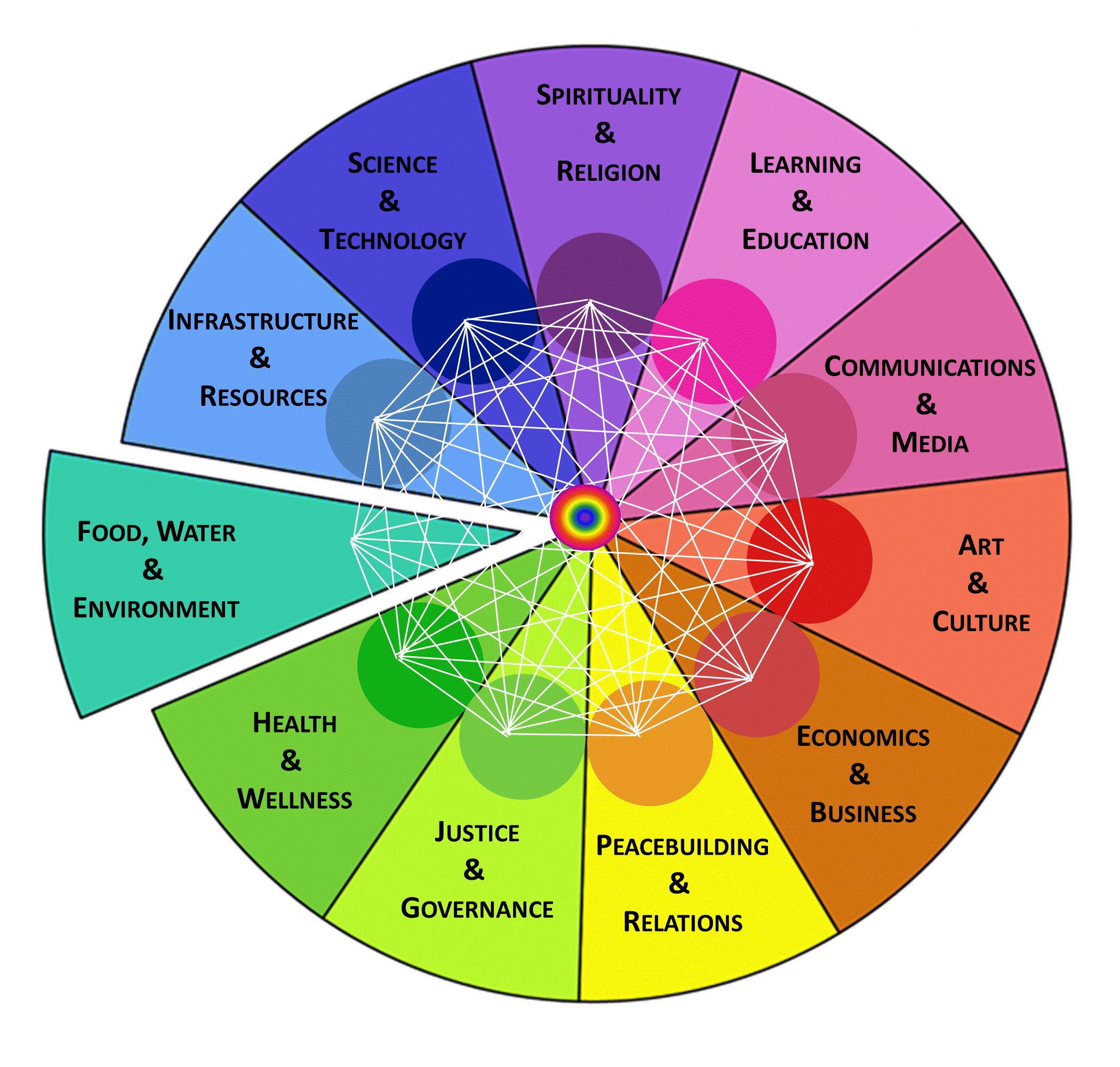
The trauma that Trump has managed to inflict in four years has in fact radically accelerated the disintegration of the American Empire. Scenes you would associate more with Mad Max at Thunderdome or whatever your favorite dystopian movie is, were played out on Capitol Hill this past week.
Trump has intentionally, systematically degraded American capabilities in every single one of the essential functions needed for a functioning society, let alone a thriving civilization. An encyclopedia would be needed to fill out the details, and that is not my purpose here. Simply fill in the blank white spaces in the above diagram for any areas close to your heart with the dysfunctions that affect you most.
I simply wish to point to the systemic and planned nature of the very real threat he and his fascist friends have posed to the USA and western civilization, such as it is. What Trump has not managed to degrade, Covid19 is now damaging in a variety of ways. No wonder he has done little to stop it- it’s all part of a plan, man. Or has he simply lost his mind? We may never know.
So, is it any wonder we are all experiencing trauma, in its many different manifestations, including old wounds triggered by the accelerating decay of our so-called western civilization? What is to be done?
The Transition We Are In
But it’s not all bad news. Not by a long shot. We are in an accelerating transition from a degenerative, exclusive, rather soulless, materialistic political economy where only money really matters, toward a regenerative, inclusive, open, more soulful multi capital system where all life, people, purpose, and principles matter equally. I know that’s quite a mouthful, but it’s currently the best description of the qualities of “where we are” to “where we need to be” I can muster in the English language right now without getting all woo woo. Others more philosophically inclined might say we are transitioning from neoliberal[1] modernism to mixed economy metamodernism. Whatever.
The bottom line is that the financialization of our global economy driven by the Anglo-Saxon deregulation and privatization of markets and governments in the past four decades has placed financial capital and shareholder value on a pedestal as the only valid goal of business and finance. How it all began with Milton Friedman and the Chicago School of monetarism in the late 1970s, building on the work of Von Hayek and others is the subject of many fine, thick tomes. For the record, Von Hayek himself was not opposed to government intervention per se; indeed, as early as 1944, he rejected the term laissez-faire as misleading because he recognized legitimate realms of government intervention.
Transitions always involve periods of social chaos and heightened anxiety and violence due to disorientation and the breakdown of the old system. Corruption, moral decline, and inefficiency appear to be signal features of the final stages of a system. The growing importance of technology in shaping the logic of transformation has led to history accelerating, where each transition happens faster than the last. Yet such periods of transformation also surface massive opportunities to change what it means to be human, to thrive and be fully alive.
[1] “Neo-liberal” is a political term, increasingly a term of abuse, often identified with people who advocate low taxes, where a public-sector deficit in need of correction is addressed by spending cuts rather than tax rises — which is almost always regressive, hitting the poor hardest.

None of this is, frankly, completely new, as any historian will tell you. The thinkers and ideas that inspired the American and French revolutions are still powerful influences on our thinking today. The early “liberal” phase of the French Revolution extolled the virtues of Liberté, Egalité et Fraternité or “Liberty, Equality, and Fraternity”. None of these three concepts can work on its own, as they lead to unhealthy extremes:
• Excessive emphasis on liberty without some level of equality or fraternity ends up in a few rich individuals dominating others, much as we are currently experiencing with neoliberal policies.
• Excessive emphasis on equality leads to economic stagnation due to a lack of incentives such as occurs in communism.
• Excessive emphasis on fraternity leads to nepotism and corruption.
• Sometimes the French add “Solidarité”, or solidarity, as in the French national anthem, which is a slightly broader embrace than fraternity.
Neoliberalism set itself in stark opposition to classic liberalism. Classic liberalism fought valiantly to prevent high levels of inequality while leaning over backward to reverse extreme inequality. By exiling the concept of Egalité from the tri-partite compact of the Enlightenment’s principles, Neoliberalism doomed itself to become the creator of demagogues and a world of haves and have-nots, with extreme inequalities of wealth, particularly in the developed countries.
After four decades of unchallenged hegemony of neoliberal philosophy in the USA, the electoral victory of Trump became all but pre-determined. While giving birth to Trump and fostering the domination of extremists in the Republican party, Neoliberalism has unleashed a legion of self-appointed carriers of great expectations, demagogues, and haranguers of all kinds. Lying has become a way of life for the more unprincipled Republicans, as they continue to perpetrate their long con that has worked so well in enriching the elites at the expense of the masses.
CON — Pronunciation /kɒn/
VERB- cons, conning, conned: Persuade (someone) to do or believe something by lying to them.
NOUN — An instance of deceiving or tricking someone.
Origin- Late 19th century (originally US): abbreviation of confidence, as in confidence trick.
The strength of these “strong (wo)men” is measured by their ability to break rather than observe the rules of games cherished by the “establishment”, their common “enemy”, while allowing the neoliberal elite of the 1% of billionaires and multi-millionaires to laugh all the way to the bank and to laugh at an electorate, dumb, angry and confused enough, to believe the fake-news promises of the neoliberal shills and charlatans they were manipulated into electing.
Shortly before his death, the great Umberto Eco drew the following sad conclusion from his numerous studies of the matter:
“Having an enemy is important not only to define our identity but also to provide us with an obstacle against which to measure our system of values and, in seeking to overcome it, to demonstrate our own worth”. In other words: we need an enemy to know who we are and who we are not; knowing this is indispensable for our self-approval and self-esteem. And he adds: “So when there is no enemy, we have to invent one”. A codicil: “Enemies are different from us and observe customs that are not our own. The epitome of difference is the foreigner”.
21st-century populism is a predictable response from those who have been disempowered by four decades of neoliberalism, an economic ideology that is long past its sell-by-date. It is also potentially very dangerous as power-hungry tyrants get their hands on the levers of power and use chaos generating divide and rule tactics to hold on to power. Populism now occupies the gap between the cynical, politically correct, anything goes post-modernism of the urban elites, and the harsh realities of the more traditional urban and rural middles classes and the poor, many of whom have not completed high school nor traveled much beyond the region of their birth. And this gap will only widen if we continue business-as-usual, given how strongly the ideology and structures of neoliberalism are now entrenched in our social and political lives.
In neoliberalism, money (or “financial capital”) is the be-all and end-all top priority of the economic and political system. As the catchphrase goes: “Follow the money”; one can explain just about anything these days by doing so; from how politicians get elected to what they vote for; from why a very large number of senior executives are paid huge amounts of money for producing little or anything of lasting value; to why most of the surplus money supply sloshing around our planet is funneled into the hands of the big banks, the already wealthy and large corporations, rather than those entrepreneurs, inventors and change agents working on making the world a better place. What little money does go to these “better world” organizations is drip-fed from Foundations, corporate social responsibility budgets, and charities, making it exceptionally difficult to scale even the most successful projects and innovations.
This obsession with financial capital now goes by the name of “Mono-capitalism”. In “A Leader’s Guide to ThriveAbility”, we outlined an approach called “Multi-Capitalism”, where the goal of a socio-economic system or political entity becomes to regenerate human, relationship, social, intellectual, natural, infrastructure, and manufactured capitals in inclusive ways. The keys to making such a system work effectively depend on shifting mindsets, organizational priorities, and measurement systems together with global indicators and programs that include all eight of these capitals so critical to life, innovation, and thriveability.
(See http://bit.ly/LeadersGuidetoThriveAbility )
Hidden Persuaders
Even if we are psychologically healthy, what our minds can imagine is strongly influenced or limited by what we are allowed or educated to know and believe. Controlling the information input and main messages received by popular culture is the key weapon of dictators, advertisers, and conmen. First, I have to get your attention (cue anxiety arousing headlines), then I implant some low-level desire for a product, service, or strong leader in your mind to relieve that anxiety temporarily, so as to absorb this month’s paycheck, or even encourage you to get into debt for something you discover you “need” right now.
PROPAGANDA — Pronunciation /prɒpəˈɡandə/
NOUN — Information, especially of a biased or misleading nature, used to promote a political cause or point of view. “He was charged with distributing enemy propaganda”.
Similar: information, promotion, advertising, advertisement, publicity, advocacy, spin, newspeak, agitprop, disinformation, counter-information, brainwashing, indoctrination, the big lie, info, hype, plugging, disinfo.
This is why mass consumerism was, literally, invented a century ago using Freudian psychology to enable mass production to scale up and ensure a ready market for its wares. PR, marketing, and advertising, weaponized with social media, have turned Instagram and Twitter into meccas for personal beauty (for women), sports (for men)- just look up the 100 trending hashtags in your browser right now to see what I mean. Meanwhile, global overheating, climate disruption, and the sixth mass extinction are literally deep underwater beneath this endless tsunami of “news” and “trends”. No wonder we find it difficult to know who we can trust and what is true anymore.
How can we inspire desirable consumer and citizen behavior that creates the powerful pull needed to help businesses and governments invest in the transition we need? We will explore that in more detail in Part 3.
Thinking Systemically with a Global Transition Model
“Every few hundred years in Western history there occurs a sharp transformation. Within a few short decades, society ─ its worldview, its basic values, its social and political structures, its key institutions ─ rearranges itself…Fifty years later, there is a new world, and people born then cannot even imagine the world in which their grandparents lived…We are currently living through such a time.”
Peter Drucker
The Global Transition Model illustrates how globalized, degenerative neoliberal monocapitalism has exploited the seven fundamental flaws in our global system to enrich itself at our expense. It shows us how we can transform these dysfunctions through seven acupuncture points into a regenerative, inclusive multi-capitalism that works for all humans and all life on our planet, which we will be exploring in Part 3.
Transitions always involve periods of social chaos and heightened violence due to disorientation and breakdown of the old system. Corruption, moral decline, and inefficiency appear to be signal features of the final stages of a system. The growing importance of technology in shaping the evolutionary logic of power/action and love/care has led to history accelerating, where each transition happens faster than the last. The chaordic zone in the exit turbulence of modernism is a crucible in which hundreds of millions are making a momentous leap into worldcentric and kosmocentric levels of mindsets, paradigms, and consciousness.
One of the signs of this transition is the hundreds of millions of people rising up against business-as-usual and demanding we address our climate emergency now. This also happened in the early 1970s, triggering the founding of the Environmental Protection Agency, yet nearly half a century later the situation is worse than ever. What must be done?
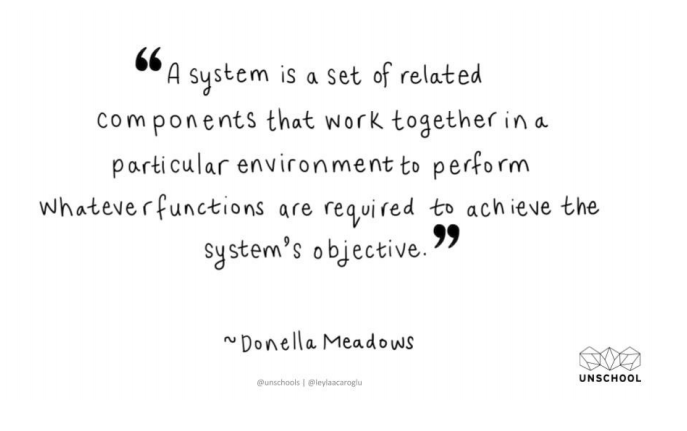
It is worth quoting Donella Meadows, one of the founders of the science of systems thinking here, describing just how counter-intuitive the insights from genuine systems thinking are- and this was “way back” in the ’70s:
“Remember, always, that everything you know, and everything everyone knows, is only a model. Get your model out there where it can be viewed. Invite others to challenge your assumptions and add their own.”
Asked by the Club of Rome to show how major global problems — poverty and hunger, environmental destruction, resource depletion, urban deterioration, unemployment — are related and how they might be solved, Donella’s mentor, Professor Jay Forrester at MIT, made a computer model and came out with a clear leverage point: Growth. Not only population growth but economic growth.
Growth has costs as well as benefits, and we typically don’t count the costs — among which are poverty and hunger, environmental destruction, and more. — the whole list of problems we are trying to solve with growth. What is needed is much slower growth, many different kinds of growth, and in some cases no growth or negative growth. The world’s leaders are correctly fixated on economic growth as the answer to virtually all problems, but they’re pushing with all their might in the wrong direction.
Another of Forrester’s classics was his urban dynamics study, published in 1969, which demonstrated that subsidized low-income housing is a leverage point. The less of it there is, the better off the city is — even for the low-income residents. This model came out at a time when national policy dictated massive low-income housing projects, and Forrester was derided. Now those projects are being torn down in city after city.
Counter-Intuitive
That’s Forrester’s phrase to describe complex systems. Leverage points are not intuitive. Or if they are, we intuitively use them backward, systematically worsening whatever problems we are trying to solve.
Top-Down Systems can be analyzed using classic “Systems Dynamics”, including Senge’s Fifth Discipline model and Scharmer’s U-Theory, but they have failed to make even minor changes to our systems of governance. At best, they have helped mitigate some of the worst excesses of top-down systems.
Bottom-Up Governance requires a very different approach, which we will start unpacking in the next three articles in this series.
In Part 3 — Reinventing the System, Healing the Trauma (out now) we examine what we can do in these traumatic times to stay sane and get better while reinventing the systems that created the mess in the first place.
In Part 4 — The Global Transition Model we will dig deeper into how human societies evolve, and how the Global Transition Model dramatically simplifies what is happening now, and what comes next.
In Part 5 — Effective Regenerative Responses: 7 Fractal Acupuncture Points we’ll investigate the interconnected set of responses we must activate now to design and build regenerative futures that work for all of us and our planet.
Feel free to share and clap for this article if you enjoyed it- thanks! You can find much more detailed treatments of some of the above topics in my recent books- check them out here: