
BIBLICAL REFLECTIONS
Creation Stories of Genesis
Genesis 1 & 2: Creation of the macrocosm and microcosm
Beginning this New Year of 2022, I joined a program to read the Bible in a year. We’ll discover whether I complete my task. A year is a long time and much can interfere, as we’ve all discovered these last two years.
As I read through this program (Fr. Mike Schmitz: The Bible in a Year), I’ll pick something in that day’s reading and write about it.
This program is unusual in that I don’t begin with Genesis 1 and read straight through.
The Bible in a Year program, according to Fr. Mike, “… you won’t just read every word of the Bible in a year — you’ll finally understand how all the pieces of the Bible fit together to tell an amazing story that fits in your life today.” (The Bible in a Year Notebook, 2021, Ascension Press, by Fr. Mike Schmitz featuring Jeff Cavins.)
Day 1 began with the creation stories, Genesis 1 & 2. Although Psalm 19 was included, I’ll focus my comments on Genesis.
Chapter 1 focuses on the macrocosm, the creation of the structure to support humanity and all the plants, animals, and sea creatures. Chapter 2 is about the microcosm, the creation of humanity and all that lives upon the land and in the seas.
The awe of the macrocosm
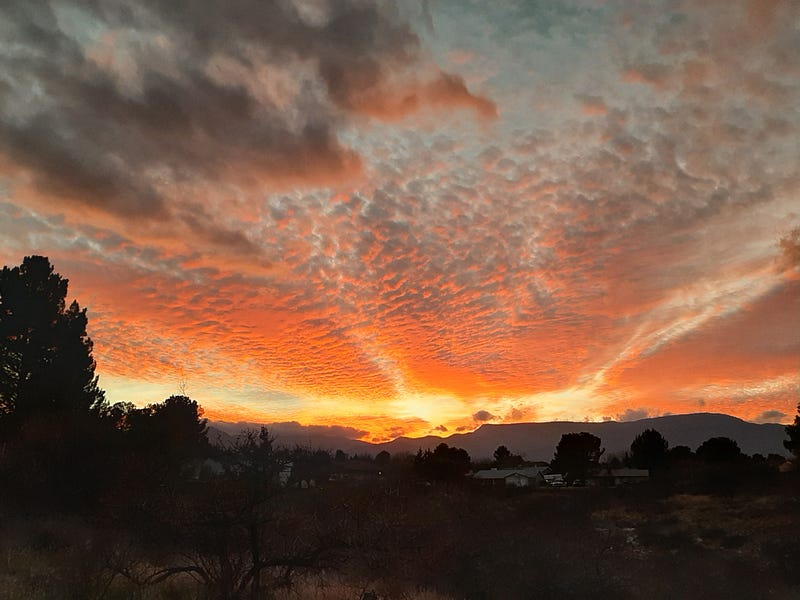
As a Texan living in Arizona, I’ve witnessed innumerable exquisite sunrises and sunsets. The non-polluted air (except during forest fires) provide a spectacle of sunrises and sunsets which pull me outdoors often during the week.
To behold the rise and fall of the sun, the movement of the moon through the sky in all its phases, the mass of stars in the sky at night, as well as the bow of many colors on occasion, throws me into awe. I’ll stand outside or watch through my window in a state of contemplation at the wonders I see.
I once listened to a lecture on the scientific reason for all the colors: the angle of the sun and the moisture in the air being major contributors to the beauty. The science was fascinating, but the experience of losing myself in the colors was spiritual.
I don’t think of the science when I’m struck dumb as the colors deepen then fade in the minutes of sunrise and sunset.
What struck me as I listened to Fr. Mike Schmitz was his discussion of the difference between the Hebrew creation story and other creation stories. (I have not done any research to fact check him in this area.) The Judeo-Christian story is the only one of creation from nothing and from the goodness of the Creator.
Other creation stories involve destruction and death in some way. Read or re-read the creation stories of the ancient Greeks, Romans, and Egyptians to get a taste of the violence involved.
In the Hebrew scriptures, which became the prelude to the Christian scriptures, a beneficent Creator created simply to share.
The microcosm of creation
Once the light and dark, the sun, moon, and stars, and the land and the water separated from each other, the macrocosm was ready for the microcosm.
The microcosm is humanity, plants, animals, and sea creatures. The separation of the water from the land provided the substance (the macrocosm) which humanity and all living things needed to survive upon this planet.
When you experience love and joy, you are smack-dab in the wonder of the microcosm of creation. Laughter burbling forth from children playing with you or other children is about the wonder of the microcosm.
You can look into the heavens for the sun, moon, and stars. You can be transported into a place within yourself where you are in awe of what happens in the skies. This is the beauty of the macrocosm we all need to live.
The same awe occurs when you hold your newborn child for the first time, and smile as s/he squalls at the new sensations greeting eyes and ears.
Even if you don’t believe in a G-d, beauty is part of this world. Beauty is contained in the smallest flower, the magnificent cloud formations, and the sound of geese flying overhead (which I’m hearing now.) Let’s not forget the wonder, and the pain, of your most cherished relationships.
An aside
In Catholic School, I was ordered not to read the Protestant Bible. I wondered why when I discovered the Catholic version had everything the Protestant Bible had plus more. (Go here to find out why.)
In case you’re not aware of this, Catholic theologians view the Bible differently than Evangelicals and many, perhaps most, Protestants. We don’t believe in Biblical inerrancy. The Creation story is seen more as a poem about Creation, not actual facts. The Bible, according to Catholic teaching, is the inspired word of G-d, not dictated by G-d to someone.
Ah, and the conflict begins between the two groups, doesn’t it?


