
Creation Is a Frenetic Process
Ideas and voices within cannot wait to be expressed
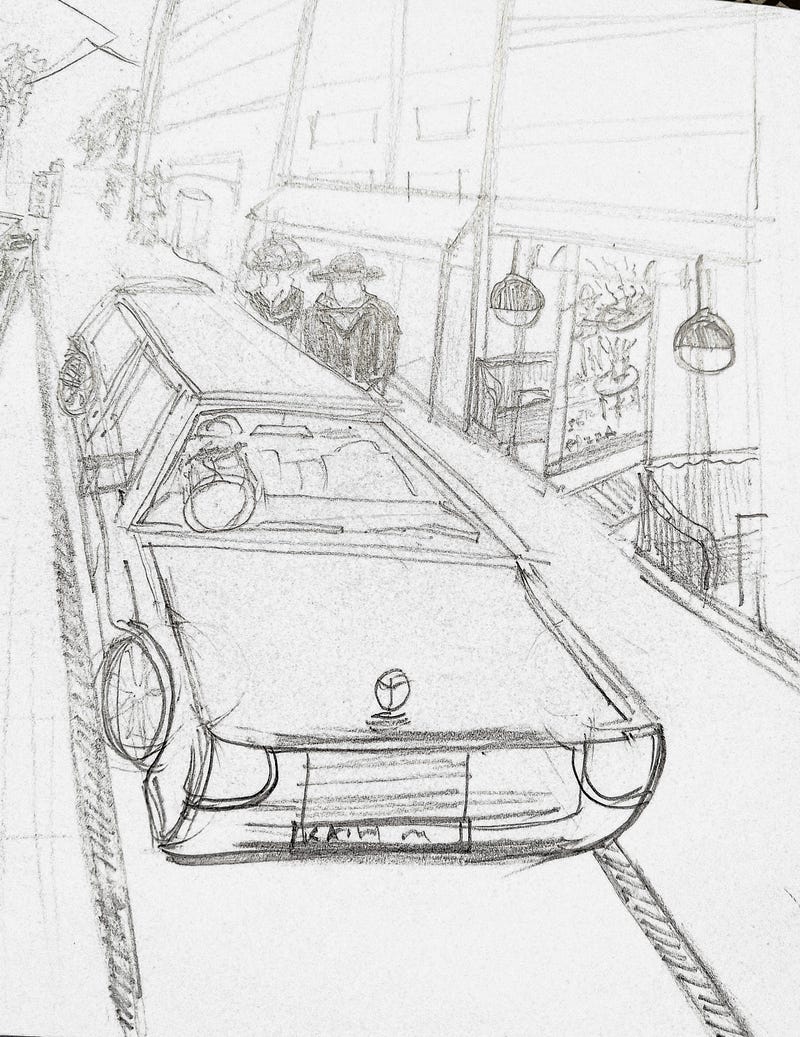
This humble sketch was done by yours truly as part of attempts to learn the basics of drawing & illustration. This “work of art” extorted a couple of hours of my time and energy. During this time, I ignored my one year old’s demands to be lifted and be shown the outside world, neglected phone calls from friends and family, and forgot about breakfast. I enjoyed the process throughout and was eager to produce a creation of my own.
Edgar Allan Poe, in his story, The Oval Portrait, describes an artist at work on a painting in a dark room.
And then the brush was given, and then the tint was placed; and, for one moment, the painter stood entranced before the work which he had wrought; but in the next, while he yet gazed, he grew tremulous and very pallid, and aghast, and crying with a loud voice, ‘This is indeed Life itself!’ turned suddenly to regard his beloved: — She was dead!
The artist gets so immersed in his act that he forgets about the subject of his painting, his ‘young bride’ who sits opposite posing for him. He does not notice her death, till after his work is complete. Leaving alone the morbid factor of the story, Peter Barry, in his book Beginning Theory, says:
The frenzy of this ‘passionate, wild and moody man’ produces a work of art so lifelike that it seems a product of a divine being
This artist’s creation was produced by such exquisite intensity, focus, filled with wonder and delight. In Poe’s text in the story itself, the narrative gets quicker during this creation phase, there is almost a feverish pace of writing to describe the whole process. This process holds true for any artistic creation. It is often driven by a natural desire to express and warrants a certain form of urgency. The closest analogy of this urgency I could think of is the process of emptying the bladder: once started, it is a continuous flow, and stopping it midway is out of the question. Joseph Conrad, writes in his book Notes on My Books, about a story that is bottled up inside him, about to explode, so much that he ditched writing another book midway to write this one instead.
At the same time, I was just as certain in my mind that “Youth,” a story which I had then, so to speak, on the tip of my pen, could not wait.
An idea, once it strikes us with reasonable clarity or delight, seems to want to burst out of us to express itself. In the modern-day office setup, “brainstorming” generates a chain of ideas based on a clash of different viewpoints. This process warrants the thoughts to be a bit chaotic, so as to organically synthesize, and the constructiveness of it may not be immediately evident. But a form emerges from it slowly, magically. The result is often surprising — a feeling of “how did we ever come up with this idea?”!
Giving shape through revision
For the writing process specifically, once an initial version or draft is produced from a chaotic episode, a round of revision is required to shape the form. Then back to an episode of chaos to generate more content. Then Revise again. And again. Mary Snyder says about Frankenstein’s creation in her book, Analyzing Literature-to-Film Adaptations,
The most important aspect of creation neglected by Victor Frankenstein was the revision of his “project.” If he, perhaps, had spent the time beyond the initial creation and crafted his creation into a refined, accomplished being, Frankenstein’s monster might have been a benevolent “monster,” and an asset to society
Writers have different styles to perform revisions, some useful practices can be found summarized here.
The fruit of chaos
The process of creation is also mentally draining. There are casualties. It was the beloved young bride for Poe, while it was my family for me. In this chaos, the writer may not entirely be in control of the actual text produced on paper. But chaos is necessary for the writer’s voice to express itself as a beautiful work of art.


