
Creating Tiny Goals That Stick and Change Your Life
This is the secret sauce you’ve been missing.

Creating very small goals and sticking with them has changed my life, more than once. It’s taken me from being nearly bedridden with pain to losing more than 100 pounds. It’s helped me write and sell four novels. It’s helped me build an incredible business.
When my tiniest goals work, they’re like a collection of Legos. Impossibly small, but I can build literally anything with them.
But sometimes? Sometimes, my teeny, tiny goals don’t stick. The collection just doesn’t take hold. Here’s an example.
I’ve tried to create a habit of practicing the guitar for ten minutes every day. I own a guitar. It’s sitting in a corner of my bedroom, where it’s sat for more than a year, untouched. I’ve never been able to make this particular goal stick for more than a few days even though I really want to learn to play the guitar.
And even though I really believe that if I did practice for ten minutes a day for long enough, I’d become a guitar player.
So, why do some teeny, tiny goals work magic and others die on the vine?
Teeny Tiny Goals Aren’t Arbitrary
It’s easy to spout off a small goal. I mean. I can do anything for ten minutes a day. But the truth is, if I don’t get over the hump between not doing the work and doing the work, the goal is useless.
A teeny, tiny goal — to be effective — has to mean something.
Clearly, even with thirty years experience really wishing I could play the guitar, I haven’t figured out how to motivate myself to do even the smallest amount of work toward achieving that goal.
In other words, it’s not enough to just declare your teeny, tiny goal. You have to actually, you know, do it. And to do it, you need to internalize it. Your small goal isn’t a throw-away. It’s not arbitrary.
It actually matters.
What’s your WHY?
When I think about the small goals that stuck around long enough to make a big difference in my life, one thing that stands out is that I knew why I wanted that thing.
I wanted to do something about my health, because I couldn’t stand up for more than ten minutes without excruciating pain, I needed a machine to help me breathe and sleep at the same time, and I was losing my mobility.
I wanted to write every day, because I needed to earn a living.
I wanted to build Ninja Writers, because I hated my day job.
Working for ten minutes a day on those goals was clearly an exercise in creating little building blocks that lead me to a higher goal.
Why do I want to learn to play the guitar? Because I think it would be cool. Because my sister can. Obviously, based on results, those are not strong enough whys. Because I’m not practicing. I set the goal, but I don’t follow through.
If I really wanted to learn to play the guitar, I’d have to connect the goal with a stronger reason.
So, what’s your why? Understanding the reason why you want to create a habit can be the difference between a failure and success.
What’s your WHERE?
I’m mildly obsessed with the question of where.
I’ve written books sitting in a McDonald’s Playplace while my kids ran around and I fueled myself on $1 Diet Coke. And in the early stages, when I was still working my day job, I did a lot of my Ninja Writers work on my phone in the bathroom during breaks.
It isn’t that the where has to be fancy. It’s just that it has to be there.
Seriously. Once I got in the habit of it, I was able to hide out in a bathroom stall and answer emails like it was my job. And I learned to simultaneously keep an ear out for my own kids while tuning out everyone else’s.
It was the act of showing up in those highly unlikely places day in and day out that made the difference.
My guitar wedged between the wall and the dog’s bed, gathering dust, isn’t a great where. When I visit my sister, she’s got a cheap music stand set up in her family room, waiting for her to sit down and spend a few minutes playing.
If you want to make a daily habit stick, think about where you’re going to actually do the work. It doesn’t have to be perfect, but it does have to be conducive.
Does Your Goal Direct You Toward a Larger Goal?
I made my first real steps toward improving my health right after my second novel was released. It suddenly occurred to me that I was on the verge of getting everything I’d ever wanted, and I was too sick to enjoy it.
My larger goal — really, my whole life goal — is to be a working writer. I’m pretty single-minded there.
No effort to lose weight (and trust me, I’ve made the effort a thousand times) ever stuck, until it tied into my larger goal.
I didn’t exercise for 10 minutes a day and magically lose over 100 pounds, by the way. I exercised for 10 minutes a day and felt better. A lot better. And then was in a place to make other decisions that led to weight loss surgery in 2015.
I didn’t create a business working ten minutes a day. I made a commitment to doing at least ten minutes a day of work on my business and started to build an audience who was excited about what I was doing. That led to me working more, which led to Ninja Writers.
I didn’t write publishable novels writing ten minutes a day. I got in the habit of working at least ten minutes a day on my work-in-progress and that consistent work led to me finishing projects and becoming a better writer.
Do you understand the larger purpose?
In other words, your teeny-tiny goal is the smallest increment of a larger purpose. It is the atom of your dreams.
Put together a long enough string of those atoms and they’ll turn into something amazing.
It helps, immensely, if you understand that larger purpose. Maybe your habit will lead somewhere you don’t quite expect. That’s okay. It’s exciting, even. But you should know the general direction you’re headed.
Wanting to play the guitar because it’s cool and my sister does leaves out the idea of a larger purpose all together. Do I want to play in a band? Do I want to play at family campfires? Do I just really love music and want to be able to immerse myself in it?
I honestly don’t know. And because I don’t know, my guitar-playing tiny goal has never stuck.
If your tiny goal isn’t sticking, I highly recommend sitting down with it for a while and really thinking about the larger purpose behind the effort.
Analyze Your Teeny-Tiny Goal
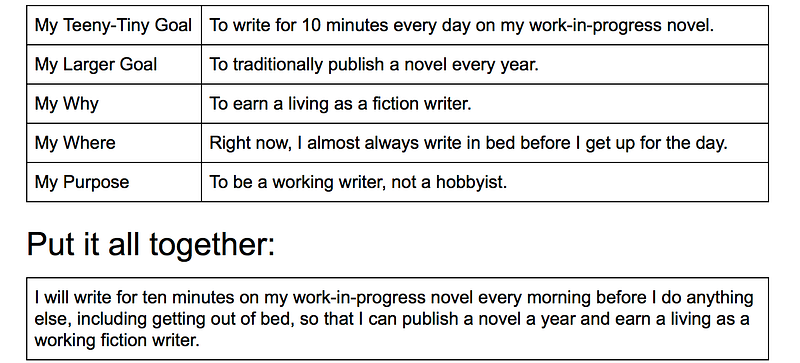
If you put all the parts together (your small goal, your larger goal, your why, where, and purpose), you’ll get a bigger picture of what it is you’re trying to do and increase your odds for success.
Here’s what that looks like for my ten-minute daily writing goal.
Analyze your own teeny-tiny goal today. Then see what happens.
Create your own daily writing habit.
Shaunta Grimes is a writer and teacher. She is an out-of-place Nevadan living in Northwestern PA with her husband, three superstar kids, two dementia patients, a good friend, Alfred the cat, and a yellow rescue dog named Maybelline Scout. She’s on Twitter @shauntagrimes and is the author of Viral Nation, Rebel Nation, The Astonishing Maybe, and Center of Gravity. She is the original Ninja Writer.