
Creating Stories By Disrupting Time
Dangerous as it may be, manipulating the timeline may give fantatic results
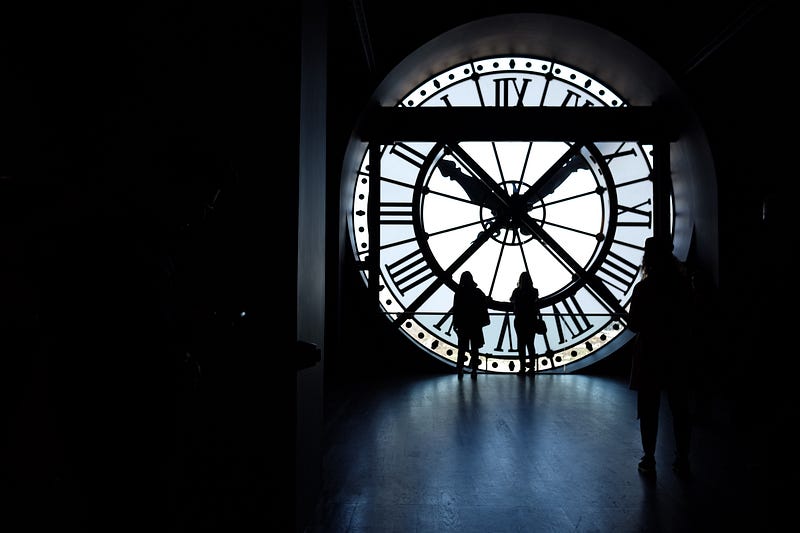
As human beings, we live on stories. We see stories everywhere. We see the events. We follow them unfold. We want to know what happens next.
This is how our lives work, and so we look for it in everything around us.
Information work mostly in the same way. We want to know everything, from beginning to end.
Information, learning, reporting, everything lives on the line of unfolding events. Everything starts somewhere, evolves and finally concludes somewhere else. We chronicle our life in this way.
But what about fiction?
We may be tempted to say that stories are built in the same way. There is a beginning, an unfolding and an end to all stories.
While this is true in a general sense, stories aren’t this straight forward.
Think about it. The very way the narrator tells us what’s happening is a manipulation of time, not a straight line from where a story starts to where it ends. The great majority of stories manipulate the sequence of events. That’s how stories become more than just plots.
Take for example two characters speaking to each other. Of course, the dialogue will follow a linear timeline, if we want to understand anything, but what about everything else? Does the narrator tell us it is a beautiful day at the beginning of the dialogue? In the middle? At the end of the dialogue? In ‘reality’, it will be a nice day all along, but the moment in which the narrator chooses to give us that particular piece of information will colour it of emotion.
What about the reaction of a character to what the other character is saying? Do we see it right away when it happens? Does the narrator wait until the dialogue line is over? Does the narrator wait until the entire dialogue is done? We may get the information with a noticeable delay in how the action actually happens, and that will colour our experience of the dialogue.
Manipulation of time happens all the time in storytelling, and most of the time, we don’t realise it.
But there are huge disruptions of time that even the most careless reader will see. This disruption will manipulate our experience of the story, the way we understand it, the emotions it elicits, the very meaning of what’s happening.
The major disruptive techniques
The way authors disrupt time in their stories is often very personal and part of their voice and style. There are however standard techniques that all authors use not just to manipulate time, but also the reader’s experience of the story. It is a manipulation of emotions and ideas as well as time, which sinks into themes and messages. Far from being just a gimmick, the manipulation of time in storytelling is a powerful tool of expression. Even when it’s done in a ‘common’ — not personal — way.
So let’s have a look at what the most common ways are to disrupt time in stories.
Flashbacks
Quite possibly, the most common time-disruptive narrative technique. Flashbacks interrupt the normal flow of the story and jump back in the past to tells us a different story, though connected to the main one.
This is probably the most ‘traumatic’ of all common time-disruptive techniques. Flashbacks put the story — and its flow — in great danger. When we stop telling the story to our readers and force them to turn to a completely different one, we need to be sure readers will care about this new story. They should care about this new story actually more than they care about the main one, or they will lose interest in both.
The best way to keep the readers’ interest is to give them a new story that is tightly connected to the main one, and will additionally give new insight into it.
This is the magic trick, in my opinion: if the flashback enriches the main story a great deal, readers will want to read it.
Fastforward
In some respect, this is the contrary of Flashbacks, since Fastforward gives us a glimpse of what will happen in the future of the story. But the way we use it and its actual structure differ quite a lot. It is shorter, for example, and it will never have a narrative structure as Flashbacks have.
The risk connected to Fastforward is quite apparent: stories feed on mystery. It is mystery that will keep the reader reading. When we reveal something of the future, we incur in the risk of killing mystery and so losing our readers. No surprise that few authors try this form of time disruption and even fewer succeed at it.
I think the secret to successfully use Fastforward is to give information that will arise expectation in the reader, but also will force them to guess. As for Flashbacks, the information should be tightly linked to action and characters in the main timeline. It should be certain (no vague hint here) and specific enough that it won’t reveal too much about anything else (that’s where the guessing happens) .
I never say it was easy, did I?
Foreshadowing
Foreshadowing is a very elusive technique and even as a time-disruptive practice is marginal, in the sense that there is no actual jumping backwards or forwards on the timeline. Still foreshadowing does use time in a way that will handle the reader’s emotional response.
We could define foreshadowing as a sort of premonition of the story. As a technique, it connects two events which are in themselves totally independent, but — here’s the manipulation of time — which the narrator will connect, generally with a trigger.
These two episodes are usually far away from one another, and the first one won’t stand out in any particular way when it occurs. It will look like the standard curse of events. But the author will plant a trigger in it. It could be a choice of wording, the structure of the events, a particular line of dialogue that will be unique enough to be noticed by the reader. The second episode will be recognisable because of the use of the trigger. The same structure of the episode, the same line of dialogue, the same or similar choice of words.
Although independent, these episodes will enrich each other once the reader makes the connection.
It is, indeed, an elusive technique. In fact, the risk is that the reader misses the trigger, and so doesn’t make the connection.
Dual Timelines
This is a technique that has become very popular lately and that sometimes involves not just two, but multiple timelines.
The quality of the different timelines can vary greatly. Using two different periods is among the most common occurrences. Maybe one timeline happens today, another in the past. But timelines can also follow different characters, or possibly events happening in different places at the same time.
Whatever the case, Dual Timelines make for massive disruptions of time. The reader jumps from one timeline to the other not just once, but many times, often in rapid succession (alternating chapters is quite a common practice). This means that not only the reader will jump from one situation to another, but also, quite likely, backward and forward in time as the narrator tries to synchronise the different timelines.
The timelines might look totally independent from one another, at least at the beginning, but in truth, they need to be connected and to enrich one another (yes, as always). Synchronising them is the great hustle of this technique.
Because they normally tell two (or more) different stories, the danger of Dual Timelines is that the reader will favour one over the other (it almost always happens). We need to be sure that both timelines tell a strong and interesting story.
Why should we go through such risks?
Yes, all time-disruptive techniques are ripe with the danger of losing our reader’s interest. It is a real danger. But dangerous as they are, these techniques exist because they are useful, so what is it that they add to a story?
They create suspense
When used with awareness, all these techniques create suspense, if only because they break away from the story to move to a different place, leaving the story hanging.
Of course, suspense works if we connect the pieces. Yes, we interrupt the story we are telling, but to give the readers another equally engaging story, which will provide them with more insight into the main plot.
It is essential then that we are very careful when we break off from the main story. The connection between the two different plots (or timelines), the reason why we break away, why in that spot and what we give to the reader in return must be clear to us. And above all, it must have meaning inside the story. It must make the story more complete and more involving.
If readers sense that there is a reason why we chose to change course at that time, they won’t be annoyed. They will want to know why, and that’s what creates suspense.
They create movement
All time-disruptive techniques create movement. It is their nature. They interrupt a story to move to a different one. This is why this kind of technique works best in the story downtime, and might even be welcome. I wouldn’t advise to use them during an action — though, if you’re going to tell me, I’ve seen it done successfully, I’ll answer, yes, me too.
But generally speaking, manipulating the timeline in a downtime section will have the benefit to make things more lively. The reader may be more welcoming to an interruption than in any other part of the story.
They create connections, therefore meaning
What stories make differently from any other form of communication is creating connections where there might not be any otherwise. The author creates a (hopefully logical) connection of events with intent. That connection will then turn into the theme of the story.
Of course, creating meaning through connections is a very personal process. Every author has their own. Using time-disruptive techniques is one of the many ways to do it. Why not giving it a go?
— — — — — — — — — — —
Sarah Zama wrote her first story when she was nine. Fourteen years ago, when she started her job in a bookshop, she discovered books that address the structure of a story and she became addicted to them. Today, she’s a dieselpunk author who writes fantasy stories historically set in the 1920s. Her life-long interest in Tolkien has turned quite nerdy recently. She writes about all her passions on her blog https://theoldshelter.com/


