
Creating a regenerative culture
There is nothing less at stake than the future of our species, much of the diversity of life, and the continued evolution of consciousness. If we achieve this ‘momentous leap’ (Graves, 1974) in human self-awareness, what lies ahead of us is the promise of a truly regenerative, collaborative, just, peaceful and equitable human civilization that flourishes and thrives in its diverse cultural and artistic expressions while restoring ecosystems and regenerating resilience locally and globally. The best of our music, art, poetry and technology will be elegant expression of the symbiotic unity of nature and culture.
We are capable of reflecting on the ‘universe story’ as our own story, the story of life evolving. Individually and collectively we are waking up to find out that the world knows and loves itself through our eyes and our hearts. What kind of culture will we create to express this wisdom? Becoming conscious of our interbeing with the world reminds us of our communion with all life as a reflection of our larger being. As conscious relational beings, love for life is our natural state.
The evolutionary biologist E.O. Wilson (1986), inspired by the psychologist Erich Fromm (1956), suggested that human beings as expressions of the process of life have an innate tendency to be attracted to all living beings. He called this love for life and attraction towards other life forms biophilia. The ‘deep ecology’ movement initiated by the Norwegian philosopher Arne Næss (1988) calls the realization of our own self as a relational reflection of the larger community of life ‘our ecological self’ and sees in it the basis for responsible action out of enlightened self-interest.
We bring forth a world in relationship to ‘other’ and without that ‘other’ — which is a reflection of our larger self — we could not exist. The ‘Santiago Theory of Cognition’, as we have seen, reframes dualistic categories like self and world as polarities of an interconnected whole which takes form by distinction without separation. As another esteemed mentor and friend of mine, Satish Kumar — editor of Resurgence and co-founder of Schumacher College — has put it: “You are, therefore I am” (2002). Or in the words of a Grateful Dead song: “Wake up to find out that you are the eyes of the world!”
In regenerative cultures, personal development and the evolution of consciousness will accelerate. As we cease to be paralyzed by the fear-driven cycle of separation, scarcity and the struggle for control and power, we will begin to unfold the potential of a compassionate, empathic and collaborative culture of creativity and shared abundance, driven by biophilia — our innate love for all of life.
The narrative of separation from the rest of life and alienation from nature’s wisdom is beginning to give way to a narrative that celebrates our communion with nature as the very essence of our being. Our subjective conscious awareness of the transforming whole (limited as it may be) is an important and valid reflection of that whole getting to know itself through all of us and as all of us. By living the questions together, we can learn to appreciate multiple perspectives and gain a shared understanding of our participation in that wholeness.
So far, most evidence of the healthy evolution of human consciousness and personal development (e.g. Graves, 1974; Wilber, 2001) indicates that nobody is born with a holistic and planetary consciousness and full awareness of the co-arising of self and world. So all present and past states and stages of consciousness (see Combs, 2002 & 2009) have to be welcome as they form the stepping stones of personal development in individuals, as well as being expressions of the evolution of consciousness of our species.
A regenerative culture will have to facilitate the healthy personal development of a human being from ego-centric, to socio-centric, to species-centric, to bio-centric, and cosmos-centric perspectives of self. This means paying attention to how our culture and education system shape our worldview and value system. We need to encourage life-long learning and personal development through supportive community processes and ongoing dialogue, guided by questions rather than answers. We need to live these questions individually and collectively to co-create a new narrative.
As the multiple converging crises we face are creating an accelerated climate of transformation, where change is no longer a possibility to entertain but an inevitable consequence of our collective actions, we are called to switch out of the mindset that created these crises in the first place. In doing so, we undergo a species-level rite of passage that offers us a new and more mature perspective on our intimacy with, and responsibility for, all of life. We are “coming home” (Kelly, 2010).
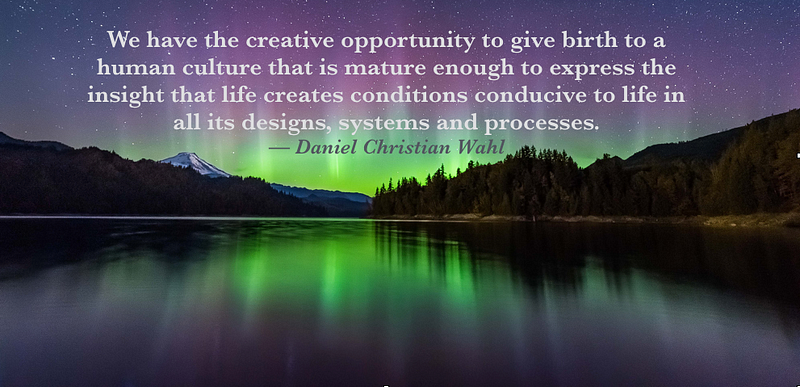
The creation of diverse, regenerative cultures collaboratively united in a regenerative civilization is the only viable future open to us as we move into the ‘planetary era’. Our collective challenge is to create cultures capable of continuous learning in the face of complexity, not-knowing and constant change. We have the creative opportunity to give birth to a human culture that is mature enough to express the insight that life creates conditions conducive to life in all its designs, systems and processes. We can co-create a world that works for all of humanity and all of life. We are capable of vibrant and diverse cultural expressions of the profoundly transformative insight that we are the eyes of the world.
[This article is an excerpt from my book Designing Regenerative Cultures, published by Triarchy Press, 2016.]
—
If you like the post, please clap AND remember that you can clap up to 50 times if you like it a lot ;-)!
Daniel Christian Wahl — Catalyzing transformative innovation in the face of converging crises, advising on regenerative whole systems design, regenerative leadership, and education for regenerative development and bioregional regeneration.
Author of the internationally acclaimed book Designing Regenerative Cultures


