
Life | Personal Leadership
Create Anything You Want in Life
Ready, Aim, Create!
Have you noticed there is a pattern often used to create anything you want in life? You will find it everywhere. An easy way to remember this pattern is by using its acronym, STAR, short for See, Think, Act, and Reap. Let’s look at how this pattern can help you create anything you want in life.
“The desire to create is one of the deepest yearnings of the human soul.” Dieter F. Uchtdorf (1940-present)
The pattern of creating
The simple graphic shown below will help you visualize how the STAR creating pattern works and can be used as a quick reference to jog your memory when needed.
Let’s look at the pattern in reverse to gain a clear understanding of how it works. Anything that is created produces a result, whether tangible or intangible. This result is what you reap “R”. What you reap comes from the actions “A” you take. Before acting, you must first give it thought “T” based on the awareness or what you see “S.”
In short, the results you reap in the world are dependent on your actions, which depend on thinking, which comes from what and how you see.
Another way to say this is to create anything in life — see what you want, think and plan what to do, then do it. You will then receive or reap the result!
Sounds simple enough, doesn’t it? To deepen our learning about this creating pattern, let’s expound on it further.
Deepening your understanding
To help you see the creating process more clearly, look closely at the following graphic.
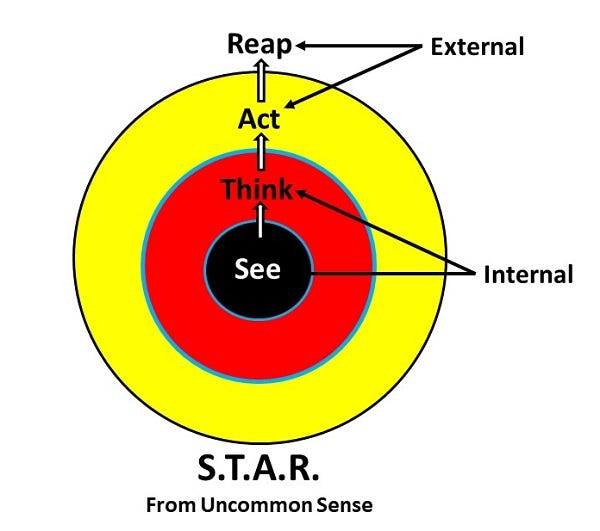
Whenever we aim at creating something, it helps to have an aiming point. The bullseye at the center of the drawing represents seeing what you wish to create in your mind’s eye. With a vision of what you want to create, you can begin giving it thought. Your thoughts will allow you to take action to create what you want.
It is important to note that seeing and thinking are internal processes. Once you have processed internally, it is time to bridge the internal to the external with action which manifests the creation leading to reaping.
“Creativity is inventing, experimenting, growing, taking risks, breaking rules, making mistakes, and having fun.” Mary Lou Cook (1908–2008)
Within the creating process, an additional pattern often emerges. When you begin taking action, you can make mistakes and learn, which require more thought. This process is natural anytime you create. You may repeat this process several times before you fully create the final product from which you can reap your reward.
A wonderful thing about the creating process is it can feed on itself. The more you create, the more you will see, think, act, and reap from creations that would otherwise have not occurred.
“Creativity doesn’t wait for that perfect moment. It fashions its own perfect moments out of ordinary ones.” Bruce Garrabrandt (1955-present)
Example 1 — creating an article
An example of the STAR creating pattern is how I used it to write this article. First, I had to see or comprehend “S” what I wanted to write. For me, it was to show others a clear, concise, and easy-to-understand process of creating.
As I saw what I wanted, I began giving it thought “T,” which included making notes and organizing my ideas. Next, I had to act “A” and start typing a draft of the article. Before I could finish the article, I had to think more deeply about the words. I wrote, edited, and rewrote them. This process continued until I had a finished product I could release into the world, from which I could begin to reap “R.”
Whether the result is intangible, like a relationship, or something material and tangible, such as a car, it all begins with clearly seeing what you want.
Example 2 — creating a changed relationship
“Everything you can imagine is real.” Pablo Picasso (1881–1973)
Imagine you want to create an improvement in a relationship with a co-worker. The current state of the relationship shows up in the way you interact and results from what is in you and what is in the other person. You could say the relationship is created by what each “sees” and interprets or thinks about what they see in one another. The solution lies in what you can do to change how you see each other.
You can try to change the other person, attempting to get them to see what you want them to see. This approach rarely, if ever, works. Experience tells us it is a difficult path to attempt to change someone else.
A better approach is to look inside yourself. What do you currently see, and what do you think about the other person? Your view and thinking of them are likely very limited. What if you were to work to “see” something else, something more, something new in them?
I once had a strained relationship with a colleague. All I had seen in him was what I considered selfishness. Everything he said was about him and how much success he had or what he wanted. He never took time to listen to much of what I or anyone else had to say.
Working with this man irritated me to no end — until one day, something happened. He made a comment about his father, and I noticed he got a little choked up. I had never seen this in him, and I became curious and started to question how I saw him.
I recall thinking he may have had a tough life. Maybe he was somewhat insecure in his position and was overcompensating. I started to see myself in him. Although I became tired of listening to this man talk about himself, I decided to make myself available to hear more.
Sure enough, as he slowly opened up, I discovered he’d had a chaotic childhood and an abrasive and mostly absent father. I started feeling compassion for him. He had struggled to finish school and was not nearly as confident as I had believed. His cockiness was an act to cover his insecurities.
As I came to see him differently, our relationship began to evolve. I started giving him positive input and encouragement and watched him change right before my eyes. We later became good friends.
Nothing in the world that I said could have made him change. Instead, the way I treated him helped us both change. To this day, he is a good friend and calls me for advice because he knows I care and will encourage him. Out of a strained work relationship, a great friendship emerged. And it only happened because I chose to see and think about him differently — as a human being instead of a thorn in my side.
“You can’t use up creativity. The more you use the more you have.” Maya Angelou (1928–2014)
Final thoughts
What is it you want to create in life? Find one thing you can clearly see, think about, and act on from which you can reap. If you are like me, you have many things that meet these criteria. Choose something, pay attention to the pattern of creating, and before you know it, you will have created something new!
“Creativity is intelligence having fun.” Albert Einstein (1879–1955)
Remember, while the results lie outside you, they begin inside you. Why not have some fun and experiment with the creating pattern of STAR, and prove to yourself you are not only a creator, but you can create almost anything you wish!
All you need to do is take hold of that insight, give it some thought, act on it, and create something that will add to your life. What could be simpler?
LinkedIn |Twitter| Medium| UncommonSense| AmazonAuthorPage
Bill Abbate Leadership Writer and Editor in ILLUMINATION
Thank you for reading this article! If you enjoyed it, I’m sure you will like the others below.


