
ILLUMINATION CHALLENGE 100 — DAY 47
Crazy Ideas or Innovation?
A Look at Loonshots

This is another post exploring literary techniques using book reviews for my personal challenge #ABCBookReviewChallenge. In this piece, I explore the technique called “neologism”, basically a made-up term or expression used in speaking or writing! These words can be used in both writing and speaking. However, all neologisms are not entirely new. Some neologisms are built from new uses of old words, while others are combinations of old and new words.
What is “Loonshot”?
A moonshot is a big idea, destination, or a goal like curing cancer, eliminating poverty, or something, originating from the audacious American goal of putting a man on the moon! However, the process to achieve these BIG goals takes a lot of persistence by the inventors/idea champions and hard-working teams working on ideas that are widely dismissed or ridiculed. We never hear about the failures but the successful ones are later lauded as paradigm-shifting innovations, or “loonshots”.
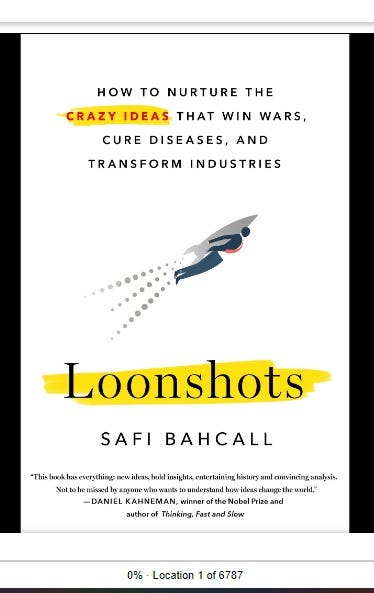
The author Safi Bahcall certainly knows a lot about innovation. He co-founded a biotechnology company Synta Pharmaceuticals and served as its CEO for 13 years. In 2011 he worked with President Obama’s Council of Science Advisors on how to transform the future of US science and technology research.
Crazy moonshots for innovation = Loonshots!
In this book, the author puts forth his business concepts using case studies of prominent companies. For example, Facebook is a billion-dollar empire, while a similar but earlier site called Friendster disappeared into oblivion. Polaroid CEO dismissed the concept of digital cameras despite being personally involved in secret government projects that used the underlying technologies!
Some other interesting points made by the author:
- Bahcall advises against the usual startup notion of ‘fail fast and pivot’.
- Usually, innovative recipes are touted to be the creation of a single person! However, the author stresses the importance of teams, and org structures that can support its implementation. Innovation magic happens when ‘creatives’ and ‘soldiers’ collaborate in harmony. The author suggests that corporations should create teams where ‘soldiers’ are given scope for creative work, while artists are asked ‘hard’ business questions!
- Although the book cites mostly tech examples, the principles are equally applicable to any business that wants to further innovation and R&D.
Personally, I felt that the book ‘Think Like a Rocket Scientist’ helps foster innovation for individuals while this book helps you gain better synergy as a team! My thoughts on the book can be found here:
Conclusion
If you have ever worked in a company or team where innovation seems stilted due to risk aversion, this book is excellent to try new ideas while balancing risk appetites!