
Uncertainty rules the world
Crashing and Crushing
Most guy event ever conceived
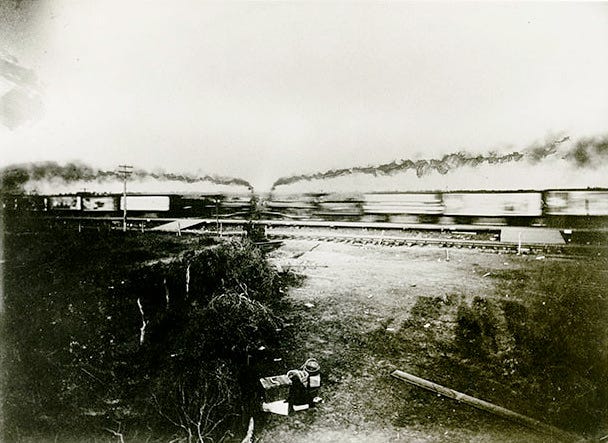
Remember electric trains? Lionel? American Flyer? Like Pugsley played with on The Addams Family?
Pugsley had it best. He got to do, with the full connivance and approval of his dad, what me and my friends in the electric train owning set could only dream of — deliberately crash his trains. We loved to crash our trains, but we had to work deniability into our crashes. They had to be explainable as simple mishaps. Thus, they compared to Pugsley’s masterwrecks as a sparkler to a fireworks display.
As I have explained elsewhere, as a child, I also had real trains to play with.
I do not recommend obtaining actual trains for your children to play with, even if in the service of their intellectual development. However, no one wonders at it if a railroad company has actual trains to play with. It’s part of what it means to be a railroad company.
The Missouri-Kansas-Texas Railroad Company — aka M-K-T or “Katy” had a few disused, out-of-date locomotives lying about. Katy Passenger Agent William George Crush had an idea: What could be more American than squeezing out one last dollar before casting them into eternal damnation in the scrapyard?
People have always loved spectacle — otherwise we’d miss out on movies like Ben Hur — and will always love spectacle. Late 19th century Americans were no exception. Crush proposed crashing two locomotives into each other at full speed. Attendance would be free, but the train ride to the event would cost. There was no other way to get to the site of the event — the specially created town of Crush, Texas — than the M-K-T railroad. It would be a good way to promote the M-K-T equivalent of the Ameripass.
The 40,000 spectators — 15,000 more than anticipated — would require food and amusement. Good old American enterprise provided eateries, cigar stands, medicine shows, game booths, and a carnival midway.
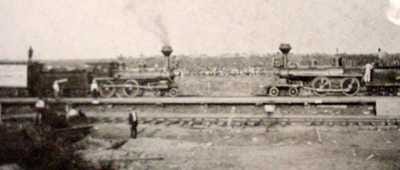
Spectators were crammed on a hill 200 yards away. Journalists were allowed within 100 yards.
Engineers determined this would provide a sufficient margin of safety.
Following the photo op shown above, the trains were backed up to opposite ends of the four mile special, disconnected track. Operators then started the trains — one locomotive + three or four boxcars covered with gaudy advertisements — and then jumped off to safety. There were now two runaway trains on a certain collision course, each traveling at about 50MPH. What could possibly go wrong?
As you may recall,
Engineers determined this would provide a sufficient margin of safety.
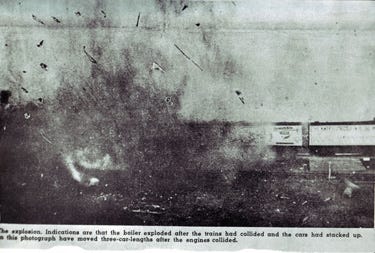

Just as the dust from the crash was setting, even before the spectators had a chance to absorb the majesty of it all, both locomotive boilers exploded, blasting metal chunks up to the size of drive wheels into the air. Two people were killed and at least six were seriously injured, which isn’t funny.
Crush was fired then rehired the next day when the company realized his marketing genius. He worked 57 years into a peaceful retirement.
Despite — or more likely, because of — the carnage, staged locomotive collisions became a staple of American entertainment, lasting into the 20th century.
I love America!
Special thanks to Amy Sea for editing.
Historical sources:
More laughs from BOFace
Even more laughs from some of my favorite people
Before I go, can someone please tell me why my email link displays with my custom message, while my subscription link displays the stock Medium message despite my having updated and saved a new version?