avatarNayanika Saikia

Free AI web copilot to create summaries, insights and extended knowledge, download it at here

5511

Abstract

t and gender norms merge in the story ‘The Day That Dusked at Dawn’ where a women’s agency and choice comes to the fore — as a leader and an active participant in the conflict.</p><p id="975a">The AFSPA (Armed Forces Special Powers Act) has been in power since 1958 and with recent happenings in Nagaland, the increasing demand for the repealing of this ‘draconian law’ is reflected in many of the works here.</p><h1 id="9dc4">The Language Question</h1><p id="b518">There was a small glossary of the native words used, towards the back. It was really interesting to know what they meant, but what I found most undoubtedly significant was the use of Manipuri words themselves (without translating) in the English used. This seamless merging was stunning but in terms of deliberate leaving of words as they were, was an important act — a retaining of the culture as it were.</p><h1 id="0daf">My Favourite Segments</h1><p id="ba27">Some of my favourite pieces from this whole collection are:</p><ol><li>“The Journey of Women’s Writing in Manipuri Literature” by Nahakpam Aruna (Essay)</li><li>Girls Hostel, by Binodini (Short Story)</li><li>Adornments, by Ayung Tampakleima Raikhan (Poem)</li><li>Where is a Daughter’s Home? by Sanjenbam Bhanumati (Poem)</li><li>The Crimson Tide, by Nepram Maya (Short Story)</li><li>My Children’s Photographs, by Ningombam Satyabati (Short Story)</li><li>Torch Warriors, and, Don’t Wait, by Toijam Sarojini Chanu (Poems)</li><li>The Skin of a Woman, by Natalidita Ningthoukhongjam (Poem)</li></ol><h1 id="009f">Verdict</h1><p id="3235">This was another book I am glad to have read. It has made me wiser (in regards to the political issues and how the citizens see them, as opposed to how they are portrayed by the government or by media), and therefore made me more empathic. And having read this book, I have to convince you to read it too.</p><p id="7d08">I am very glad I read it and I hope you too will consider picking it up soon! If you are interested in participating in this reading challenge along with me, simply comment below, or reach out to my <a href="https://www.instagram.com/readwithnika_bookclub/">book club’s Instagram page</a>.</p><p id="3543">Following is the list of all the reviews I have written for the books I read from the 8 Northeast Indian states:</p><div id="cc03" class="link-block"> <a href="https://baos.pub/the-inheritance-of-words-writings-from-arunachal-pradesh-dbe908fc8e65"> <div> <div> <h2>The Inheritance of Words: Writings from Arunachal Pradesh</h2> <div><h3>Of literatures, old and new, from Northeast India</h3></div> <div><p>baos.pub</p></div> </div> <div> <div style="background-image: url(https://miro.readmedium.com/v2/resize:fit:320/1*gANNwsbL-5lrwRPZ0-MJyg.jpeg)"></div> </div> </div> </a> </div><div id="3918" class="link-block"> <a href="https://baos.pub/literature-from-northeast-india-the-legends-of-pensam-5ef93b7e864b"> <div> <div> <h2>Literature from Northeast India: ‘The Legends of Pensam’</h2> <div><h3>Mamang Dai’s guide into the misty lands of the Adi tribe of Arunachal Pradesh</h3></div> <div><p>baos.pub</p></div> </div> <div> <div style="background-image: url(https://miro.readmedium.com/v2/resize:fit:320/1*IJwRCCnNsqHHu114IIlaVA.jpeg)"></div> </div> </div> </a> </div><div id="6aaf" class="link-block"> <a href="https://baos.pub/a-forgotten-history-of-assam-11d6f265a301"> <div> <div> <h2>A Forgotten History of Assam</h2> <div><h3>On ‘Chinatown Days’, originally ‘Makam’, by Rita Chowdhury</h3></div> <div><p>baos.pub</p></div> </div> <div> <div style="background-image: url(https://miro.readmedium.com/v2/resize:fit:320/1*cCeNMGDoMZfSOKa1M5lv4A.jpeg)"></div> </div> </div> </a> </div><div id="4ebf" class="link-block"> <a href="https://baos.pub/crafting-the-word-writings-from-manipur-e848e0da2fc4"> <div> <div> <h2>Crafting the Word: Writings from Manipur</h2> <div><h3>Women, morality, patriarchy, and the act of writing</h3></div> <div><p>baos.pub</p></div> </div> <div> <div style="background-image: url(https://miro.readmedium.com/v2/resize:fit:320/1*lzEPCGe2JoL1Zku_dFloRw.jpeg)"></div> </div> </div> </a> </div><div id="f2fb" class="link-block"> <a href="https://baos.pub/the-heart-and-all-its-mysteries-7f956872d24b"> <div> <div> <h2>The Heart and All Its Mysteries</h2> <div><h3>The Nine Chambered Heart, by Janice Pariat (Meghalaya)</h3></div> <div><p>baos.pub</p></div> </div> <div> <div style="background-image: url(https://miro.readmedium.com/v2/resize:fit:320/1*13iCLrUytlNAOXBKok_nXg.jpeg)"></div> </div> </div> </a> </div><div id="3f23" class="link-block"> <a href="https://baos.pub/literature-from-mizoram-mizo-songs-and-f

Options

olk-tales-ee7ab68ff1a9"> <div> <div> <h2>Literature from Mizoram: ‘Mizo Songs and Folk Tales’</h2> <div><h3>Thoughts on an anthology by Laltluangliana Khiangte</h3></div> <div><p>baos.pub</p></div> </div> <div> <div style="background-image: url(https://miro.readmedium.com/v2/resize:fit:320/1*BpI9ilJEJVqvSQKi67LfPw.jpeg)"></div> </div> </div> </a> </div><div id="1bcb" class="link-block"> <a href="https://baos.pub/literature-from-nagaland-the-last-light-of-glory-days-6f4566bddc76"> <div> <div> <h2>Literature from Nagaland: ‘The Last Light of Glory Days’</h2> <div><h3>Stories from Nagaland, by Avinuo Kire</h3></div> <div><p>baos.pub</p></div> </div> <div> <div style="background-image: url(https://miro.readmedium.com/v2/resize:fit:320/1*L2GnISurLGDZSCNdXUsYOw.jpeg)"></div> </div> </div> </a> </div><div id="e4b4" class="link-block"> <a href="https://baos.pub/boats-on-land-by-janice-pariat-533699ec6a96"> <div> <div> <h2>‘Boats on Land’, by Janice Pariat</h2> <div><h3>My thoughts on this short story collection from Meghalaya, Northeast India</h3></div> <div><p>baos.pub</p></div> </div> <div> <div style="background-image: url(https://miro.readmedium.com/v2/resize:fit:320/1*q0hd-td2zMvW2g8PcPnRyw.jpeg)"></div> </div> </div> </a> </div><div id="c530" class="link-block"> <a href="https://baos.pub/literature-from-mizoram-zorami-93cb5507398e"> <div> <div> <h2>Literature from Mizoram: ‘Zorami’</h2> <div><h3>The first Mizo novel in English, by Malsawmi Jacob</h3></div> <div><p>baos.pub</p></div> </div> <div> <div style="background-image: url(https://miro.readmedium.com/v2/resize:fit:320/1*vOhqtsoMwNFbPtNltvmKHw.jpeg)"></div> </div> </div> </a> </div><div id="28c4" class="link-block"> <a href="https://baos.pub/literature-from-nagaland-a-terrible-matriarchy-7d07c2b185d"> <div> <div> <h2>Literature from Nagaland: 'A Terrible Matriarchy'</h2> <div><h3>Easterine Kire's novel, first published in 2007</h3></div> <div><p>baos.pub</p></div> </div> <div> <div style="background-image: url(https://miro.readmedium.com/v2/resize:fit:320/1*k620PLGSERfZbQKfhgFWWQ.jpeg)"></div> </div> </div> </a> </div><div id="db6e" class="link-block"> <a href="https://baos.pub/literature-from-meghalaya-neti-neti-878ea822d858"> <div> <div> <h2>Literature from Meghalaya: ‘Neti, Neti’</h2> <div><h3>By Anjum Hasan, on Identity and the Motherland</h3></div> <div><p>baos.pub</p></div> </div> <div> <div style="background-image: url(https://miro.readmedium.com/v2/resize:fit:320/1*eABTX3tl2qA-hNuGFdyGWQ.jpeg)"></div> </div> </div> </a> </div><div id="af40" class="link-block"> <a href="https://baos.pub/literature-from-nagaland-laburnum-for-my-head-496f7fd3ecc3"> <div> <div> <h2>Literature from Nagaland: ‘Laburnum for My Head’</h2> <div><h3>Short stories by Temsula Ao, winner of the Sahitya Akademi Award 2013</h3></div> <div><p>baos.pub</p></div> </div> <div> <div style="background-image: url(https://miro.readmedium.com/v2/resize:fit:320/1*b8tZIoD_wSj5tTqVCadmTQ.jpeg)"></div> </div> </div> </a> </div><div id="d148" class="link-block"> <a href="https://baos.pub/literature-from-assam-a-novel-a-journal-and-a-short-story-collection-cfe483c43c01"> <div> <div> <h2>Literature from Assam: A Novel, A Journal and A Short Story Collection</h2> <div><h3>Reading Jahnavi Barua, Indira Goswami and Arupa Patangia Kalita</h3></div> <div><p>baos.pub</p></div> </div> <div> <div style="background-image: url(https://miro.readmedium.com/v2/resize:fit:320/1*1tHE1FddUafeO6pvKh8fuQ.jpeg)"></div> </div> </div> </a> </div><p id="30bf"><i>Nayanika Saikia graduated summa cum laude with a Bachelor’s degree in English Literature and was also a Dean’s List student. She is currently pursuing her Master’s degree and is also a Booktuber and Bookstagrammer. She can often be found on her Instagram account <a href="https://www.instagram.com/pretty_little_bibliophile/">Pretty Little Bibliophile</a>.</i></p><p id="a028"><i>You can support her by <a href="https://ko-fi.com/prettylittlebibliophile">Buying Her a Coffee</a> or by using her <a href="https://nayanikasaikia.medium.com/membership">Referral Link</a> while getting a Medium membership!</i></p></article></body>

Crafting the Word: Writings from Manipur

Women, morality, patriarchy, and the act of writing
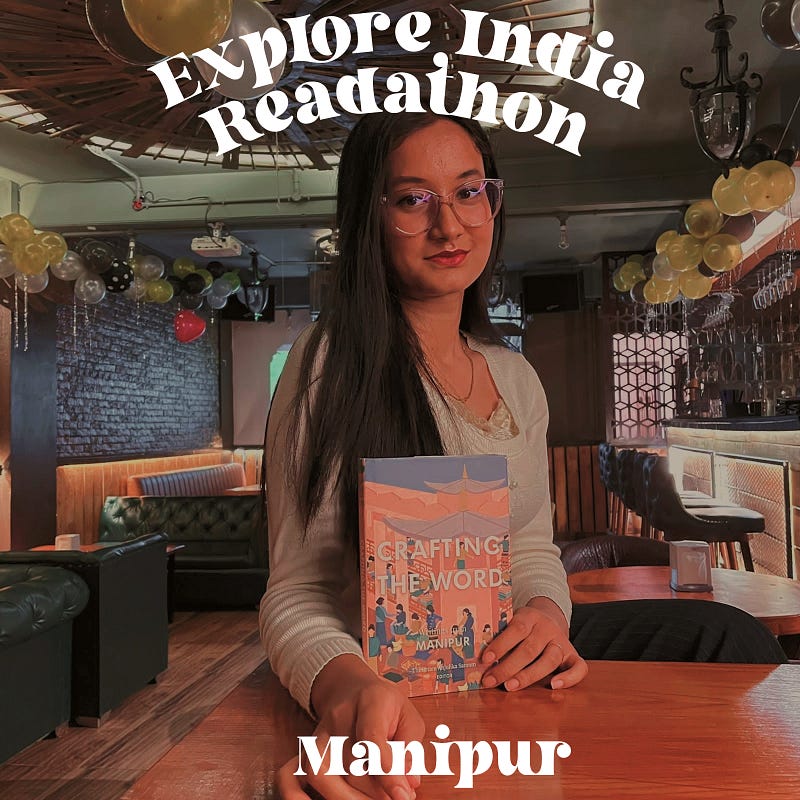
Image by the author

Back when I first started my reading challenge of reading a book each from every state and union territory of India, I had no idea that it would become such a fulfilling and profound experience even about three months in.

In November, my goal for the Explore India Readathon was to read a book from the northeastern state of Manipur. I had previously read books from Assam and Arunachal Pradesh and had alphabetically moved on to M. As was the case in October, in November too, I decided to pick up an anthology of works rather than one complete novel or any such concrete work by just one author. I believed that this would expose me to the various voices that emerged from a state and therefore give me a chance to come across more literature from a state/region that had already been put on the back burner for so long.

And so, I picked up Crafting the Word, a collection of writings by women writers of Manipur. It was edited by Thingnam Anjulika Samom. Here is a short synopsis from Goodreads:

Manipur has a rich tradition of folk and oral narratives, as well as written texts dating from as early as in eighth century AD. But it was only in the second half of the twentieth century that women began writing and publishing their works. Today, women’s writing forms a vibrant part of Manipuri literature, and their voices are amplified through their coming together as an all-woman literary group. Put together in discussions and workshops by Thingnam Anjulika Samom, Crafting the Word captures a region steeped in conservative patriarchy and at the center of an armed conflict. It is also a place, however, where women’s activism has been at the forefront of peace-making and where their contributions in informal commerce and trade hold together the economy of daily life.

Contributors: Dr Arambam Ongbi Memchoubi | Dr Aruna Nahakpam | Ayung Tampakleima Raikhan | Bimabati Thiyam Ongbi | Binodini | Chongtham (o) Subadani | Dr Chongtham Jamini Devi | Guru Aribam Ghanapriya Devi | Haobam Satyabati Khundrakpam ongbi | Dr haobijam Prema Chanu | Dr Koijam Santibala | Kshetrimayum Subadini | Kundo Yumnam | Dr Lairenlakpam Ibemhal | Moirangthem Borkanya | Mufidun Nesha | Natalie Nk | Nee Devi | Dr Nepram Maya Devi | Ningombam Sunita | Ningombam Surma | RK Sanahanbi | Sanatombi Ningombam | Sanjembam Bhanumati Devi | Satyabati Ningombam | Tonjam Sarojini Chanu | Yuimi Vashum

You can check out the review I made for this book here:

First Impressions

What I love about these anthologies brought out by Zuban is how very diverse they are. Just like The Inheritance of Words, Crafting the Word too was a delightful collection of words from across various genres — poems, non-fiction essays, fictional pieces, as well as a graphic narrative.

One of the issues I had with the previous book that I just mentioned, was how an important nonfictional historical piece was placed towards the end when it would have done much better as a starting point for the readers, had it been placed first. That was not the case with Crafting the Word. The introduction by the editor Thingnam Anjulika Samom, followed by the essay “The Journey of Women’s Writing in Manipuri Literature” by Nahakpam Aruna, served as very informative, providing interesting revelations, especially by letting the reader understand the background of the experiences that the writers were writing from.

The Woman Question (and other questions)

Manipur is very famous for Ima Keithel, or the Nupi Keithel — the market run wholly by women, so much so that it is a tourist attraction spot today. But behind all of it, patriarchy still is dominant in the state and some of the works in this collection definitely address that. Female desires, gender relations, power structures within personal spaces as well as the merging of the personal and the political — all of it is explored brilliantly in this collection.

The Political and the Historical

The ongoing armed conflict in the state is also explored in this collection. The stories and the poems are often harsh and portray a raw picture of life through the emotions of a mother, of women who lose everything, etc. These writers have put in their hearts and soul in rendering the truth within the written word.

Conflict and gender norms merge in the story ‘The Day That Dusked at Dawn’ where a women’s agency and choice comes to the fore — as a leader and an active participant in the conflict.

The AFSPA (Armed Forces Special Powers Act) has been in power since 1958 and with recent happenings in Nagaland, the increasing demand for the repealing of this ‘draconian law’ is reflected in many of the works here.

The Language Question

There was a small glossary of the native words used, towards the back. It was really interesting to know what they meant, but what I found most undoubtedly significant was the use of Manipuri words themselves (without translating) in the English used. This seamless merging was stunning but in terms of deliberate leaving of words as they were, was an important act — a retaining of the culture as it were.

My Favourite Segments

Some of my favourite pieces from this whole collection are:

  1. “The Journey of Women’s Writing in Manipuri Literature” by Nahakpam Aruna (Essay)
  2. Girls Hostel, by Binodini (Short Story)
  3. Adornments, by Ayung Tampakleima Raikhan (Poem)
  4. Where is a Daughter’s Home? by Sanjenbam Bhanumati (Poem)
  5. The Crimson Tide, by Nepram Maya (Short Story)
  6. My Children’s Photographs, by Ningombam Satyabati (Short Story)
  7. Torch Warriors, and, Don’t Wait, by Toijam Sarojini Chanu (Poems)
  8. The Skin of a Woman, by Natalidita Ningthoukhongjam (Poem)

Verdict

This was another book I am glad to have read. It has made me wiser (in regards to the political issues and how the citizens see them, as opposed to how they are portrayed by the government or by media), and therefore made me more empathic. And having read this book, I have to convince you to read it too.

I am very glad I read it and I hope you too will consider picking it up soon! If you are interested in participating in this reading challenge along with me, simply comment below, or reach out to my book club’s Instagram page.

Following is the list of all the reviews I have written for the books I read from the 8 Northeast Indian states:

Nayanika Saikia graduated summa cum laude with a Bachelor’s degree in English Literature and was also a Dean’s List student. She is currently pursuing her Master’s degree and is also a Booktuber and Bookstagrammer. She can often be found on her Instagram account Pretty Little Bibliophile.

You can support her by Buying Her a Coffee or by using her Referral Link while getting a Medium membership!

Manipur
Reading
North East India
Northeast
Literature
Recommended from ReadMedium