
Crafting My Land Acknowledgement
A necessary first step in decolonizing myself.
Let’s face it. This is not a simple topic to tackle. How does a non-Indigenous Settler like myself respectfully craft a good Land Acknowledgement?
It’s not easy and by no means am I any kind of expert!
But I can tell you this.
As I continue my journey along this path of discovery and renewal, I’ve already experienced so many emotional pitfalls and upheavals that it’s hard to remember them all.
But it’s also been a superb learning experience! It’s caused me to think about and remember all kinds of past events in my history. And to start to uncover some of my own unconscious biases.
Does this sound like something you’re up for?
If so, come tag along with me. It isn’t something we can do in one simple 5-step program. I can’t put together a simple X-items checklist for us to know how good our progress is.
But I think if we do this with right mind and right intentions in a good way, we will know that we are on the path and moving toward our ultimate destination. Personal decolonization and reconciliation.
Will there be any way of knowing if we’re headed in a good direction?
I think we have a very simple test; just answer this question. Does it feel right and do other people feel connected to you? Especially Indigenous people with whom you would like to engage.
I also know that this isn’t going to be a short, one-off article. By its very nature, it will happen in stages. Let’s think of these stages as mountain peaks or viewpoints along a trail and see how many we encounter along the way.
I’ve listened to a lot of webinars, read books and articles, and asked Indigenous people how I might best proceed along this path. All these initial efforts have given me some idea of how to get started and to do it with authenticity, empathy, and integrity.
Let’s start with Land Acknowledgements. These are becoming more common in Canada, where I reside. And in more and more situations, it’s a required form of introduction before the conversation begins.
My Old Land Acknowledgement
At first, I thought just doing a simple Land Acknowledgement was enough. DOH!
After a few efforts along that line, I realized I wasn’t doing a very good job with my Land Acknowledgement. I was sharing some basic location facts but not much more. This was my “beginner’s” Land Acknowledgement.
“Hello, I'm a white settler and my name is Rich Sobel. I live, work and play in the city of ……. which is on the unceded, ancestral territory of the ……. (I list the nations here). I thank them for their ongoing stewardship of this land and for letting me reside here.”
Sounds like it should be ok, right?
Not really.
It’s basically a 15-second elevator speech Land Acknowledgement and I don’t even think that it suffices for that anymore.
You might say, “What’s the problem here? What is it lacking? What is wrong with it?”
Simply put, it’s superficial.
To start, it gives no sense of who I am. Am I merely a white settler? Personally, I find that to be a kind of reverse racist way of viewing myself. And it tells nothing about me. Just the colour of my skin. And that I live in a place.
If I’m to say anything about myself and give some sense of who I am, there needs to be more than that.
I was recently told that in traditional Land Acknowledgement greetings between two individuals from different First Nations, it is common to give a bit of background as to your own personal lineage. Who you’re related to; Parents, Aunts, Uncles and where you and your people live.
Do you see any of that in this statement:
“Hello, I’m a white settler and my name is ….. I live, work and play in the city of ……. which is on the unceded, ancestral territory of the ……. (list the nations here). I thank them for their ongoing stewardship of this land and for letting me reside here.”
Just a couple of gnawed off bare bones. I’m a white settler, and I live in such and such a place.
No sense of my history, my family or who I am.
So for the rest of this “chapter”, I’m going to explore that with you and you can see if that helps me/us to be more authentic.
Some Personal History
I was born in New York City and my family lived in Nassau County on Long Island.
When I was still very young, in 1st grade if I remember correctly, we moved a bit further East into Suffolk County. We stayed there until I was entering my 3rd year of high school when we moved back to Nassau county. By then I was the oldest of 4 children.
I graduated from high school and went to a college in Iowa where I promptly failed out. We’re talking hippy days here, folks, and I was having, well, a lot of fun!
Eventually, that wore thin and I returned home to my parents’ house. I very quickly got a job and started back to night school at Nassau Community College. I also got my own apartment a few blocks away from my parent’s home. And that was the beginning of my living independently.
After a couple of years and part-time attendance at the local community college, I applied to and was accepted as a full-time student at the State University of New York College of Environmental Science and Forestry.
Two and a half years later I graduated with a degree in Forest Botany and Pathology and proceeded to play in a folk music band for the next 13 years. During that time we recorded 3 albums for small independent labels. I played gigs all over the Northeast and some of the major folk festivals. We even played on the Garrison Keillor’s Prairie Home Companion show. That was a highlight!
About 10 years into playing music, I realized I missed my biology “mind” and after working at a few entry-level technician jobs, I maneuvered my way back into graduate school at Syracuse University where I eventually succeeded in getting my Ph.D. in cell and molecular biology in 1996.
I never stopped playing music, I just downgraded it to a part-time professional hobby. I still play gigs with my band, The Sybaritic String Band; fiddle, mandolin, djembe and some harmonica when the urge strikes. And I keep pretty good rhythm accompaniment with my feet!
I moved to Vancouver, British Columbia, Canada to do a post-doctoral fellowship at the University of British Columbia. That was in late 1995 and I was 46 years old!
I remained in the metro-Vancouver area as a molecular biology scientist and did prostate cancer research for almost 8 years. After that, I left the world of laboratory bench scientists and entered the world of project management and grant facilitation. I also teamed up with some other former post-doc colleagues to help with their Biotech start-up, Fusion Genomics, which is still going strong, but which I have since retired from.
This brings us to the present.
Shortly after I retired, I found I wanted to give back to the world and looked for volunteering opportunities. I found the BC Patient Voices Network and became a patient partner volunteer.
That volunteering led me to a part-time position as a Research Navigator for the BC SUPPORT Unit Fraser Centre, a position I have held for more than 2 years. It will end this Spring.
My job with the Fraser Centre was to encourage academic and clinical health researchers to include patients as partners on their research team. In this role, I had a fair amount of interactions with people involved in Indigenous Health Research.
And that’s when this need for a Land Acknowledgement that preceded conversations arose.
So as part of my professional development, I was entered into the San’yas Indigenous Cultural Safety Training Program. And that’s where I began this journey of self decolonization and developing my Land Acknowledgement.
Okay, now you have some sense of who I am. Not everything — I haven’t even talked about my marriages and daughter! — but a nice, short background.
Putting the “me” in my Land Acknowledgement
How can I best summarize all this to have my Land Acknowledgement give more of a personal sense of who I am?
I’m not sure. Remember I said this decolonization effort is a life-long journey. Still, let’s give it a go.
How about this for my first couple of sentences?
Hello, my name is….. and my pronouns are he, him, his. I’ve been a research scientist and musician and currently work on a team to support and promote patient-oriented research to improve patient healthcare.
I think that is starting to sound very much like who I am and what I currently do.
It’s personal, authentic, and has a nice positive strengthening energy feeling to it. And I’ve taken myself out of that box of merely a “white settler”. As I said above, yes, I am a settler and yes, I am white but those are in some sense superficial adjectives. And there is no positive energy associated with either of them.
What else might I add?
I think this part is still pretty good; I live, work and play in the city of ……. which is on the unceded, ancestral territory of the ……. (list the nations here). I thank them for their ongoing stewardship of this land and for letting me reside here.”
But as I think about it, if I want to be true to the Indigenous perception of me, then I have to include that I am, in fact, a settler. So maybe I can say, “I’ve settled, work and play….”
Ok, so why did I settle here?
Ah, that lets me share another deep part of me; I love being in mountains and being near the ocean. I first saw the mountains around Vancouver, BC, on a seminar tour I arranged to promote myself as a post-doctoral candidate looking for the perfect research lab to continue my studies. I had given a talk in Seattle and had one scheduled at a lab in the University of British Columbia. I opted to rent a car and drive there. It was late Fall, the sky was blue and the mountains were covered in snow. It was love at first sight. I said to myself “if the lab is even half as good as these mountains are beautiful, this is where I want to be!” It was and that’s where I started the next phase of my career.
So maybe I should say that I settled in British Columbia because I fell in love with the mountains and ocean here and never left.
How about this? “I live work and play in the city of ….which is on the unceded, ancestral territory of the…. I settled here because I love venturing in mountains and exploring seashores and BC has a lot of both!”
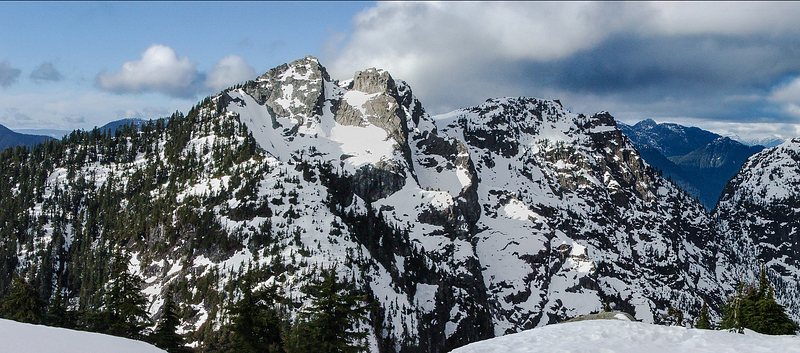
Here’s one of my photos from a snowshoe trip a few years ago. Peruse my Flickr photostream and you’ll see a lot more!
Anything else I should include?
It depends on the situation. If time is not an issue, I could say a bit more about my ethnic ancestry and cultural and spiritual heritage.
But for now, I think I’ve got some of the basics covered
- It tells a succinct story about who I am and why I settled here
- It’s friendly and has a strong positive feel to it.
- It shows respect to the First Nations whose land I’m currently settled on
- And I don’t think that it’s too long.
Hello, my name is Rich Sobel and my pronouns are he, him, his. I’ve been a research scientist and musician and currently work on a team to support and promote patient-oriented research to improve patient healthcare.
“I live work and play in the city of ….which is on the unceded, ancestral territory of the…. I settled here because I love venturing in mountains and exploring seashores and Southwestern BC has a lot of both!”
Here’s what I might add about my cultural and spiritual heritage.
“My ancestors were Jewish immigrants that came to the USA in the late 19th and early 20th centuries both to escape anti-semitism in Slavic and European nations and to improve their economic opportunities. Although raised as a cultural and ethnic Jew, I ultimately found that I was atheistic. I nourish my spirituality as a practicing Zen Buddhist for the past 30+ years and deeply feel that all life on this planet is intimately connected to each other. All life.”
I think this is a good start for my Land Acknowledgement needs at this moment in time. In a few years, it might be completely different. But I think I can live with this for now.
So that’s one of the first steps in my personal journey to decolonize and reconcile myself.
I’d love to hear your comments and/or have you share your Land Acknowledgement in the comments.
And if you’d like more guidance, here’s an excellent series of webinars if you want to really dive in and learn more about Land Acknowledgements.
I look forward to having you join me on my next steps toward decolonizing myself.
Until later,
Rich


