
Crafting Emotions with Arcs and Dominoes
Using feelings to lead a character toward change
A few days ago, I was mindlessly scrolling Facebook, wasting time, when I found a very old post recirculating, one about advice kids would give to their younger selves. It was far from the first time I’ve read it, but this time, a specific piece of advice stood out to me:
Don’t let your mom brush your hair when she’s mad at your dad.
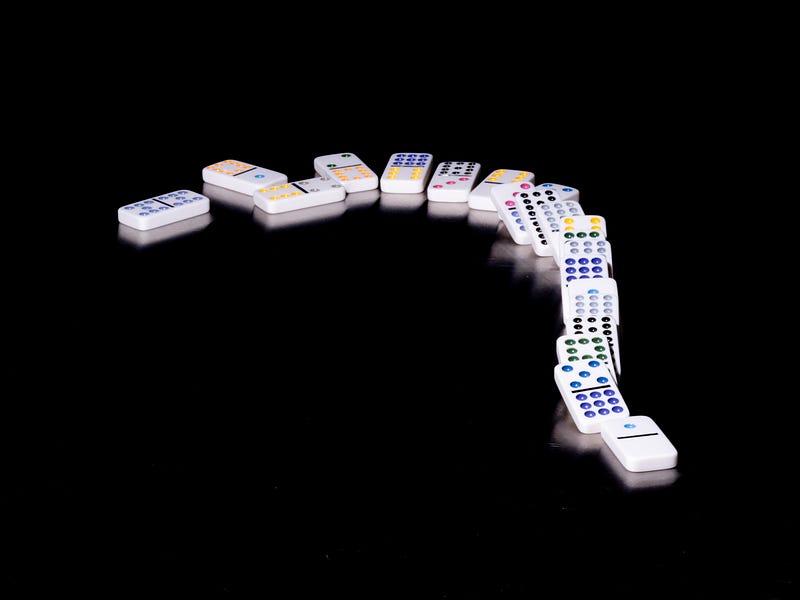
That child had figured out a concept that evades a lot of writers, one that’s called emotional dominoes by Susan Dennard. Almost a decade ago, Dennard wrote about it on the now-nonexistent Publishing Crawl blog. I draw on it, and K.M. Weiland’s work on emotional arcs, routinely when editing.
Let’s look at each of these concepts separately, and then how they combine to create a seamlessness to a story, even across subplots.
Emotional Dominoes
The idea of emotional dominoes comes down to one thing: what happened in the previous scene affects how the character feels in the current scene.
That is, if I just got a bill that’s twice as much as I thought it would be, and I’m on the way to meet my best friend at an expensive nail salon, the mood I left the house in will carry over to how I feel getting that manicure.
Or if I just got in a fight with my husband and now I’m brushing my daughter’s hair, well, the kid above said it best. It’s maybe not a good time to be brushing her hair.
Maybe it seems obvious when I write it out with real-life examples. But what about in fiction? Having emotions domino well can be especially tricky to get right as you move between subplots, but getting it right is part of what lends realism to your stories. None of us live separate subplots in a vacuum.
The conversation I had texting my friend while in a waiting room at a doctor is still on my mind when the doctor starts speaking to me. A bad day at work can affect the version of me my kids get when I pick them up a few minutes later.
But what about in books?
In Enchantress, Celeste and her love interest finally have an intimate moment together. Celeste leaves in the middle of the night, and in the morning is called to a meeting with her brother. When she arrives to his office, she’s thinking not about what her brother wants, but about what happened the night before:
She smoothed her gown and her hair, then pressed her lips together, trying to fold away the memory of all the places those lips had so recently been. Then she gathered her graces and knocked on the doors to the West Wing.
Even as he gives her an ultimatum about his own concern — the duke who wants his land — Celeste thinks almost entirely about the implications for her own relationship. That is, her emotions domino from the moment she had with her lover into this scene with her brother. They affect the decisions she makes, what she says, what she thinks. Everything is touched by this romance.
By the time the scene ends, Celeste has a plan and a timeline to enact it. But this is where her mind is:
The room became suddenly cold, as if a window had been left open in a storm. It should have felt better than this to have the last piece of her plan in place. Yet all Celeste felt was an emptiness every place Renee’s lips had touched, a wrongness in being apart from her that Celeste had excused as the dregs of their exploration together, residue that would wash away.
While this example of the feeling after a romantic moment is perhaps obvious, there are more subtle ways to make this happen. A wild party one night means a character must then go to work with a nasty hangover. A great presentation helps someone feel a little more sure of themselves when they go out to the bar. The snide remark from a mother-in-law that won’t relent even hours later when playing with the kids. An emotion doesn’t just disappear. It dominoes.
Emotional Arcs
Emotional dominoes are the key for stitching together disparate scenes and making them feel like they belong exactly in the order they are. But what happens after the emotion that starts a scene?
K.M. Weiland has the answer for that with her work on emotional arcs. While Dennard talks about the link from the end of one scene to the beginning of the next, Weiland’s focuses mainly on the emotional change within one scene.
She notes:
You can write a scene that’s perfectly structured in the classic scene, but if it lacks this emotional scene arc, it will still fall flat.
The article linked above talks about three reasons to have emotional arcs, and how they help with the reader’s emotions as well. These are 1. to avoid writing “on-the-nose” scenes that people expect; 2. to surprise your readers with the final emotional reveal; and 3. to ensure the emotions complement the scene structure.
Of her post, the advice that revolutionized my writing was this: if you know how a scene is supposed to end, make sure you start with its opposite.
I also apply that advice in reverse, using the concept of emotional dominoes: if you know how a scene is supposed to begin, be sure you are working toward its opposite.
I looked at this idea in detail in my full chapter rewrite, but let’s summarize it below.
An Arc of Dominoes
When I started rewriting a scene where Celeste takes a walk in the rose garden with her friend, and runs into her brother and her fiance while there, I had the emotional dominoes of a punishment her mother set out — she was feeling frustrated and confined — and had the scene shift into… just kidding. I didn’t. At the end she still felt frustrated, confined, and caught off guard.
I realized that lack of emotional shift was one of the biggest problems with that scene. I couldn’t change the ending emotion, because it was an important reveal. I needed her feeling powerless and frustrated by the time the scene was over. That meant I had to go back not only to the beginning of the scene, but to the dominoes from the previous one.
Before the punishment, Celeste had felt triumphant and powerful. Now that was a place for an emotional shift. So what I did was make it so that Celeste was nonplussed by her punishment and active in her goal, using the fact that she had to drag a young charge along with her as a reason to, essentially, go spy on her brother.
It’s all her idea. She’s the confident host… until her brother outmaneuvers her, and she’s left feeling frustrated, confined, and caught off guard.
Now we not only domino well from the last scene, but also have an emotional shift that pulls Celeste through.
Emotional Pinball
Another thing of note is that while in my scene, I had the problem of not enough shift in emotion, something I’ve encountered often at work is too many emotions. While an arc is good and a domino is ideal, playing emotional pinball can leave the reader more confused and less connected.
By emotional pinball, I mean cycling through emotions and changes so fast that none of them sink in.
If a character is mad at their mom because of a fight they had before school, then they’re elated when they sit by their crush in science class, then there’s a pop quiz, then their best friend publicly shuns them, then their crush laughs at them, then they get told they aced the quiz, and we’re only three paragraphs into a scene, it’s a problem.
We don’t slow down enough to relate to the character, to feel things with them and understand why they’re feeling what they’re feeling, and things are happening so fast we might quite literally lose the plot, too.
Most likely, if a scene is playing emotional pinball, it’s lacking the sequel part of scene structure. When talking about a sequel in this sense, it isn’t the second book; it’s the second part of a scene. There is the active part: the goal, the conflict, and the disaster. Then there is the reactive part: the reaction, dilemma, and decision.
Sequels don’t have to be long, but they do have to exist. They show us how a character reacts to a disaster. This helps deepen our understanding of them, and we feel their emotions deeply. It should be only once a decision is made about how to handle that information that the emotion can begin changing.
Perhaps a high schooler can have as bad of a day as I talked about a few paragraphs ago. But with that many emotions, it has to be slowed down, taking place as several mini-stories with their own arcs.
Then each emotion can domino once it’s been processed, instead of bouncing around like pinball.
Have you considered the ways emotions change in your scenes? Which of these concepts do you plan to implement in a revision?
If you like my work and would like to read more of it, consider joining Medium with my referral link to get full access to every article on Medium. Using my referral link doesn’t cost you anything extra, but half of the fee goes directly to supporting me each month.


