
Cracking the Google Associate Product Management (APM) Interview
How to differentiate yourself from 1000s of candidates.

The Google Associate Product Management (APM) program is one of the most prestigious and highly coveted positions in tech. There are only ~45 full time hires each year for over 8,000 applicants, an acceptance rate of ~0.56%. Put simply, do not take interview prep lightly. When I was going through the process, I did not leave my room for 45 days and did interview prep daily from 8am — 12am. Obviously that amount of prep was an overkill, but you should be aware that other candidates are working just as hard, if not harder, than you to get one of the few offers available.
Before diving into all of the tools and resources that I used to land my offers, I must preface this article by saying that your own preparation process should be tailored specifically to your learning style. Resources that were helpful for me may be a waste of time for you and vice versa. I made this mistake early on and tried to use every resource that I found on the internet to prepare. As a result, the majority of the time I spent preparing was not in the most efficient manner possible. If you’d like to learn more about my personal and professional background, or are interested in doing a mock interview, please reach out to me on Instagram or Twitter @angelonuoha7.
Now enough chatting, let’s dive into it.
The Google Interview Process
The Google APM interview process is broken down into four rounds.
1. Resume + Cover Letter Application
2. Phone Screen
3. Onsite Interview (5 interviews)
4. Final Round with an executive PM
Half the battle is actually getting the interview. I’d strongly recommend cold reaching out to people on LinkedIn and getting a referral. This is the most important thing that you’ll read today. With over 8,000 applicants, if you do not apply the day that the application opens with a referral, you can almost guarantee that your resume will not be seen. One interesting trick that I used was guessing the recruiter’s email from their LinkedIn page (search Google APM recruiter). Here’s a screenshot of the actual email that I sent in August 2020 (names are blurred out for privacy).
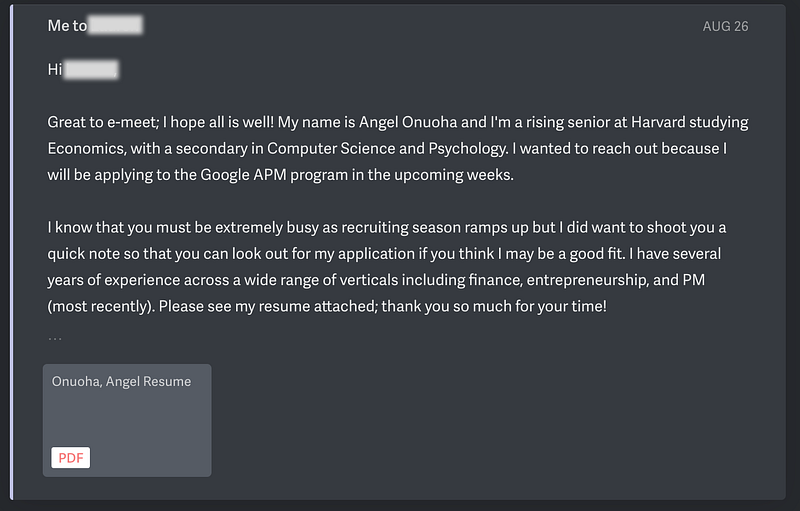
Notice how I didn’t ask for a phone call from the recruiter and used language such as “if you think I may be a good fit.” This was intentional because people are much more likely to respond positively when you shift the agency of decisions into their hands instead of making demands. From this cold email, the recruiter replied in less than two hours and offered to hop on the phone with me to share information about the early stages of the process and the application timeline. I repeated this process for four different companies and received positive responses + first round interviews at every single one.
“People are much more likely to respond positively when you shift the agency of decisions into their hands instead of making demands.”
The prep before the prep
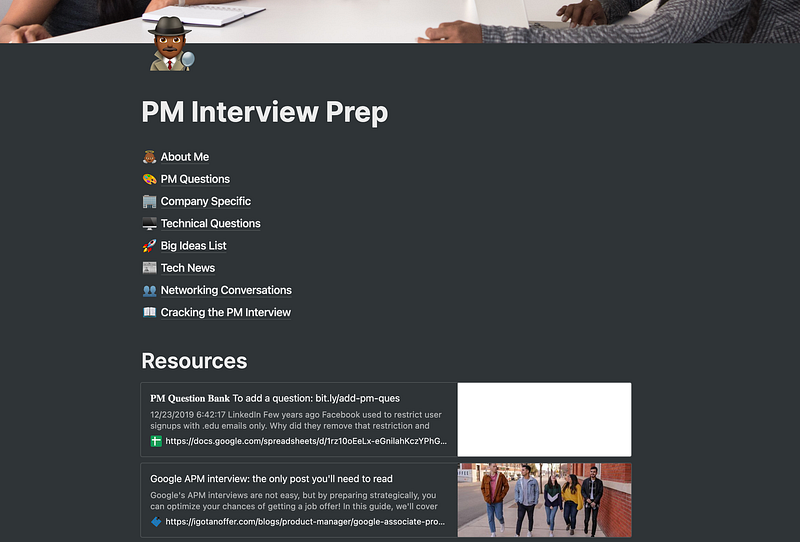
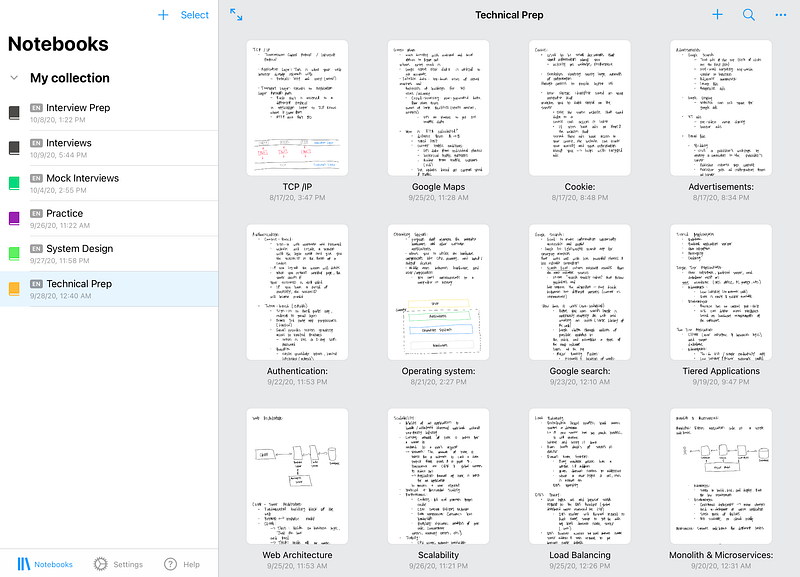
Tackling the interview process is arduous and seemingly mind boggling when you first begin. Before I started preparing, I spent ~1 week cold reaching out to current APMs on LinkedIn and setting up conversations to learn about the application process. This was one of the most impactful uses of my time. Not only did I get a referral, but I also built long-lasting relationships with future co-workers who guided me through the entire process. The best mock interviews that I had were all from current APMs. For organization, I used Notion and Nebo to create an all-encompassing study guide.
My Notion Pages:
My Nebo Pages:
Diving into the Interview Questions
Google APM interview questions can be broken down into six major categories: Product Design, Estimation, Behavioral, Technical, Strategy, and Analytical.
Product Design
The core responsibility of a Product Manager is to build new product features and to improve existing ones. Product design questions assess your ability to understand ambiguous problems, define goals, empathize with customers, identify pain points, brainstorm creative ideas, and measure success. This is the most frequent question type that you will get during the Google APM interview process. There are several frameworks that you can use to tackle these questions such as CIRCLES, BUS, UDR, etc. However, exceptional candidates leverage these existing frameworks to create something unique that differentiates themselves from others.
Example Product Design Questions:
1. What is your favorite product and why?
2. How would you improve Instagram Stories?
3. Design an alarm clock for blind people.
Estimation
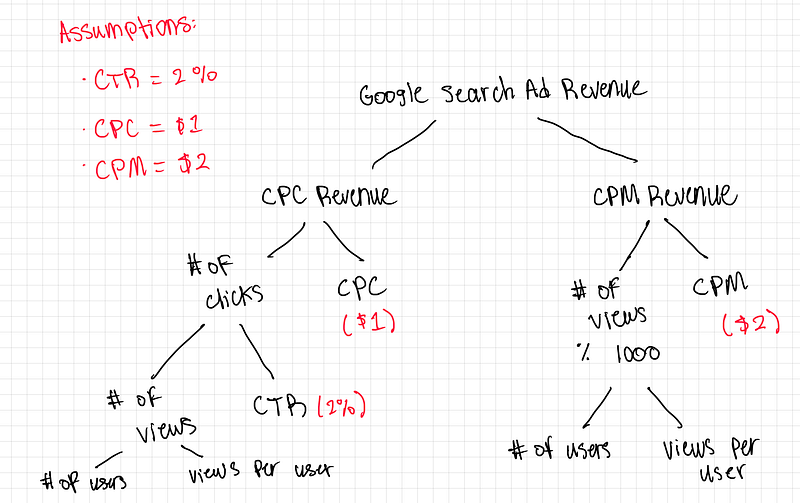
Estimation questions assess your ability to break down a large, undefined question into a series of manageable steps to arrive at a reasonable answer. These questions often require domain-specific knowledge, such as the average size of a smartphone image, and will test your mental math skills. Generally, interviewers are not interested in whether you arrived at the correct answer or not. Instead, they are testing whether you can communicate clearly, create a series of logical assumptions, and execute on simple calculations. Before doing any math, I’d strongly recommend first narrowing down the scope of the problem by asking follow-up questions, then creating a list of assumptions and an equation. Here’s an example of how I broke down the following estimation question: Estimate the Search Ad Revenue for Google.
Example Estimation Questions:
1. How much storage would it take to store all of the data on Google Maps?
2. Estimate the number of Gmail users in the U.S.
3. Estimate the total dollar amount of food delivery per year in NYC.
Behavioral
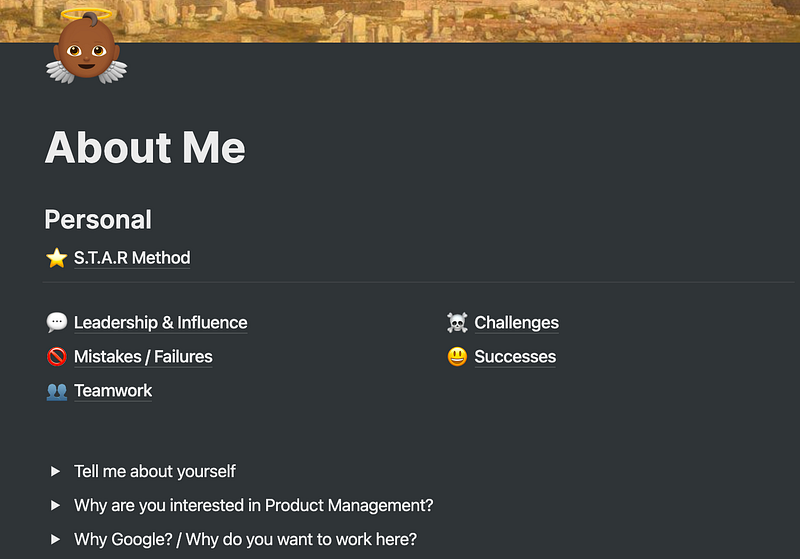
Behavioral questions are the easiest interview question types but should not be taken lightly. These are equivalent to free throws at the end of the game that can be the deciding factor between a win or a loss. These are the five major categories of questions for which you should be prepared: Leadership & Influence, Mistakes / Failures, Teamwork, Challenges, and Successes. There are a few frameworks that you can use such as the STAR method or DIGS. The best candidates are the ones who clearly communicate their responsibilities and impact and provide engaging stories (talk about how you prioritized making one decision over the alternatives). I’d strongly recommend creating a document of potential questions in each of these categories and memorizing a few prepared bullet points. Below is a screenshot of my Notion page in which I did exactly that.
Example Behavioral Questions:
1. Why Google? Why APM?
2. Tell me about a time that you resolved a conflict amongst a team.
3. Give me an example of a time that you’ve demonstrated leadership.
Technical
Google requires its APMs to be highly technical. I would guess that ~80% of new grad hires majored in Computer Science. In fact, if you have no technical experience you are almost guaranteed to not make it past the first resume screen. I majored in Economics at Harvard but taught myself how to code and built multiple apps through Udacity. Because PMs don’t code on the job, Google’s interview questions focus more on systems design. The only resource that I used to prepare for the technical interview was Grokking the System Design Interview.
Example Technical Questions:
1. Design a simple Load Balancer for Google.
2. How would you build a newsfeed for Facebook?
3. How would you write an algorithm for an elevator in a large building?
Strategy
Strategy questions assess your ability to understand a wide range of factors in building and launching product. This includes marketing, competition, pricing, market analysis, etc. These questions are typically used as follow-ups to the product design question. There are several frameworks for these types of questions such as the 5 C’s, SWOT analysis, and Porter’s Five Forces. In order to stand out, I’d strongly recommend creating custom frameworks that are tailored specifically to the question you are asked and interweaving company specific knowledge into your answers. For example, if asked about the future of cloud computing you could mention the strides that Google has made in Quantum Computing.
Example Strategy Questions:
1. Should Google get into the ridesharing market?
2. How would you launch a new product recommendation carousal for Amazon?
3. What is the biggest threat to YouTube?
Analytical
Effective product managers must define a set of primary and secondary metrics by which they will measure success. Analytical questions evaluate your ability to understand and define these metrics for a product, as well as investigate any major changes to a given metric. These questions are relatively straightforward and are extremely common. I’d recommend learning the HEART and GAME frameworks.
Example Analytical Questions:
1. If you were the PM for Lyft, what dashboard would you build to track the health of the app?
2. What metrics would you focus on as the PM of YouTube?
3. You’re the PM for Amazon and sales just dropped 7%. What would you do?
Last minute tips
As mentioned previously, there are only ~45 spots available for over 8,000 applicants. Thus, you need to figure out how to differentiate yourself. One of the best ways to do this is to practice making the interview as conversational as possible. This means that you should limit the number of silent breaks that you take to think about your answers. Instead, practice thinking out loud in a structured manner that is easy to follow. Additionally, when relevant, embed jokes and personal stories into your interview questions. This helps both you and the interviewer relax and leads to a favorable review of your overall performance.
“When relevant, embed jokes and personal stories into your interview questions.”
Practice makes perfect
Doing mock interviews is the best way to master your skills and is where you should spend most of your time preparing. Approaching each question with a predefined method or framework that you can expand upon will allow you to stand out amongst the crowd. When I first started, I would record myself answering practice questions and then review the recordings to learn how to enhance my communication skills. I then cold reached out to current APMs at Google on LinkedIn and asked for mock interviews. This was the single best decision that I made as experienced PMs have much better feedback than friends and peers. Finally, I spent most of my time doing mock interviews with the Lewis Lin Interview Practice Partner Community in order to get repetitions. This was particularly helpful because it gave me experience sitting in the interviewer seat and allowed me to understand the difference between a good and a bad answer. I did ~60 hours of mock interviews in total.
Perks of the Google APM program
- Tight knit community with your APM cohort (long-lasting relationships)
- Access to management coaching (from outside Google) and APM alumni
- 2-week trip to Google offices around the globe to learn about how technology is used in different geographies
- High annual compensation and numerous benefits
Resources that I used (Order: Most to least helpful)
(1) Mock Interviews (I did ~60 mock interviews)
- Lewis Lin Interview Practice Partner Community
- Exponent Practice Community
- Cold reaching out to current APMs on LinkedIn
(2) Preparation Courses
- Exponent (Highly Recommend)
- Product Alliance
- Grokking the System Design Interview (Technical Prep)
(3) Books
- Cracking the PM Interview (Highly Recommend)
- Swipe to Unlock
- Decode and Conquer
- The Product Manager Interview
- Cracking the Coding Interview (Systems Design Chapter)
(4) Online articles
That’s it. Good luck!!
Follow me on Instagram and Twitter @angelonuoha7 if you’d like to chat more about the process or do a mock interview!


