
Covid-19 Vaccines Are Still Effective
Debunking the “12% efficacy” viral myth
This piece is based on a fantastic investigation by Dr. Jeffery Morris that is worth reading and linked here.
Recently, the internet has been abuzz with a new and shocking claim. Apparently, the Pfizer vaccine was not as effective as the 95% we were sold on — in fact, people are claiming that it was barely effective at all. Dozens of tweets and articles have gone viral with this massive claim across the world.
This makes sense, because we are all deeply invested in the efficacy of Covid-19 vaccines. If true, this claim would have serious implications for our trust in the vaccines, and indeed governments across the world.
Fortunately, it is completely and utterly false. The claim is based on a very simple misreading of the documents, and some truly woeful science.
Let’s have a look at the data.
The Claim
The claim itself is quite hard to source. Despite dozens (if not hundreds) of viral tweets referencing information recently released from Pfizer’s data dump, it is surprisingly hard to track down where the idea actually originated. While people have indeed recently uploaded a huge number of documents relating to Pfizer’s clinical trials on vaccines — which is great, transparency from drug companies is a rare occurrence — after having a look at the files I could not find the claim anywhere. Many of these are massive PDFs simply documenting things like exclusion reasoning for patients in the trial, and despite searching I could not find any source for the claim.
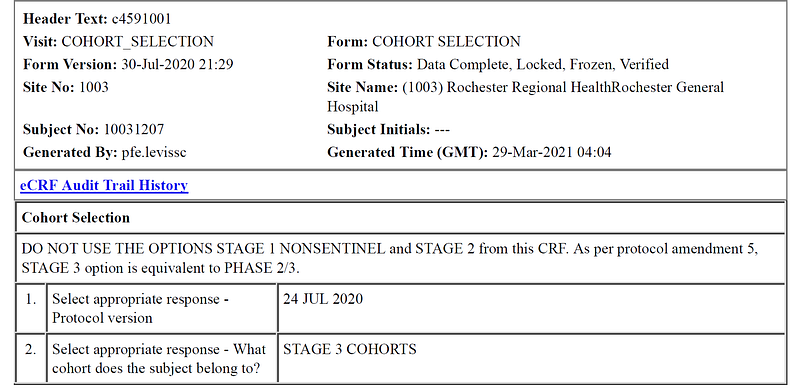
However, if you look at enough of the tweets, you do see a clear common source between them all. They often reference the same Substack post, which was published about a month ago, and seems to be the first place that this extraordinary claim was made.
This isn’t actually based on any recently released documents, but on an FDA briefing paper put online more than a year ago. Nevertheless, it seems to be where everyone is getting this false idea from. So as not to misrepresent the claim, I will repeat it here in full:
A key section buried within this document, which alludes to possibly the real VE at that time, is the following damning data below (found on page 42).

These were people showing actual symptoms. If you calculate the VE from these numbers, it’s a staggeringly low 12%!
VE is calculated by dividing the difference between the case numbers in the placebo and vaccine groups, by the case number in the placebo group x 100 = VE of 12 %
Now, this sounds very bad. A vaccine efficacy of only 12%, based on Pfizer’s own documents!
Luckily, this is based on a complete misreading of the Pfizer documentation. You see, the author has calculated this 12% efficacy based on what are called “suspected but not confirmed” Covid-19 cases. But these people by definition did not have Covid-19 at all.
The Science
If you carefully read through the clinical trial protocol and FDA documentation, which Pfizer publicly posted online in a fantastic display of transparency well over a year ago, it becomes obvious why the 12% figure is completely incorrect.
People who were considered “suspected” Covid-19 cases, as detailed in section 8.13 of the protocol, were those experiencing Covid-19 symptoms including:
“A diagnosis of COVID-19; Fever; New or increased cough; New or increased shortness of breath; Chills; New or increased muscle pain; New loss of taste/smell; Sore throat; Diarrhea; Vomiting.”
These people were encouraged to get a test, and see if they did indeed have a Covid-19 infection. Of those people, a small proportion tested positive, while the majority tested negative. The positive tests are where we get the 8 positives and 162 negatives that the true vaccine efficacy of 95% is based on, while 3,410 tested negative on PCR and were considered “suspected but unconfirmed”. What this actually means is that these people did not have a Covid-19 infection.
Indeed, the Pfizer documents confirm very strongly that in their clinical trial of the immunization, the vaccine had 95% efficacy on its primary endpoint of preventing Covid-19 infection.
Now, the author of the Substack post does not agree. They argue that, because PCR tests at high cycle thresholds do not always culture live virus, that the tests are highly unreliable and that “up to 97 % of positive results could be false positives” depending on how Pfizer ran their analysis.
However, this is a very basic misunderstanding of how these tests work. The issue is that PCR tests are too accurate, rather than not accurate enough. PCR is incredibly sensitive to any viral RNA picked up, and so may identify people even if they’ve already cleared the Covid-19 infection. Indeed, the paper cited by the author of the Substack post says exactly this — if you run PCRs at a high cycle threshold, you will capture people who no longer have live virus in their body.
But this isn’t a false positive by any medical definition — those with a high cycle threshold count but no live virus culture were almost always either recently infected with Covid-19 or are recuperating from an infection. In other words, they currently have Covid-19 or have very recently had the disease. It’s possible for PCRs to throw up false positives, but in most places the specificity of the test is far above 99.9%, meaning fewer than 1 in 1,000 people who don’t have Covid-19 will test positive to the disease on PCR.
Bottom Line
I’m not a huge fan of drug companies. They’re cagey with data, they fudge results to make themselves look better, and they have, in the past, done horrifyingly amoral things to further their own monetary interests.
I personally am strongly in favor of more openness in science, and a big step in the right direction would be forcing pharmaceutical companies to be more open about their clinical trials data generally.
However, it’s also important to be accurate. The facts simply do not support the assertion that Pfizer’s vaccine had a 12% efficacy in its primary analysis — the evidence shows that the shot prevented 95% of infections in the vaccinated group.
The many, many viral claims that the Pfizer vaccine is only 12% effective are, thankfully, completely and entirely wrong.


