
Humanitarian Affairs
Menacing Storms
How Might We Rise as a Storm Shelter for the Most Vulnerable?
Our world is rippling with crisis.
Our societies are ruptured by rampant instability, inequality and insecurity. Conflict and turmoil endlessly roil Yemen, Syria, Somalia, and other soil in Africa and the Middle East.
Infestations range from biblical hordes of locusts by the trillions devouring crops and threatening famines in wide swathes across East Africa, to the far less serious threat of so-called “Murder Hornets” in the Western United States.
Of course the ubiquitous CoronaVirus is writhing around the planet, lashing out at individuals, taking down economies, and overwhelming health systems in Asia, Europe and pockets of the Americas.
Even worse, Covid-19 portends unimaginable horror to be visited upon nations lacking sufficient resources to fight it, the robust health systems to tend to its targets, or the economic resilience at the household level to avoid sheer collapse.
For the first time this Century, the “World Poverty Clock” has ticked backwards. My colleagues in international development and humanitarian response arenas warn that decades of progress are in peril of being wiped off the map, along with the lives and livelihoods of millions.
The head of the World Food Program, David Beasley, has cautioned that upwards of 130 million additional people could be pushed to the brink of starvation by year’s end.
The good news is that people of good will are rising up.
We’ve seen heroic first responders and health care workers don masks and gloves for 18 hour shifts to save lives — or, tragically, serve without benefit of Personal Protective Equipment (PPE’s), often laying their own lives in the line of duty.
We’ve seen businesses shift production lines to manufacture items meant to preserve health and safety. Grocery and other essential service workers stand in the gap to ensure that our seniors and the rest of us have food on our tables and supplies in our cupboards.
Researchers have kicked into high gear to find a vaccine and a cure. And humanitarian organizations are preparing to stand against the devastating Tsunami-like waves Covid-19 is threatening to unleash upon the most vulnerable children and families on our planet.
Even now, NGO workers, religious and community leaders are stepping into the gap to deliver food items and other provisions to families in dire straits.
We’ve seen people in Lower and Middle Income Countries (LMIC’s) rising with creativity and care, adapting their normal routines and approaches. Community leaders, religious leaders and educators, shifting their location-based programs to mobile response.
This shows up as:
individuals delivering food parcels to families that lack the mobility to get to distribution centres to address food shortages;
hygiene education and hand sanitizers being provided at the local household level; and,
people who have graduated from tailoring courses shifting from clothing to manufacturing protective masks which were previously unavailable in remote locations.
In the face of the rising storms, please keep hope. Keep pressing. The world needs each one of us to rise to the hour and help. With generosity. With courage. In service.
This moment requires a movement of creativity and artistry and beyond to raise awareness, awaken people and advocate for innovative solutions to be devised, local capacities to be enhanced, and massive resources to be accelerated to places of greatest need.
From a song I’m working on with my friends, as we contemplate these storms:
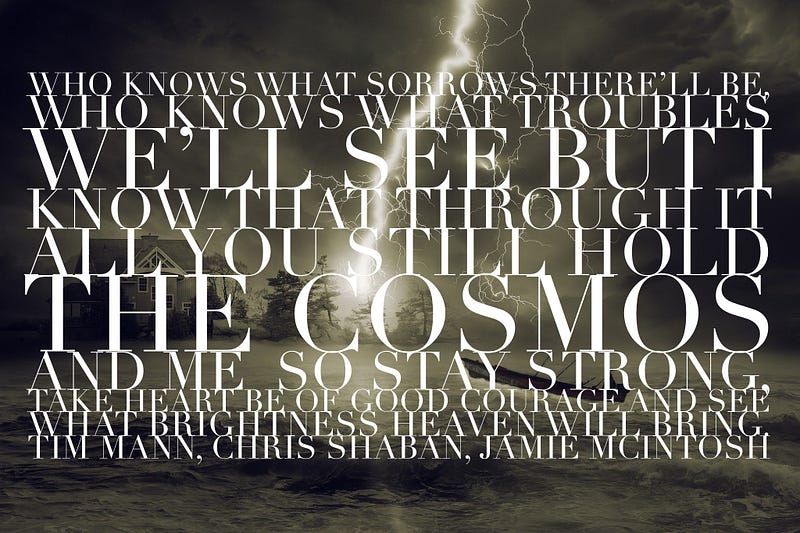
Who knows what troubles we’ll see
But I know that through it all
You still hold the cosmos and me
So stay strong, Take heart Be of good courage And see what brightness Heaven will bring
As we take heart, let’s rise to confront these massive, menacing storm systems as a shelter for those most in harm’s way.
Please check my 90 second video on Twitter about the #WeRiseAsOne Campaign to protect vulnerable children & families from #CoronaVirus
#WeRiseAsOne
(The opinions expressed in this piece are the author’s own, and may not necessarily reflect the views of any other individual, entity or organization referenced herein.)
To make a contribution to Compassion International’s COVID-19 Disaster Relief Fund: https://www.compassion.com/ In Canada: www.compassion.ca
Jamie McIntosh is speaker, writer & executive leader in the international humanitarian, development, global surgery & human rights arenas. He holds a Masters degree in International Human Rights Law from Oxford University. To connect with his reflections in poetry & prose: LinkedIn | Twitter | Instagram


