avatarJ. Andrew Shelley

Free AI web copilot to create summaries, insights and extended knowledge, download it at here

5892

Abstract

ngleyearofageandaverageageofdeathofpeoplewhosedeathwasduetoorinvolvedcovid19">detailed data set</a> from the United Kingdom, the average age of Covid death has been 79.6 years of age; the midpoint is even older, 80. Each country varies somewhat, but Covid-19 deaths skew quite old.</p><p id="6051">What does the age of death mean?</p><p id="7349">The Social Security Administration maintains a curious table called <a href="https://www.ssa.gov/oact/STATS/table4c6.html">Actuarial Life</a>. A modern day Rosetta Stone, this table projects the remaining years of life for the typical American at each year. A 79-year-old can look forward to 10 additional years of life. A 28-year-old can expect to great 54 additional years.</p><p id="aaee"><i>By this blunt measure, each H1N1 death in 1918 wiped out <b>five-times as many years of life</b> as Covid-19.</i></p><p id="394f">Though World War I earned a thousand times more books and memorials than H1N1, there are things to remember about <b>the Spanish flu in 1918</b>:</p><ol><li><b>It was far worse than Covid-19. </b>The 1918 flu proportionally killed more than twelve times as many people as Covid-19. Also twice the number of actual soldiers and civilians killed in WWI.</li><li><b>It targeted the young.</b> The average age of flu death was 28 versus Covid’s near 80. Given the numbers of dead (3x), the relative populations (4x), and especially the remaining years of life (5x), H1N1 proportionally wiped out up to <i>60 more human life years</i> (3 x 4 x 5) in 1918 than Covid-19 has through October of 2022.</li><li><b>It is still around today. </b>Across the globe, from <a href="https://www.hopkinsmedicine.org/health/conditions-and-diseases/coronavirus/coronavirus-disease-2019-vs-the-flu">290,000 to 650,000 die from the flu each year</a> despite significant <a href="https://data.oecd.org/healthcare/influenza-vaccination-rates.htm">vaccination efforts</a>. From <a href="https://www.cdc.gov/flu/about/burden/index.html">12,000 to 52,000 American deaths</a> each year from 2010 to 2020.</li></ol><h2 id="eab4">Polio (poliomyelitis)</h2><p id="577d">Polio <a href="https://www.cdc.gov/polio/what-is-polio/polio-us.html">terrified generations</a> like a vampire spirit. Some victims outright died, but many more were paralyzed into an undead state. The worst affects of polio became more common in the late 1800’s and remained until the polio vaccine was widely adopted, starting in 1955.</p><p id="5205">Polio primarily <a href="https://www.who.int/news-room/fact-sheets/detail/poliomyelitis">affected children under age 5</a>.</p><p id="a594"><a href="https://www.sciencemuseum.org.uk/objects-and-stories/medicine/polio-20th-century-epidemic">Epidemiologists explain</a> that polio had been present for centuries, but that <i>improvements in hygiene</i> counter-intuitively made children <i>more</i> <i>susceptible</i> to acute infection and paralysis. In less-hygienic regions, children were exposed to the polio virus in the first months of life when their cells still held the memories of their mother’s immune system. If they became visibly ill at all, the sickness was much less severe.</p><p id="38bf" type="7">Advancements in hygiene made polio more dangerous.</p><p id="88b2">A <a href="https://www.sciencemuseum.org.uk/objects-and-stories/medicine/polio-20th-century-epidemic">1916 polio breakout</a> reportedly killed about 6,000 in New York state and left 27,000 paralyzed. In the 1940’s, the CDC notes that 35,000 Americans were harmed by polio each year. <a href="https://www.cdc.gov/polio/what-is-polio/polio-us.html">About 15,000 cases of paralysis</a> occurred annually in the early 1950's. Mercifully, by 1961, vaccine adoption had <a href="https://www.cdc.gov/polio/what-is-polio/polio-us.html">virtually eradicated</a> polio in the US.</p><p id="4da4">In comparison to polio, <a href="https://www.statista.com/statistics/1191568/reported-deaths-from-covid-by-age-us/">Covid-19 has been much more deadly for the aged</a> and far less so for the young. About 1 million Americans have died of Covid, but less than 1,300 under the age of 19.</p><p id="0af1">In 2022, after significant adoption of Covid-19 vaccines and treatments, less than <a href="https://www.cdc.gov/coronavirus/2019-ncov/science/forecasting/forecasting-us-previous-2022.html">10,000 Americans</a> are dying each month from Covid.</p><p id="d53c">The most dreaded 20th-century disease before HIV and Covid-19, <b>polio</b> has followed quite a different path than Covid-19:</p><ol><li><b>It had been highly visible for decades. </b>Polio sucked away life for a century. Polio victims were horribly debilitated and hard for society to ignore.</li><li><b>It targeted the young.</b> Polio victims were usually the very young.</li><li><b>It is almost gone through vaccination. </b>Considered eradicated in the US, only 140 wild polio cases were reported in the world in 2020. Significant efforts continue to bring about worldwide elimination.</li></ol><p id="d756">In comparison to our experience with previous pandemics, <b>Covid-19 in 2022 is</b></p><ul><li>Not nearly so deadly — due to medicine, hygiene, and the nature of the virus</li><li>Particularly harmful to the aged and sick</li><li>Still killing two to three times as many Americas as the flu each month</li><li>Residually harmful (like polio) but in less obvious ways</li><li>An accelerant of social change (like the plague) in work, school, and medicine</li></ul><p id="a962">Covid-19 is pushing us to research difficult questions:</p><ul><li>How much is the human immune system “social”? (As with polio and <a href="https://www.ncbi.nlm.nih.gov/pmc/articles/PMC2720273/">possibly H1N1</a>, humans may suffer more illness with a lack of exposure to pathogens in childhood.)</li><li>In what situations do masks help?</li><li>In what situations does social distancing help?</li><li>Who

Options

should take the Covid vaccines? Who not?</li></ul><p id="867e">The modern culture war pushes us to answer through the lens of political bias.</p><p id="60e4">These questions should be addressed thoughtfully:</p><p id="a0e5"><i>Was Covid never a serious problem?</i></p><p id="507d">Covid-19 has proven to be a serious disease even if not nearly so devastating as the Black Death or the Spanish flu. Even with modern hygiene, medical care, and trillions of dollars sacrificed, up to 15 million lives have been lost to Covid-19.</p><p id="3221">Critically, in early 2020 we didn’t know whether Covid-19 would behave more like Nipah virus (<a href="https://www.path.org/articles/nipah-virus-film-contagion-vaccine/">40%+ case fatality ratio</a>) or modern H1N1 (<a href="https://www.thelancet.com/journals/laninf/article/PIIS1473-3099(10)70120-1/fulltext">as little as .048% CFR</a>).</p><p id="7ffc"><i>Are we forgetting about those who will suffer from Covid-19 or might still be suffering from complications from the disease (or even the vaccine)?</i></p><p id="9891">Caring for the victims of war and disease is always challenging. Societies often ignore them or use them for political advantage. Long covid sufferers will be little different.</p><p id="490a">Covid-19 will become part of the world’s healthcare milieu. Can we eliminate it like polio? Can we mitigate it like the flu? We shall see.</p><p id="7eaf"><i>Have we “normalized mass death” (quoting Umair Haque)?</i></p><div id="0c62" class="link-block"> <a href="https://eand.co/how-covid-became-the-normalization-of-mass-death-95e44b477804"> <div> <div> <h2>How Covid Became the Normalization of Mass Death</h2> <div><h3>If “Covid’s Over,” Then Why Doesn’t it Ever Actually End? Because — Hint — It’s a Big Lie.</h3></div> <div><p>eand.co</p></div> </div> <div> <div style="background-image: url(https://miro.readmedium.com/v2/resize:fit:320/1*MUx5OnvZCZxssxsknNffyg.jpeg)"></div> </div> </div> </a> </div><p id="973f">This is a tough question with a lot of nuance. It might, though, lead to important learnings.</p><p id="4a5c">US life expectancy dropped in 2020 and 2021. <a href="https://www.cdc.gov/nchs/pressroom/nchs_press_releases/2022/20220831.htm">The CDC explains</a> that 74% of the fall from 2019 to 2020 was due to Covid-19 and 50% from 2020 to 2021.</p><figure id="9c09"><img src="https://cdn-images-1.readmedium.com/v2/resize:fit:800/1*LiwKpPNYoo7VTGqgM7IirA.jpeg"><figcaption>Chart from <a href="https://www.advisory.com/daily-briefing/2022/09/01/life-expectancy">Advisory Board</a>. Data from <a href="https://www.cdc.gov/nchs/nvss/life-expectancy.htm#data">CDC</a>.</figcaption></figure><p id="d36c">More importantly, though, while other countries are bouncing back from Covid-19, US life expectancy continues to fall. Americans’ life expectancy <a href="https://www.commonwealthfund.org/blog/2022/americans-no-matter-state-they-live-die-younger-people-many-other-countries">remains far less</a> than peer countries.</p><p id="8309">On the one hand, it is fair to say that the US and its partners have continued to invest in technology. How else could we have seen a Covid-19 vaccine in such record time?</p><p id="12f8"><i>The polio vaccine took decades. Covid-19 less than a year.</i></p><figure id="36e8"><img src="https://cdn-images-1.readmedium.com/v2/resize:fit:800/1*Kc718e5YubHAG5JC8PMQAQ.jpeg"><figcaption><a href="https://www.mckinsey.com/featured-insights/coronavirus-leading-through-the-crisis/charting-the-path-to-the-next-normal/mind-over-matter-how-the-world-developed-covid-19-vaccines-in-record-time">Source</a>. Data from fda.org and Our World in Data.</figcaption></figure><p id="42bb">On the other hand, social choices are hurting Americans year after year.</p><p id="95b0">Objectively, <a href="https://ourworldindata.org/us-life-expectancy-low">American life expectancy is dropping</a> because of</p><ul><li>obesity</li><li>homicides</li><li>opioid overdoses</li><li>suicides, and</li><li>infant mortality</li></ul><p id="0477">Some groups are far more inclined than others to suffer. The recent life expectancy decline is <a href="https://www.cdc.gov/nchs/pressroom/nchs_press_releases/2022/20220831.htm">most dramatic</a> in native American and white men. The poor suffer most from <a href="https://ourworldindata.org/us-life-expectancy-low">rising infant mortality</a>.</p><p id="c580">The criticism that America has “normalized mass death” is overstated for dramatic effect. However, Americans seem strangely comfortable accepting a rather <a href="https://www.ncbi.nlm.nih.gov/books/NBK154469/">unhealthy society</a>.</p><p id="f52d">We stop serving bread in elite Los Angelas restaurants — <i>it is so fattening!</i> — while we do little to tackle the deeper problems making so many unwell.</p><p id="37fc">Rather than addressing problems with honesty and transparency — rather than honestly assessing our handling of Covid — we would rather blur the truth within our culture war debates.</p><p id="aaa9">And do nothing.</p><p id="640f"><i>J. Andrew Shelley distills work and life into stories offering worthwhile lessons. He has spent years in startups that did nice stuff. One was sold for over half a billion dollars, but that is a story for another day.</i></p><p id="1044"><i>Please <a href="https://americanbutterfly.medium.com/subscribe">subscribe to read his stories</a>. Bettering our lives means the world to him.</i></p><p id="85f3"><i>Check out his book <a href="https://www.amazon.com/American-Butterfly-Lessons-Learned-Culture/dp/1735497401/">American Butterfly</a>. It tells the story of America’s Culture War through the lens of a Southern family suffering a great loss.</i></p></article></body>

Covid-19 Is Now A Virus in Wolf’s Clothing

It’s time to understand how to manage the next pandemic

When Covid-19 came knocking at our door in January 2020, we didn’t know what to expect.
Photo by Elizabeth McDaniel on Unsplash

Was it a wolf knocking on our door?

Or was it grandma?

Even now, it is unclear how the virus will behave this fall. Fortunately, it is extremely likely we have survived the worst of Covid-19.

Now, then, is the time for good questions. The time to begin planning how to manage the next pandemic better and how to make our world healthier.

One small piece of that work involves understanding Covid-19 in comparison to the pandemics of the past.

Let’s start with the doozy…

The Black Death (bubonic plague, the plague)

We hardly need do the math to know that Covid-19 is a guppy in comparison to the Black Death.

Historians estimate that 30% to 40% of Europe’s population died in the 14th century from the bubonic plague: 25 to 50 million people.

Europe is thought to have lost 2.1 million people to Covid-19. That’s .28% of Europe’s current population. One-quarter of 1%.

30% dead by Plague vs .28% dead by Covid

The Black Death was not just a whale. It was a zombie whale that wouldn’t die for centuries. That (and Monty Python) is why we still make dark jokes about something that Americans have never seen.

Three things other than its deadliness are striking about the bubonic plague:

  1. It kept on coming back. The plague struck Europe again every ten years or so through the mid-17th century.
  2. It is still around. Better hygiene and medicine keep the plague in check.
  3. It changed human society. Modern historians argue that massive depopulation wrecked the power of the Catholic Church and the feudal system in Europe. The Black Death paved the way for the Age of Enlightment, rationalism, capitalism, and individualism.

The Spanish Flu (H1N1, the flu)

The H1N1 flu of 1918 was not a whale like the bubonic plague. It was more like a great white shark that comes back each season, killing from 290,000 to 650,000 people across the globe each year.

In 1918, H1N1 killed upwards of 50 million people worldwide. At that time the human population was about one-quarter of today’s. If the same number of people had been alive, there would have been four times as many people dead of the 1918 flu: 200 million souls lost.

As of October 2022, Covid-19 is thought to have killed 6.5 to 15 million people. Even being conservative, the 1918 flu actually killed three times as many people worldwide as Covid-19 has.

Three times as many actual deaths. In a population one-forth the size.

H1N1 was twelve times as deadly as Covid-19

Despite its fearsome toll, the 1918 flu was overshadowed by World War I. A hot war waging across continents was more memorable.

H1N1 in 1918 had another interesting feature: it affected young adults, not just the very young and the very old. Studies of detailed data from the US and Canada indicate that the greatest numbers of flu deaths occurred in children under 2 and in adults age 28. Not coincidentally, the CDC states that the average age of death from flu in 1918 was 28.
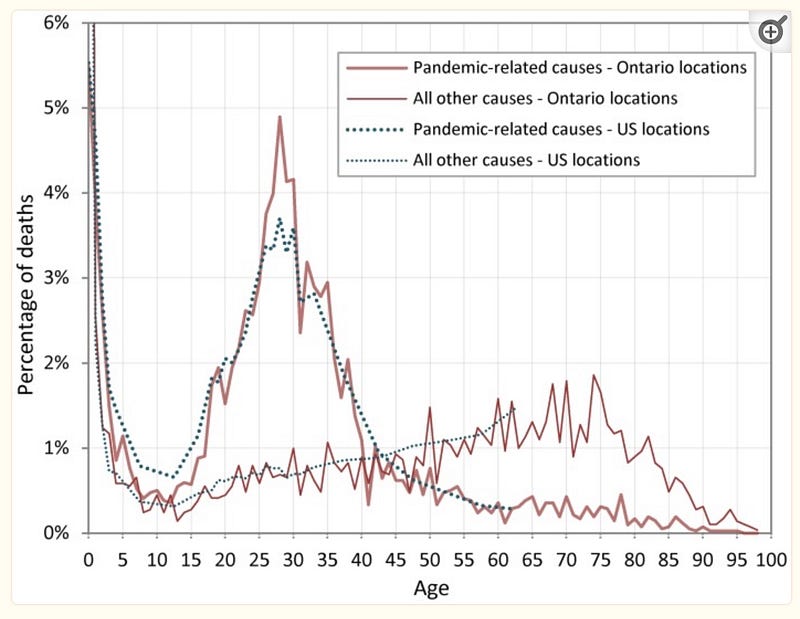
Age Specific Mortality During the 1918 Influenza Pandemic, PLOS, Alain Gagnon et. al.

In comparison, 75% of Covid-19 deaths have occurred in people age 65 and older. Only 2.5% of Covid deaths have occurred in people under 40.

According to a detailed data set from the United Kingdom, the average age of Covid death has been 79.6 years of age; the midpoint is even older, 80. Each country varies somewhat, but Covid-19 deaths skew quite old.

What does the age of death mean?

The Social Security Administration maintains a curious table called Actuarial Life. A modern day Rosetta Stone, this table projects the remaining years of life for the typical American at each year. A 79-year-old can look forward to 10 additional years of life. A 28-year-old can expect to great 54 additional years.

By this blunt measure, each H1N1 death in 1918 wiped out five-times as many years of life as Covid-19.

Though World War I earned a thousand times more books and memorials than H1N1, there are things to remember about the Spanish flu in 1918:

  1. It was far worse than Covid-19. The 1918 flu proportionally killed more than twelve times as many people as Covid-19. Also twice the number of actual soldiers and civilians killed in WWI.
  2. It targeted the young. The average age of flu death was 28 versus Covid’s near 80. Given the numbers of dead (3x), the relative populations (4x), and especially the remaining years of life (5x), H1N1 proportionally wiped out up to 60 more human life years (3 x 4 x 5) in 1918 than Covid-19 has through October of 2022.
  3. It is still around today. Across the globe, from 290,000 to 650,000 die from the flu each year despite significant vaccination efforts. From 12,000 to 52,000 American deaths each year from 2010 to 2020.

Polio (poliomyelitis)

Polio terrified generations like a vampire spirit. Some victims outright died, but many more were paralyzed into an undead state. The worst affects of polio became more common in the late 1800’s and remained until the polio vaccine was widely adopted, starting in 1955.

Polio primarily affected children under age 5.

Epidemiologists explain that polio had been present for centuries, but that improvements in hygiene counter-intuitively made children more susceptible to acute infection and paralysis. In less-hygienic regions, children were exposed to the polio virus in the first months of life when their cells still held the memories of their mother’s immune system. If they became visibly ill at all, the sickness was much less severe.

Advancements in hygiene made polio more dangerous.

A 1916 polio breakout reportedly killed about 6,000 in New York state and left 27,000 paralyzed. In the 1940’s, the CDC notes that 35,000 Americans were harmed by polio each year. About 15,000 cases of paralysis occurred annually in the early 1950's. Mercifully, by 1961, vaccine adoption had virtually eradicated polio in the US.

In comparison to polio, Covid-19 has been much more deadly for the aged and far less so for the young. About 1 million Americans have died of Covid, but less than 1,300 under the age of 19.

In 2022, after significant adoption of Covid-19 vaccines and treatments, less than 10,000 Americans are dying each month from Covid.

The most dreaded 20th-century disease before HIV and Covid-19, polio has followed quite a different path than Covid-19:

  1. It had been highly visible for decades. Polio sucked away life for a century. Polio victims were horribly debilitated and hard for society to ignore.
  2. It targeted the young. Polio victims were usually the very young.
  3. It is almost gone through vaccination. Considered eradicated in the US, only 140 wild polio cases were reported in the world in 2020. Significant efforts continue to bring about worldwide elimination.

In comparison to our experience with previous pandemics, Covid-19 in 2022 is

  • Not nearly so deadly — due to medicine, hygiene, and the nature of the virus
  • Particularly harmful to the aged and sick
  • Still killing two to three times as many Americas as the flu each month
  • Residually harmful (like polio) but in less obvious ways
  • An accelerant of social change (like the plague) in work, school, and medicine

Covid-19 is pushing us to research difficult questions:

  • How much is the human immune system “social”? (As with polio and possibly H1N1, humans may suffer more illness with a lack of exposure to pathogens in childhood.)
  • In what situations do masks help?
  • In what situations does social distancing help?
  • Who should take the Covid vaccines? Who not?

The modern culture war pushes us to answer through the lens of political bias.

These questions should be addressed thoughtfully:

Was Covid never a serious problem?

Covid-19 has proven to be a serious disease even if not nearly so devastating as the Black Death or the Spanish flu. Even with modern hygiene, medical care, and trillions of dollars sacrificed, up to 15 million lives have been lost to Covid-19.

Critically, in early 2020 we didn’t know whether Covid-19 would behave more like Nipah virus (40%+ case fatality ratio) or modern H1N1 (as little as .048% CFR).

Are we forgetting about those who will suffer from Covid-19 or might still be suffering from complications from the disease (or even the vaccine)?

Caring for the victims of war and disease is always challenging. Societies often ignore them or use them for political advantage. Long covid sufferers will be little different.

Covid-19 will become part of the world’s healthcare milieu. Can we eliminate it like polio? Can we mitigate it like the flu? We shall see.

Have we “normalized mass death” (quoting Umair Haque)?

This is a tough question with a lot of nuance. It might, though, lead to important learnings.

US life expectancy dropped in 2020 and 2021. The CDC explains that 74% of the fall from 2019 to 2020 was due to Covid-19 and 50% from 2020 to 2021.
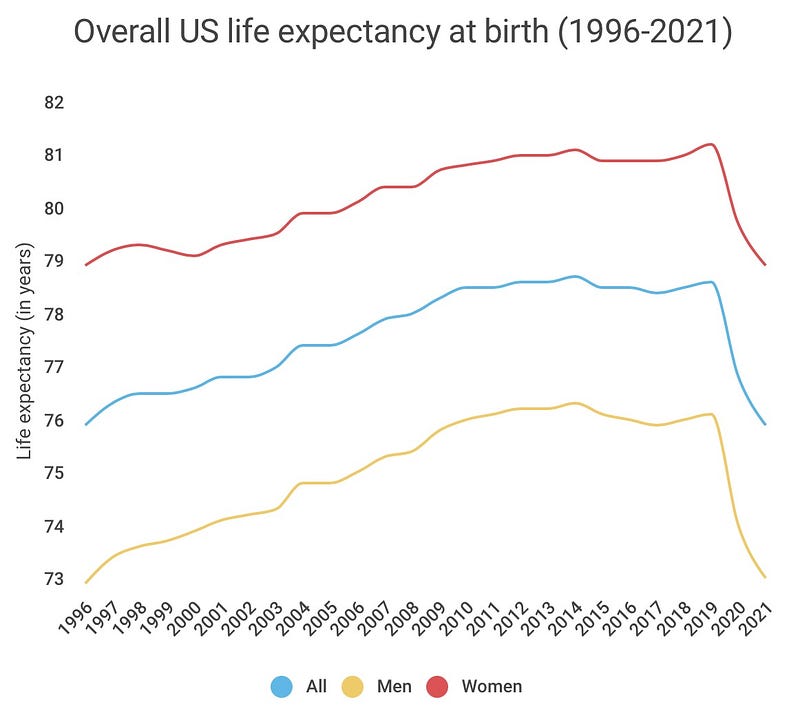
Chart from Advisory Board. Data from CDC.

More importantly, though, while other countries are bouncing back from Covid-19, US life expectancy continues to fall. Americans’ life expectancy remains far less than peer countries.

On the one hand, it is fair to say that the US and its partners have continued to invest in technology. How else could we have seen a Covid-19 vaccine in such record time?

The polio vaccine took decades. Covid-19 less than a year.
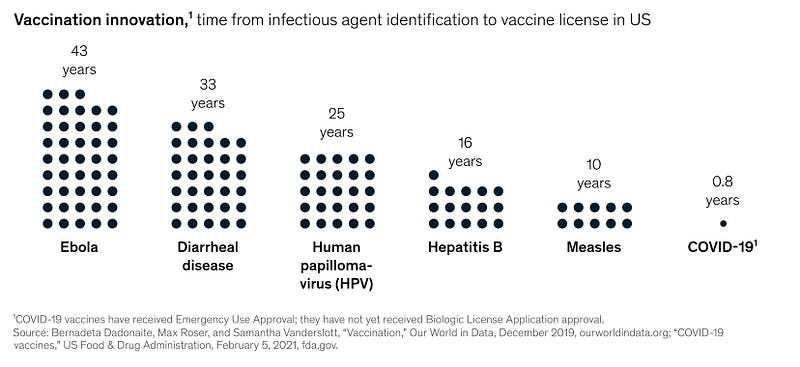
Source. Data from fda.org and Our World in Data.

On the other hand, social choices are hurting Americans year after year.

Objectively, American life expectancy is dropping because of

  • obesity
  • homicides
  • opioid overdoses
  • suicides, and
  • infant mortality

Some groups are far more inclined than others to suffer. The recent life expectancy decline is most dramatic in native American and white men. The poor suffer most from rising infant mortality.

The criticism that America has “normalized mass death” is overstated for dramatic effect. However, Americans seem strangely comfortable accepting a rather unhealthy society.

We stop serving bread in elite Los Angelas restaurants — it is so fattening! — while we do little to tackle the deeper problems making so many unwell.

Rather than addressing problems with honesty and transparency — rather than honestly assessing our handling of Covid — we would rather blur the truth within our culture war debates.

And do nothing.

J. Andrew Shelley distills work and life into stories offering worthwhile lessons. He has spent years in startups that did nice stuff. One was sold for over half a billion dollars, but that is a story for another day.

Please subscribe to read his stories. Bettering our lives means the world to him.

Check out his book American Butterfly. It tells the story of America’s Culture War through the lens of a Southern family suffering a great loss.

Culture
Covid-19
Recommended from ReadMedium