
Covid-19 and Vitamin D: What to do While You Wait for the Vaccine
Here’s what you need to know about the role of vitamin D.

There is good news and there is bad news, regarding the latest Covid-19 developments. The good news is that a vaccine to protect against infection is looking highly promising, with preliminary analysis revealing 90% success rate in trials.
The bad news is that for the vast majority of people, the vaccine won’t be available for quite some time. And winter’s coming. But here’s more good news: trials on the efficacy of vitamin D are also looking very promising, and it’s something you don’t have to wait for.
Vitamin D can’t stop you from getting infected, but it can mitigate the severity of symptoms, and help get you through the winter.
“There are now close to 30 or so studies demonstrating that having optimal blood levels of 25(OH)-vitamin D (75–150 nmol/L) reduces covid-19 risks: reduced risk of infection; reduced risk of severe disease; reduced risk of dying. Many researchers now regard the evidence as ‘overwhelming’.”
Governments have started to pay attention, and to act. In Scotland, vulnerable people who are shielding are entitled to a free 4-month supply of vitamin D to get them through the cold dark months. The same is about to happen in England, where care home residents will also receive a free, four-month supply.
Vitamin D is safe and inexpensive. For that reason, scientists now take the view that by taking it, there is nothing to lose, and potentially much to gain.
“…it would seem uncontroversial to enthusiastically promote efforts to achieve reference nutrient intakes of vitamin D, which range from 400 IU/day in the UK to 600–800 IU/day in the USA…. there is nothing to lose from their implementation, and potentially much to gain”.
Details of many of the studies that have been carried out on vitamin D and Covid-19 have started to make their way into the press. Many papers, including the Times, picked up the results of a recent Spanish study that found that more than 80% of 216 hospitalised Covid-19 patients had vitamin D deficiency.
Vitamin D — limited production
Vitamin D is made in the skin in the presence of sunlight. Or more specifically, on exposure to solar ultraviolet B (UVB).
Some vitamin D is stored in the liver, which is just as well. Even so, we can only store so much. In the Northern Hemisphere, liver supplies are non-existent by the end of October. The further north you are, the worse the situation becomes. Once you travel above 37º latitude in winter, you can forget it.
Residents of Edmonton, Canada, are on a latitude of 52º north. They cannot make sufficient levels of vitamin D for 5 months of the year. London is on a latitude of 51.3º, so Londoners can expect much the same capacity. You are obviously even worse off in Birmingham (England) at 52º , Belfast at 54º and Edinburgh at 55º.
Who’s affected?
There are some remarkable similarities between those who are most vulnerable to Covid-19 symptoms, and those most likely to experience vitamin D deficiency.
“The striking overlap between risk factors for severe COVID-19 and vitamin D deficiency, including obesity, older age, and Black or Asian ethnic origin, has led some researchers to hypothesise that vitamin D supplementation could hold promise as a preventive or therapeutic agent for COVID-19.”
Dark skinned people
Black and minority ethnic people appear to be worse affected than white people by Covid-19. In England and Wales, black people are more than four times more likely to die from Covid-19 than white.
It is already known that black people need around five times more time in the sun to produce vitamin D than white people, thanks to the blocking effect of the pigment melanin.
The elderly
The older you are, the greater the risk of dying from Covid-19. The risk doubles for approximately every eight years of age.
Vitamin D deficiency affects nearly 50% of older adults, though the real figure may be as high as 90%. People over 60 require three to four times more sun exposure than people under 20. That’s because they have decreased presence of 7-dehydrocholesterol, a substance required to make vitamin D in the presence of sunlight.
Obese people
Public Health England has estimated that having a body mass index of 35 to 40 could increase a person’s chances of dying from Covid-19 by 40%, while a BMI greater than 40 could increase the risk by 90%.
A high level of body fat inhibits the release of vitamin D stored in the liver. The higher the body mass index of an individual, the lower the level of vitamin D in the blood.
Immunocompromised people
Being immunocompromised means having a weakened immune system, one that responds poorly to invading pathogens, such as viruses. Immunocompromised people are at higher risk of becoming seriously ill from Covid-19, and are more likely to stay ill for longer than other people.
Vitamin D is a crucial component of the immune system, especially in the respiratory system, where it strengthens mucosal defences. Low vitamin D is associated with increased susceptibility to infectious diseases of the upper respiratory tract. Many trials have shown that vitamin D supplementation offers protection against acute respiratory tract infections.
Those living in colder climes
Those northern countries with low UVB exposure have higher Covid-19 mortality. Countries in the Southern Hemisphere, on the other hand, have relatively low mortality.
There are exceptions. Northern countries such as Norway and Sweden have fared much better, but they also have better vitamin D status: they have higher consumption of oily fish and cod liver oil (both good dietary sources — see below) and take supplements.
Nearly a quarter (23.3%) of the overall US population has insufficient or deficient vitamin D. In the UK, 30–40% of the population are deficient during the winter months, thought that figure may be as high as 90% during winter and spring.
What’s recommended?
There are two types of vitamin D: D2 and D3. The form that humans make and use is vitamin D3. Vitamin D3 is converted to 25(OH)D, the form of vitamin D that circulates in the blood.
It was once thought that there was no difference between D2 (ergocalciferol) and D3(cholecalciferol) in their ability to improve vitamin D status. However, trials in humans now consistently find that vitamin D3 increases total 25(OH)D concentrations much more than D2.
How much?
Recommended doses vary — 400iu (international units) generally, rising to 600–800iu for the housebound, and 800–1000iu for people aged 70 and above.
Good dietary sources
There are some good but limited dietary sources of vitamin D. Oily fish is the best source, especially salmon. Even then, it has to be wild. Farmed salmon has been found to have only 25% of the vitamin D content of its wild counterpart. Wild salmon contains approximately 400iu of D3 per 3.5oz — a ‘typical’ serving size.
Eggs are also a good source, with the yolk containing almost all the vitamin D. And there’s a big difference between eggs from hens that are free range, and eggs from indoor-reared hens. Free-range eggs have been found to contain 3–4 times more vitamin D than non-free-range eggs. Whereas free-range egg yolk may average 14.3μg per 100g of D3, yolk from indoor eggs may average as little as 3.8μg vitamin D per 100g.
After eggs, your next best source is meat, including offal. Meats with a high fat content, such as lamb, tend to have the highest amounts of D3. Which is convenient, because vitamin D is fat soluble, which means that you have to eat fat in order to absorb it in the gut.
Dairy is another natural source, though not a great one. Like eggs, the D3 content of dairy can vary according to the animal’s habitat and quality of life — the D3 content of dairy is much affected by outdoor grazing. Even so, unless milk has been fortified, it is not a rich source of vitamin D3, and if it is skimmed it contains undetectable amounts. Butter is an exception to the dairy rule, containing reasonable amounts of D3.
Plants (mushrooms) contain only vitamin D2. Fresh shiitake mushrooms contain about 100iu of D2 per 3.5oz portion. Choose wild mushrooms, or mushrooms that have been grown under exposure to ultraviolet B radiation. Even mushrooms need the sun to make D2.
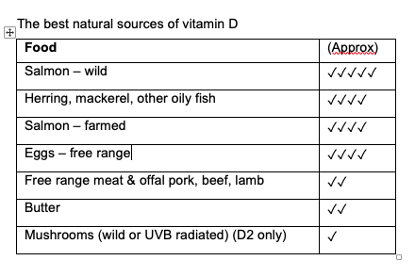
So as winter approaches, in the absence of sunlight and with diminishing supplies, think supplements and salmon. Especially if you’re at the back of the queue for the vaccine.