
Covid-19, And The Stress Of Online Learning-Could A Bucket Load Of Creativity Be The Answer?
In which case, come play with me…
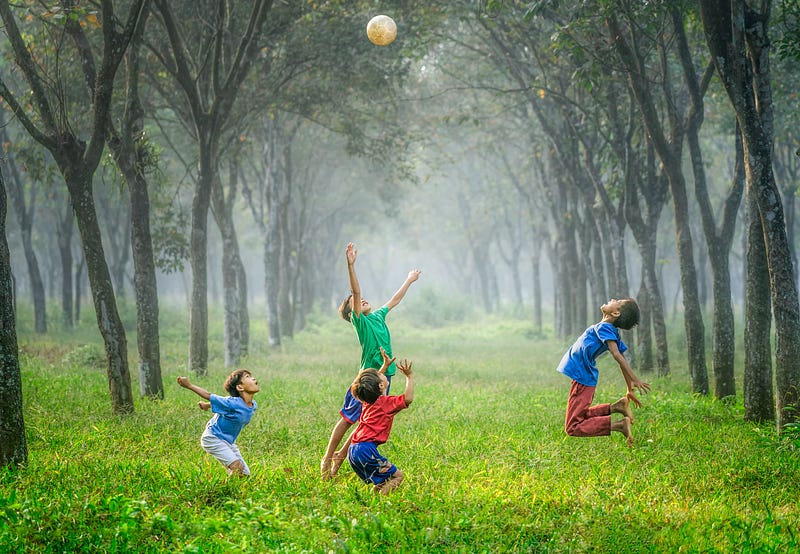
‘I tried to teach my child with books.
He gave me only puzzled looks.
I tried to teach my child with words.
They passed him by, often unheard.
Despairingly I turned aside.
“How shall I teach my child?” I cried.
Into my hand he put the key.
“Come,” he said, “come play with me.” Author unknown
Only a few days ago, I learned of the passing of one of the most inspirational educators of all time, Sir. Ken Robinson, a passionate advocate of creativity in order to learn.
Now there’s a man who would have had much to say about Covid-19, ZOOM, and online learning, but by the time of its emergence, he would have been a very sick man.
I know of many parents who struggled during the lock down. Some had children in early learning, and some in high school. You don’t even need to be a parent to imagine the mayhem this would have caused in some homes, the stress of coming to terms with tasks, the struggle to get children to stay focused, and the overnight learning of what it means to be both parent and teacher.
It was very difficult, but what it did bring about, was a renewed appreciation of what it means to be a teacher, and how challenging it can be.
What most parents worried about, was that their children would fall behind academically, so stressed as they were with their personal challenges of work commitments, they determined to do everything possible to ensure their children didn’t lag behind.
But what does that mean? Lag behind in what ways?
If you view learning as linear and incremental, it is easy to understand their concerns. You feel you can’t afford to miss a step, a piece of the jigsaw puzzle, because otherwise your child will never catch up.
Tuning into ZOOM each day to try to get a handle on the requirements for several children, well, I can only imagine the angst.
If you have children who are compliant, who learn easily, who are at one with an educational system that allows you to tick the boxes, all well and good.
But what if your children are not compliant? What if they’d rather be at school, and seeing their teachers and friends, and having fun?
What if they are grieving for the routines and friendships that school once provided?
What if your children are creatives?
What if they are not quite ready for the box-ticking study of the day?
And what if you, as a parent, are already struggling with working from home?
Can you even begin to imagine the combinations of struggle?
That the ZOOM lessons, and the new mode of learning had to be prepared overnight, and teachers were suddenly superstar front and center educators, gives us no idea of the actual all-round chaos, the family arguments, the defiance in some cases, and the meltdowns that occurred, or the yelling that took place when buttons were not muted.
To suggest this was an onerous task is an understatement.
Let’s just stop for a moment and think about all of this.
In a pandemic should we even care if our children fall behind?
Should our parenting instead be one of fostering calm?
Should we just be grateful that they are hail and hearty and safely at home?
Should we, as parents, throw caution to the wind and just do what’s best…for everyone?
Or as parents, might we choose another way?
One of my friends is a lawyer. She has two children in primary school, and a little boy who loves to hoon around the house, imagining, creating, comparing, contrasting, asking questions, asking more questions…and dare I say, learning!
So on one particular day, there she was, working two jobs (three if you include teaching), and her girls are setting up the walls of defiance.
They’re smart girls, and they love being at school. But home’s not school, and they tell their mother that: this is not how the teacher teaches… fractions, or whatever.
‘Well it’s how I learned,’ Amy sighs, ‘so too bad.’
The rest of the conversation I will leave you to speculate on. There she is with two work requirements that need to be tendered by the end of the day, twins who are rapidly digging their heels in, and a three-year-old who is totally oblivious of the mayhem he is adding to.
Fortunately Amy’s mother is a retired teacher, knee-high to a grasshopper, but strict when she needs to be. So when she tells her grandchildren to jump, they only ask, how high! She has their measure.
Amy calls her mother, and just happens to burst into tears.
“You want me to come over?’
She did!
And within a few minutes of her arrival, defiance has turned to enthusiasm. Yes they’d love to do some cooking. Yes they have got a favorite recipe book. And soon, the girls are searching for suitable recipes to make, getting out equipment for their cooking, deciding what pan will suit what they have chosen to make.
Peace reigns, and Amy pads to the study, coffee in hand, earmuffs on, and quietly locks the door.
Granny hasn’t talked about reading, or pronunciation, ingredients, or fractions, nor adding, or subtracting. Nor has she poked her nose into the suitability of the recipe or the pan it’s going to be cooked in.
And suddenly there’s an air of calm. Even Sam the three-year-old has drawn up a stool and is lending suggestions as to all that will soon take place.
Granny has set her grandies up to create, to have fun, and for the outcome to be positive, with ne’er a word about numerators and denominators, nor a vinculum.
Instead they’re going to be baking and eating cake!’
Can you imagine the fun?
And learning fractions due to a need?
Reading and note-taking, maybe?
They all want to eat cake, so they have a vested interest in doing the right thing.
There’s no fear of getting things wrong.
There is help, if necessary. Instead a watchful eye.
Butter on the floor? Why cares? They have a dog.
And who cares about licked fingers and cross-contamination?
We’re having fun! And when you have fun, you learn.
Children are creative little beasts. All children are, but formal learning often reduces natural creativity to a point where children no longer think that way. As Sir Ken once said:
‘We don’t grow into creativity. We grow out of it. Or rather, we get educated out of it.’
So what Granny set up was a creative environment for learning. It’s hard to imagine any child not responding to the opportunity. There was no question as to their readiness to cook. A quiet confidence was instead in place.
Unfortunately not everyone has a retired teacher to call on, but as parents we can choose. We have options. We can call the shots when coping is no longer feasible…and play…or go for a walk…or have some quiet reading time.
We can’t always get things right, and we often miss the mark about all manner of things, but we can and should tune in to what is right for our children.
For instance, just imagine if all you wanted to do, was dance, or sing, be on stage…and nothing much else took your fancy. How would you behave? How might others perceive you?
‘As evidence of how schools kill creativity, Robinson cites the example of a young girl called Gillian Lynne who, at the age of eight, was already viewed as a problem student with a probable learning difficulty due to her inability to sit still and concentrate. When her mother sought a medical explanation for Gillian’s constant fidgeting and lack of focus, the doctor suggested they speak privately. As the two adults got up to leave, the doctor turned on the radio. Left alone in a music-filled room, young Gillian began to dance. Observing her through the window, the doctor turned to her mother. “Gillian’s not sick,” he said, “she’s a dancer.” Today, at the age of 92, Gillian can look back on a long career in ballet, dance and musical theatre which saw her become one of the world’s most successful choreographers, with hits like Andrew Lloyd-Webber’s Cats and Phantom of the Opera among her many achievements. Yet her school had all but written her off, mistaking her extraordinary talent for some form of behavioural problem or cognitive impairment.’
Imagine all the students throughout time whose creative needs were not met at the expense of knowing their French verbs or their Latin declensions.
Imagine a whole bank of students suddenly understanding that an angle is all about the measure of turning after they’ve used their bodies to demonstrate.
Imagine the Pythagoras theorem coming to life on a classroom floor as students happily put pieces together, and all of a sudden, they get it!
Imagine, just imagining, and feeling free to do so.
You may say I’m a dreamer But I’m not the only one I hope someday you’ll join us And the world will be as one.