
Courses To Learn Data Science In 2021
A List Of Courses To Help You Upskill

We’ve seen that Data Science is still an exciting career in 2021. We’ve also seen some of the subjectively “boring” aspects of Data Science and you’ve decided this is still what you want to do — Continue reading.
Especially when you’re new, learning Data Science and becoming a professional Data Scientist in industry can almost feel as though you’re navigating in a maze. The internet doesn’t help in some respect because there is so much noise in the Data Science arena. Some say you need a degree, some say you don’t. Some say you need software engineering skills, some say you don't.
All we truly want to know is how a beginner or someone without much skill can develop their skills and become a top Data Scientist. That is all!
I’ve put together a list of some of the top recommended courses — some I have not completed but I took counsel from very well trusted sources in the Data Science industry and their stamp of approval gave me the confidence to share with you.
The Math
Data Science involves analyzing data in a manner that allows for useful and actionable insights to be drawn. In order to do this effectively, knowledge of basic math is essential. The math can be broken down further into 3 categories: Linear Algebra, Calculus, and Statistics & Probability. I’m not asking you to be Albert Einstein, but you should be capable of understanding very basic concepts in these areas such as the distribution of data.
Linear Algebra Courses:
Calculus Courses:
Probability and Statistics Courses:
I reiterate once again, you don’t need to become the next Albert Einstein. You only need a basic understanding which is enough to get you by as a Data Scientist. I am a massive advocate of Khan Academy and I believe his courses are enough.
Programming Skills
I can’t seem to determine what part of becoming a Data Scientist is the scariest for other people from a non-technical background however for myself it was most definitely programming. I was disillusioned that programming skills were for people that had no friends, were stupendously smart, worked in a garage from sunrise to sunrise, drank a lot of Redbull, and started from the age of 3 — to some extent I was right but this doesn’t mean absolutely anybody cannot learn how to code.
Here are some great courses to get started:
- Applied Data Science with Python Specialization
- Codeacademy: Learn Python 3
- Learn Python Programming Master Class
- Google’s Python Class
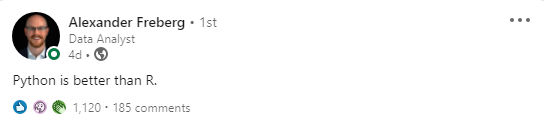
As you may have noticed, these courses are all in Python since I feel the Python syntax is much easier to grasp for beginners than R — it doesn’t really matter whether you learn R or Python in my opinion so I’d just pick the easiest one and carry on.
There are most definitely tons more courses that I could have added to this list (feel free to do a google search) but which one you decide to do doesn’t really matter as long as it helps you learn the basics of Python and once you’re familiar with the basic you can progress to more intermediate and advanced levels.
Note: It’s recommended to at least have an intermediate understanding of Python for Data Science.
Machine Learning
Machine learning is the process by which computers learn from data without having to be explicitly programmed — computers learn automatically through experience — and it is a subset of Artificial Intelligence (although in the business world you may hear the terms being used interchangeably).
As a Data Scientist, you’d be expected to build predefined algorithms to model data depending on the type of data and the business problem at hand. The models would train themselves on what is known as “training data” and you’d use this trained model to draw conclusions on new unseen data.
I am aware there are many Machine Learning courses out there, but after attempting half a dozen before developing the confidence to move on, I can truly say there is really only 1 that I would recommend.
Andrew Ng, the teacher of the course and co-founder of Coursera (the website the course is on), previously worked as Chief Scientist at Baidu and was the Founder & Lead of Google’s Deep Learning project — just in case you weren’t convinced of his credentials.
After speaking to a few of my peers, here are some of the courses that they suggested were extremely useful (I haven’t done these courses personally but I’d vouch for the authorities that recommended them):
- Machine Learning with Python by IBM
- Machine Learning by Columbia University
- Introduction to Machine Learning for Coders
Deep Learning
Deep Learning is a subfield of Machine Learning concerned with methods inspired by the structure and function of the brain called “Artificial Neural Networks”. Although Deep Learning existed long before 2012, it became a smash hit this year when it was used to win a Brain Image Segmentation Contest. Now, it’s considered a breakthrough technology and has really enabled the feasibility of some of the most difficult problems the world faced.
The course I’d suggest:
Courses suggested by other Data Scientist:
- Deep Learning Nanodegree
- Deep Learning A-Z: Hands-On Artificial Neural Networks
- Introduction to Deep Learning
Once again, you only need to select one of these courses. Don’t fall into the trap of doing course after course and not using the knowledge you’ve learned practically.
Wrap Up
I am sure that by following the path and guidelines I’ve set in this post, you’d be well equipped to develop your Data Science skill set. The greatest thing about being a Data Scientist is that with an ever-changing world, new challenges arise each day meaning your development and learning will never end. Therefore, I advise you to embrace your learning and look forward to being a lifelong learner.
Other Notable Courses:
- AI for Everyone by Deeplearning.ai
- Data Science Specialization by John Hopkins University
- IBM Data Science Professional Certificate
- Fast.ai: Practical Deep Learning For Coders & Part 2: Practical from the foundation (Continuation course by the same author).
Thank you for reading! Please connect with me on LinkedIn and/or Twitter if you’d like to discuss more — If you’ve completed a course that I haven’t listed then also feel free to leave a comment on this post for others to see.


