
LIFE LESSONS | HEALTHY LIFESTYLE | SLEEP
Counting Sheep — Still No Sleep?
You can fix your sleep and make your day better.
According to research, 35% of American adults rated their sleep “poor” or “only fair”. A thick pile of research tells that Americans are not alone awake at night. It’s a global problem — almost a pandemic.
Poor sleep — or lack of it — is a significant cause of health issues in modern society. Poor sleep quality has both short-term and long-term consequences.
Stress, psychosocial issues, cardiovascular disease, obesity and even cancer have been linked to poor sleep quality.
It’s time to sleep better. But how?
My sleep problems became severe in 2018. I was working for a terrible company with a bully as the GM.
It was a nightmarish situation, but sleep evaded me. I would have paid for an excellent nightmare if I had just been able to sleep. But no, my mind was running 180 km per hour, and the nights were long.
Days were even longer because, at work, I couldn’t focus properly; I started to gain weight and consistently had somebody squeezing my intestines with steely and cold fingers. The GM got under my skin big time with her grip.
Then — luckily as it turned out — I had an accident and had to get my knee operated on. I had to stop and take two weeks off from purgatory and return to Mother Earth’s surface.
As if the universe had some pity on me, at the same time, my Ōura ring (a brilliant little sleep tracker) arrived. I had already forgotten that I had ordered it some 7 months earlier when I started to have these issues.
Then everything started to change.
How can a high-tech ring help you to sleep better?
For me, it was the awareness it built about my sleep patterns.
Being mindful of the different factors and aspects of my sleep helped me step back and look at my situation objectively.
Even on those nights that I woke up several times and thought I didn’t sleep a wink, the ring revealed that I had been sleeping. Badly, but still.
I realised that I could sleep if the circumstances were right. Even after surgery and medication, I slowly got better results.
Awareness of my sleep patterns helped me diagnose the causes and start changing my lifestyle.
Then other things started to become clear:
- I slept better if I didn’t eat after 6 pm anything.
- I slept better if I chanted my Buddhist mantra (Nam-Myoho-Renge-Kyo) for at least one hour in the evening.
These little findings and adjustments helped me to develop more healthy habits. And I tracked everything almost religiously. I could see from the data that something was happening and moving in the right direction.
Once when I was back on my feet again, I started to go for long bush walks and joined a gym, etc.
My wife helped me eat healthier. For example, I got rid of gluten, which had an unbelievable positive effect on my sleep — more fruits, less red meat and everything in smaller portions.
What about the psychosocial problems, stress and terrible company culture? Did I manage to change them? Unfortunately not, but the new awareness and adjusted lifestyle choices made me more resilient.
I could return to work after my sick leave with a determination not to let anybody get under my skin.
I was less stressed because I started to sleep better. I saw opportunities and options because my mind was clearer, and finally, I dared to leave the toxic environment and landed a dream job elsewhere.
The accident — however painful it was — forced me first to stop and ponder. Then the Ōura ring gave me a tool to gather data about my situation to become more informed, optimistic and resourceful.
And there it was, the key to better sleep: awareness, analysis, and action.
I built awareness, analysed the situation based on data and not only my foggy feelings and developed new healthier habits. That led to my determination to transform my work situation and my courage to make the change.
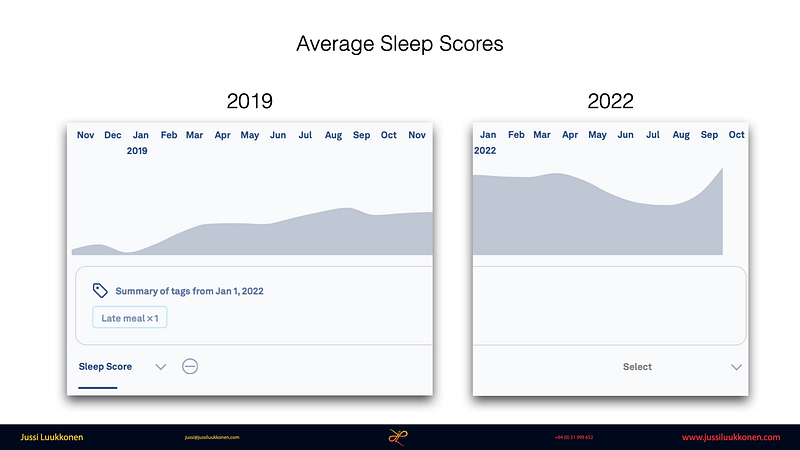
See below the comparison screenshot of how my overall sleep score changed. The year 2019 was a long recovery, and you can see that compared to this year, there is a significant change from poor to healthy curves.
What is this magic Ōura ring that even prince Harry is wearing?
Ōura was founded in Finland in early 2013 by a small group of innovative engineers. They were initially working at Nokia together and, after its fall, had to find something other than smartphones to make.
I assume those engineers had their fair share of sleepless nights when Nokia started to go pear-shaped. So, it was appropriate and timely to look at sleep tracking.
They engaged with sleep researchers and research institutes and started to develop the first-generation ring in 2015 with the help of Kickstarter. I now have a third-generation ring, and I love it very much.
The ring has several sensors capturing your biometric data. The infrared LEDs are reflected through the skin on your finger, and the ring records the microscopic changes. It has also sensors to measure your body movements.
Your physical activity, heart rate and rate variability (HRV), body temperature, respiratory rate, and sleep data are then transferred via Bluetooth to a smartphone app.
The ring is super accurate and has been tested in laboratories to validate the results. And the battery life is impressive: you need to recharge it max twice a week.
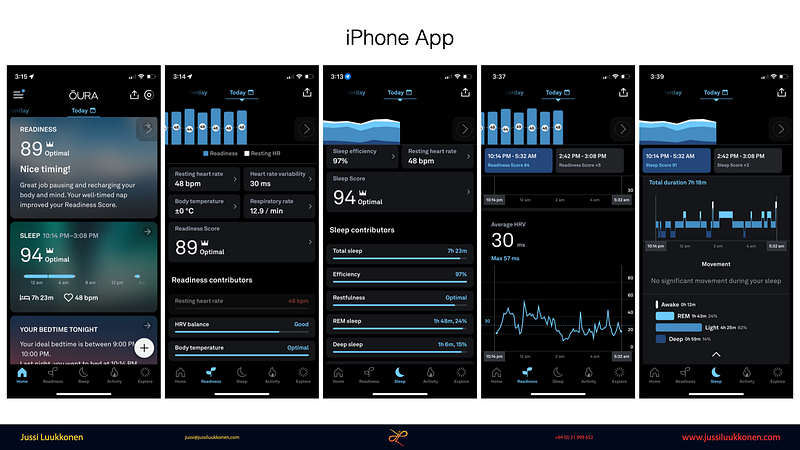
See the screenshot of my iPhone app Ōura dashboard from today.
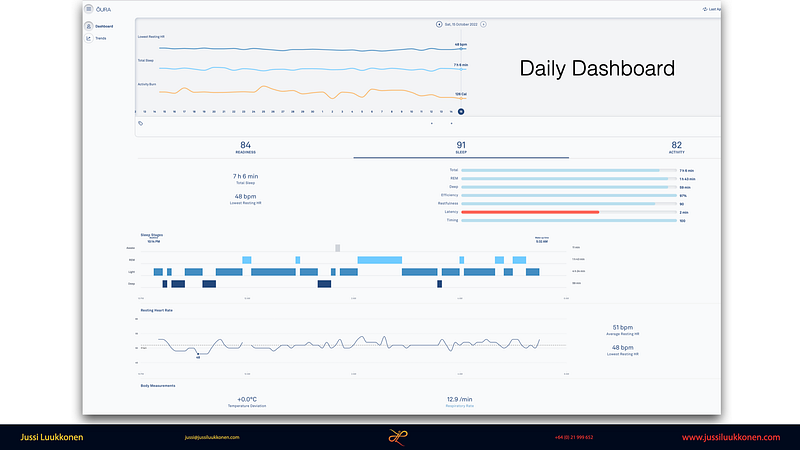
If you buy the membership, you will get access to your data on the web and can download it as a CSV file for further analysis. See the screenshot below.
Ōoura was heavily criticised for the subscription model they implemented a year ago when they released the new generation 3 ring.
I was lucky because I got the lifetime membership as an old user. I don’t like paying for the membership if you buy an expensive product. I might have skipped that and had just the local data on my phone without this free option.
How about you and your sleep?
Everybody has different sleep patterns, habits and problems. There is no one answer to all those issues. And indeed, there is no one ring to rule them all.
Apple Watch and other wearables can track your sleep today, and the accuracy of those devices is increasing. Ōura was my choice because I don’t like wearing a watch (or anything around my wrist) at night and wanted to have something that became an almost invisible part of me.
However, the answer is never in a gadget. You must become aware of your situation, analyse it properly, and take corrective action.
If you have a severe sleep problem, seek professional help but look at these devices, too. They might push you to move from suffering to seeking a solution and begin a consistent and persistent journey towards better sleeping habits.
I am a curiosity expert; if you want to know how I can help you to become a more curious leader, creative and confident thinker, book a free discovery meeting with me here.
If you enjoy reading stories like these and want to support me as a writer, consider signing up to become a Medium member. It’s $5 a month, giving you unlimited access to stories on Medium. If you sign up using my link, I’ll earn a small commission: click here to join :-)


