
Could Your Pain Be the Pupa of Paradise?
Destructive forces can be the path to fulfillment.
Life hurts.
And pain is awful. There never was a philosopher who could endure toothache. Epicurus, who understood in the 3rd century BC that matter is composed of atoms, taught the point of all rational actions is to attain pleasure. Aristotle claimed that happiness is the highest good.
It makes sense to maximize pleasure and minimize pain. That’s what our cities are built on. Walls to keep the wolves away soon turn into neon pleasure palaces where a man can get a wet shave, a warm bath, and a welcome handjob in a single evening. Houses are heated. Corners are rounded. Our favorite shoes have rubber soles.
All through history, pain has been the driving force behind achievement. Missile technology sent us to the moon. The atomic bomb opened up the field of quantum discovery. Dostoevsky’s epilepsy filled him with light, and Nabokov wrote masterpieces in exile.
In the real world, pain and pleasure grow together, twisting around each other, thorny stems producing perfumed flowers. Get rid of pain, and you abolish what’s most essential in your own spongy soul.
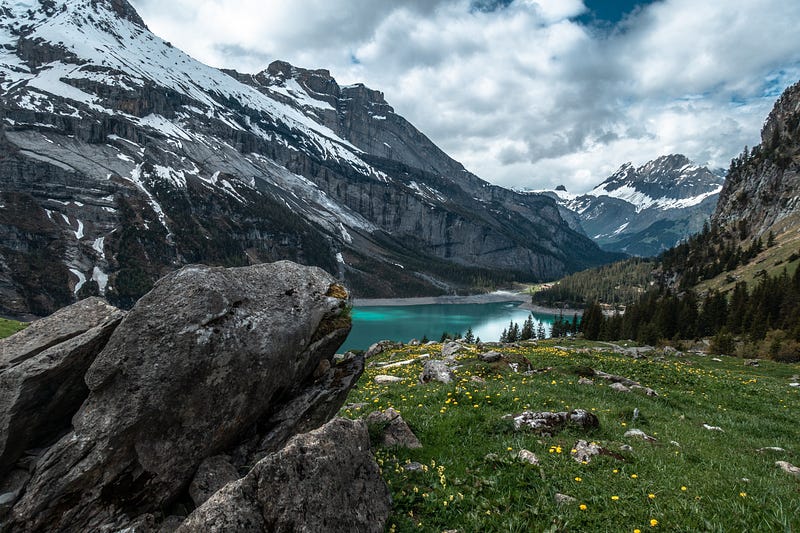
The mountains behind my house are white in winter.
But they long ago lost the shiny glacial caps they once had. Along the broad river, forests of corn grow in the summertime. Cows wander impassively from field to barn and back again. The fertile soil that feeds us comes from the action of grinding glaciers that carved out this valley on their way to the sea.
Have you ever stood on top of a glacier? They are fearful places. Lifeless rivers of ice filled with deep crevasses. Nothing lives up there. Nothing grows. The only sign of life is the occasional tortured groan of the grinding ice.
But the glaciers are gone now. As vanished as the wolves and lions that used to haunt the forests. Even the bears are on probation. The forests themselves are shrinking and thinning like a 40-year-old hairline.
It’s more comfortable to drive a tarmac road than bounce along a rutted wagon trail. We spare ourselves the jolts and let nature take the hit. Our efforts to eliminate pain mostly just pass it on.
Trees need storms. And forests need the fire that cleanses them, clearing out knotted growth to make space for something new.
People aren’t forests. But we are alive in this world in the same way as everything else. The salmon that flail and die as they reproduce, and the moths whose papery wings ignite in the firelight. Life is pain, Princess. I’m not trying to sell you anything. Ultimately, we are all born through the agony of our mothers.
What if no worthwhile achievement is possible without suffering? What if pain is not simply a fact of life, but a necessary and even desirable condition? What if pain, ultimately, is the pupa of paradise?
Nietzsche lived in the mountains, too.
Rising at five every morning, he would work until noon, then walk in the mountains that rise like shattered tusks into the clear Swiss sky.
“Only thoughts which come from walking have any value,” the philosopher said. The mountain air of his afternoon hikes creeps into his writing again and again.
“Philosophy,” he writes in Ecce Homo, “is a voluntary living in ice and high mountains.” And it’s in the works of Nietzsche that we find the best formulation of the idea that suffering may be something to be desired.
“Examine the lives of the best and most fruitful people and peoples and ask yourselves whether the tree that is supposed to grow to a proud height can dispense with bad weather and storms; whether misfortune and external resistance, some kinds of hatred, jealousy, stubbornness, mistrust, hardness, avarice, and violence do not belong among the favorable conditions without which any great growth even of virtue is scarcely possible.”
Nietzsche once wrote that without music, life would be a mistake.
But Nietzsche knew that music requires all notes, the sweet and the strong, the melodious and the discordant. Anyone who aspires to great achievement — as Nietzsche surely did — must allow themselves to remain open to the powerful shocks that flesh is heir to. It’s precisely that sensitivity that makes living worthwhile.
“What if pleasure and displeasure were so tied together that whoever wanted to have as much as possible of one must also have as much as possible of the other… You have the choice: either as little displeasure as possible… Or as much displeasure as possible as the price for the growth of an abundance of subtle pleasures and joys that have rarely been relished yet? If you decide for the former and desire to diminish and lower the level of human pain, you also have to diminish and lower the level of their capacity for joy.”
There is no front without a back.
Pleasure and pain run so close together because they are the same thing. The party and hangover are not two separate events, but parts of a single continuous motion. And by trying to get rid of pain, we risk losing the capacity for joy.
“You must have chaos in your soul to give birth to a dancing star.”
I don’t run without being chased. But those who do talk of the runner’s high, a euphoric release of endorphins that mines bliss out of agony. Pain and pleasure have a similar effect on the brain, releasing opioids into our swarming blood. You don’t need to be a masochist to see it. Anyone who’s climbed a mountain knows the weird elation and feeling of lightness that waits at the windswept summit.
Nietzsche himself suffered plenty. For all their insight, none of his books sold more than two thousand copies in his lifetime — many significantly less. He grew up without a father. He was perennially lonely. Hopelessly in love with the wife of his friend, composer Richard Wagner, he never married for himself.
He was plagued with poor health, and ultimately had a mental breakdown from which he never recovered. He spent the final eleven years of his life in an asylum before dying at fifty-five.
It was this stunted and compromised life, in part, that allowed Nietzsche to understand suffering. In keeping with his own philosophy, his pain is part of what made him great.
Pain exists in the gap between who we are and who we want to be. It’s the divide between the world we long for and the world that exists. For Nietzsche, as for all of us, sensitivity to that pain is the toll we pay on the path to ecstasy.
“The secret for harvesting from existence the greatest fruitfulness and the greatest enjoyment is — to live dangerously! Build your cities on the slopes of Vesuvius!”


