
Could a Philosopher Be the Cure for Those Who Want to Commit Suicide?
Immanuel Kant’s correspondence with the woman who wanted to commit suicide out of her love
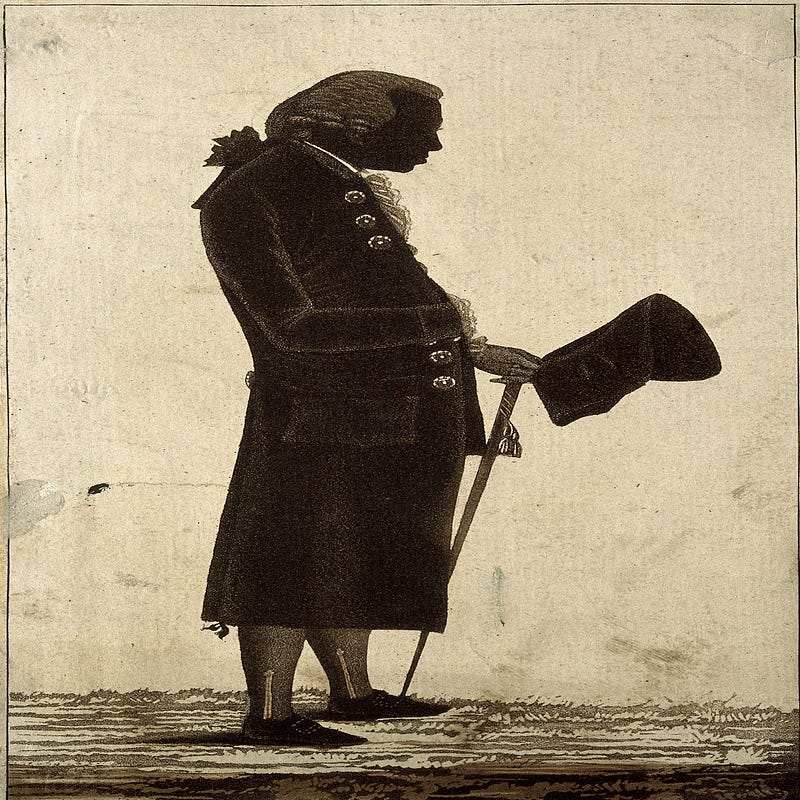
When Sophocles defined love, he said: “One word frees us of all the weight and pain of life: That word is love." Undoubtedly, love is such a magical word that the most virtuous feeling or is the most sinful for some, that connects us to life and allows us to embrace it passionately. Regardless, this magical state of love has an effect on human life that will completely renew or transform it.
However, this transformation does not always promise “happy endings” to us. When the loves we live do not cause a bilateral relationship, or when we desire an impossible love, we often go through a process that must be overcome emotionally. I have always wondered how the love and emotions experienced in the period when communication tools were not so common. At the end of the 18th century, Maria von Herbert, who caused her beloved person to move away from her life due to her own mistake, finds the solution to hold on to life by sending a letter to the famous philosopher Immanuel Kant. Let’s all now see the story of a woman who wanted to commit suicide and a philosopher who pays attention to her cries for help.
Kant receives a letter from Maria von Herbert of Austria in 1791. In her letter, Maria seeks advice from Kant to deal with a recent heartbreak that would drive her to suicide.
Great Kant,
As a believer calls to his God, I call to you for help, for comfort, or for counsel to prepare me for death.
Your writings prove that there is a future life. But as for this life, I have found nothing, nothing at all that could replace the good I have lost, for I loved someone who, in my eyes, encompassed within himself all that is worthwhile, so that I lived only for him, everything else was in comparison just rubbish, cheap trinkets. Well, I have offended this person, because of a long drawn out lie, which I have now disclosed to him, though there was nothing unfavourable to my character in it, I had no vice in my life that needed hiding
The lie was enough though, and his love vanished. As an honourable man, he doesn’t refuse me friendship. But that inner feeling that once, unbidden, led us to each other, is no more — oh my heart splinters into a thousand pieces!
If I hadn’t read so much of your work I would certainly have put an end to my life. But the conclusion I had to draw from your theory stops me — it is wrong for me to die because my life is tormented, instead I’m supposed to live because of my being.
Now put yourself in my place, and either damn me or comfort me. I’ve read the metaphysic of morals, and the categorical imperative, and it doesn’t help a bit. My reason abandons me just when I need it. Answer me, I implore you — or you won’t be acting in accordance with your own imperative.

Kant was impressed by the letter he received, and in his letter, he points to the distrust between people, and the lie that led to this is perhaps harmless, but certainly not innocent. He also sees suicide as a logical contradiction to the ethical decision-making paradigm. The answer is interesting:
Your deeply felt letter comes from a heart that must have been created for the sake of virtue and honesty, since it is so receptive to instruction in those qualities.
A love like that wants to communicate itself completely, and it expects of its respondent a similar sharing of heart, unweakened by distrustful reticence. That is what the ideal of friendship demands.
But there is something in us which puts limits on such frankness, some obstacle to this mutual outpouring of the heart, which makes one keep some part of one’s thoughts locked within oneself, even when one is most intimate. The sages of old complained of this secret distrust — ‘My dear friends, there is no such thing as a friend!’
We can’t expect frankness of people, since everyone fears that to reveal himself completely would be to make himself despised by others. But this lack of frankness, this reticence, is still very different from dishonesty. What the honest but reticent man says is true, but not the whole truth. What the dishonest man says is something he knows to be false. Such an assertion is called, in the theory of virtue, a lie. It may be harmless, but it is not on that account innocent. KIt is a serious violation of a duty to oneself; it subverts the dignity of humanity in our own person, and attacks the roots of our thinking. As you see, you have sought counsel from a physician who is no flatterer. I speak for your beloved and present him with arguments that justify his having wavered in his affection for you.
Ask yourself whether you reproach yourself for the imprudence of confessing, or for the immorality intrinsic to the lie. If the former, then you regret having done your duty. And why? Because it has resulted in the loss of your friend’s confidence. This regret is not motivated by anything moral, since it is produced by an awareness not of the act itself, but of its consequences. But if your reproach is grounded in a moral judgment of your behaviour, it would be a poor moral physician who would advise you to cast it from your mind.
When your change in attitude has been revealed to your beloved, only time will be needed to quench, little by little, the traces of his justified indignation, and to transform his coldness into a more firmly grounded love. If this doesn’t happen, then the earlier warmth of his affection was more physical than moral, and would have disappeared anyway — a misfortune which we often encounter in life, and when we do, must meet with composure. For the value of life, insofar as it consists of the enjoyment we get from people, is vastly overrated.
Here then, my dear friend, you find the customary divisions of a sermon: instruction, penalty and comfort. Devote yourself to the first two; when they have had their effect, comfort will be found by itself.
Kant has one last solution: Time. Only time can heal the emotional pain in the girl’s heart and cause their love to flare up. If time is not the answer, then love is “physical” rather than “moral”.

Maria’s final answer in its abbreviated form:
My vision is clear now. I feel that a vast emptiness extends inside me, and all around me — so that I almost find my self to be superfluous, unnecessary. Nothing attracts me. I’m tormented by a boredom that makes life intolerable.
…I’m indifferent to everything that doesn’t bear on the categorical imperative, and my transcendental consciousness — although I’m all done with those thoughts too.
…You may think I’m younger, but the only thing that interests me these days is getting closer to death. If you consider that I am still young and that each day interests me only to the extent that it brings me closer to death, you can judge what a great benefactor you would be if you were to examine this question closely. I ask you, because my conception of morality is silent here, whereas it speaks decisively on all other matters. And if you cannot give me the answer I seek, I beg you to give me something that will get this intolerable emptiness out of my soul.
Kant does not reply to this letter at all.
Maria von Herbert commits suicide in 1803.
References
Bilkent Philosophy. (2018). Story behind the picture: Maria von herbert. Retrieved from http://www.phil.bilkent.edu.tr/index.php/2018/12/15/story-behind-the-picture-maria-von-herbert/
Langton, R.Maria von herbert’s challenge to Kant. Retrieved from https://www.csus.edu/indiv/b/bellonc/Fall14/117/KantSuicide.pdf
Mahon, J. E. (2006). Kant and maria von herbert: Reticence vs. deception. Philosophy, 81(317), 417–444. Retrieved from https://www.jstor.org/stable/4127403


