avatarThe Wordsmith™🏳️‍🌈🇺🇸

Free AI web copilot to create summaries, insights and extended knowledge, download it at here

6462

Abstract

d Trump family members who travel with him. The lodging is invariably at one of Trump’s properties worldwide.</p><p id="e230">Favors for cash also figure in this tale. China gave Ivanka seven trademarks for her lifestyle brand at the time Trump was making noises about saving ZTE, a major Chinese telecommunications company. After White House meetings between Jared Kushner and top executives from Citigroup and Apollo Global Management, both companies made large loans to Kushner Companies including $184 million from Apollo. The next month, the SEC dropped an investigation into Apollo.</p><p id="201f">Foreign states are not immune to the prospect of buying influence in Washington through Kushner.</p><blockquote id="a2e5"><p>China, Israel, Mexico and the United Arab Emirates — “have privatelyscience, discussed ways they can manipulate” Mr. Kushner “by taking advantage of his complex business arrangements, financial difficulties and lack of foreign policy experience.”</p></blockquote><p id="7abe">Mz. Cottle proceeds to enumerate many violations of campaign finance laws by former campaign manager Brad Parscale.</p><p id="4061">In an allusion to Trump’s 2016 campaign slogan, “drain the swamp,” Mz. Cottle concludes,</p><p id="6831" type="7">Forget draining the swamp; the president slapped his name on it and began charging admission.</p><div id="ea85" class="link-block"> <a href="https://www.nytimes.com/2020/10/16/opinion/trump-covid-public-health.html"> <div> <div> <h2>Opinion | When Science Is Pushed Aside</h2> <div><h3>President Trump has politicized public health measures during a pandemic, costing untold lives. Kathleen Kingsbury…</h3></div> <div><p>www.nytimes.com</p></div> </div> <div> <div style="background-image: url(https://miro.readmedium.com/v2/resize:fit:320/0*X527F1TWGM63woMi)"></div> </div> </div> </a> </div><p id="379e">In <i>When Science Is Pushed Aside</i>, Jeneen Interlandi tackles Trump’s egregious effects on the authority of and the public perceptions of trustworthiness in government when the president wages an unrelenting war on science, in particular on the CDC, FDA, and EPA. Trump’s “relentless and cynical campaign against the institutions most responsible for turning science into sound policy.” has badly imperiled their effectiveness and triggered a crisis of confidence in the integrity and honesty of the Executive.</p><p id="5e21">In the past,</p><blockquote id="0213"><p>these institutions have set standards that the rest of the world still aspires to, for safe food and medicine, for clean air and water, and, until recently, for effective disease control. At their best, they stand as a bulwark against the apathy that can attend such difficult problems and as a beacon for human society’s highest ideals: intelligence, discernment, and moral action in the face of grave threats.</p></blockquote><p id="a485">At their worst, as they are after four years of Trump’s presidency, the institutions have bodies disconnected from and at war with their heads. At each agency, the phalanx of career civil servants that are its life-blood finds itself increasingly in a defensive encampment against the cadre of presidential appointments at the agency’s head. The president’s men are engaged in an unforgiving campaign to dismantle the agency (EPA), to force it to grant approvals imprudently (FDA), and to suppress or alter objective data and facts (CDC).</p><p id="c5d6">In exquisite detail, Mz, Interlandi lays out the continuous assaults on these three agencies over the president’s term. She condemns him as a “president who muzzles credible scientists and amplifies charlatans” and who has</p><p id="9229" type="7">lied, again and again, about the severity of threats the country is now facing — be they from climate change or the pandemic — even as reams of evidence make those threats plain.</p><p id="c205" type="7"></p><p id="3228" type="7">Mr. Trump’s disdain for science is so terrifying that two of the nation’s oldest scientific publications — Scientific American and the New England Journal of Medicine — have waded into the morass of electoral politics for the first time in their more-than-100-year histories. The Journal implored voters to fire the president come November, while Scientific American went a step further and endorsed Joe Biden.</p><div id="4c79" class="link-block"> <a href="https://www.nytimes.com/2020/10/16/opinion/trump-extremism-conspiracy-theories.html"> <div> <div> <h2>Opinion | The Radicalizer in Chief</h2> <div><h3>Violent extremists and conspiracy theorists found their tribune in Donald Trump. By Mr. Wegman is a member of the…</h3></div> <div><p>www.nytimes.com</p></div> </div> <div> <div style="background-image: url(https://miro.readmedium.com/v2/resize:fit:320/0*cDqhJi01B3mMZciM)"></div> </div> </div> </a> </div><p id="58da">In <i>The Radicalizer in Chief</i>, Jessee Wegman takes Trump to task for his “demagogy,” his “violent rhetoric, and its consequences,” for his “crude insults, trivial gripes and constant mockery of those who disagree with him,” and for his constant portrayal of himself “as another anti-government insurgent.” A portrayal one thinks he believes.</p><p id="ab50">Laying out instance after instance of Trump’s incitements of hate groups to action, from the attempted kidnapping of Gretchen Whitmer to the massacre of 23 people in an El Paso Walmart, Wegman builds a cogent and eloquent indictment of Trump’s continued, egregious conduct. He notes the deleterious effect on society done by Trump’s speech.</p><blockquote id="c1c9"><p>[P]art of what the presidency is about is norm-setting. When a president establishes that it’s OK to make fun of people with disabilities, or to be racist, or to lie, or to assault women, you see that replicated in society.</p></blockquote><p id="a878"></p><p id="bddf" type="7">This harm won’t end with Mr. Trump’s presidency. His toxic rhetoric has filtered down to elementary and secondary schools around the country, where children have been repeating the president’s most vile language for the past five years.</p><p id="43f6" type="7">“They hear

Options

it. They think it’s OK. The president says it. … Why [shouldn’t] they?”</p><div id="8028" class="link-block"> <a href="https://www.nytimes.com/2020/10/16/opinion/trump-working-class-economy.html"> <div> <div> <h2>Opinion | Why They Loved Him</h2> <div><h3>The president tricked working-class voters. But the problems he railed about are real. Kathleen Kingsbury, acting…</h3></div> <div><p>www.nytimes.com</p></div> </div> <div> <div style="background-image: url(https://miro.readmedium.com/v2/resize:fit:320/0*-lFejm8tzZTCeNr9)"></div> </div> </div> </a> </div><p id="76a8">In <i>Why They Loved Him</i>, Farah Stockman addresses Trump’s “fake populism.”</p><p id="20c8">Stockman writes of the many instances of American blue-collar workers losing their jobs to globalization, to the normalization of trade with China, to the flood of factory exoduses to Mexico that came with NAFTA, and to the “tyranny of global capitalism” which they saw as a “world order crafted by elites, for elites.”</p><p id="4c9e">Worse, the jobless were abandoned by the system. There was no effort to retrain them for the new jobs that appeared in the wake of the death of too many blue-collar jobs.</p><p id="7c96">During the height of euphoria about free trade in the 1990s, philosopher Richard Rorty wrote presciently that</p><p id="5b68" type="7">workers “will sooner or later realize that their government is not even trying to prevent wages from sinking or to prevent jobs from being exported.” At that point, he wrote, parts of the electorate “will decide that the system has failed and start looking around for a strongman to vote for — someone willing to assure them that, once he is elected, the smug bureaucrats, tricky lawyers, overpaid bond salesmen and postmodernist professors will no longer be calling the shots.</p><p id="a0cd">Trump was that strongman. To many of them, he still is. But for others of them, the realization that Trump lied, that he cared not a fig for their plight and that he instead “used blue-collar workers to get into the White House, only to hand over the keys to the one percent” has set in.</p><p id="fc03">Now that Trump’s fake populism has been exposed for the lie that it always was, many of the non-college-educated, blue-collar workers are realizing whose side he’s on. The extent of their disaffection with and defection from Trump will determine the election</p><div id="1f6f" class="link-block"> <a href="https://www.nytimes.com/2020/10/16/opinion/trump-foreign-policy-errors.html"> <div> <div> <h2>Opinion | The Foreign Policy That Wasn't</h2> <div><h3>Kathleen Kingsbury, acting editorial page editor, wrote about the editorial board's verdict on Donald Trump's…</h3></div> <div><p>www.nytimes.com</p></div> </div> <div> <div style="background-image: url(https://miro.readmedium.com/v2/resize:fit:320/0*V5vWbFQWplQ-AXzS)"></div> </div> </div> </a> </div><p id="8562">Finally, in <i>The Foreign Policy That Wasn’t</i>, Serge Schememann writes of Trump’s “incompetent statesmanship.” From Trump’s phone conversation with President Volodymyr Zelensky, to his failure to bring American troops home from around the globe, including Afghanistan, Syria, and Iraq, to his bizarre tête-à-têtes with North Korean despot Kim Jong un, Trump’s brand of failed international statesmanship leaves in its wake, a veritable cornucopia of</p><p id="a8f7" type="7">abandoned multilateral commitments [that] litter the halls of Washington, often for no reason other than that they were produced by previous presidents or somehow irked Mr. Trump.</p><p id="1357">From Vladimir Putin to Xi Jinping, from Recep Tayyip Erdogan to Crown Prince Mohammad bin Salman, there “doesn’t seem to be an illiberal leader Mr. Trump doesn’t admire.”</p><p id="c7cc" type="7">If Mr. Trump is re-elected, he will conclude that he has a mandate to continue in his dysfunctional statesmanship, and the world will have no choice but to conclude that the past four years were not an aberration, but the United States they now have to deal with.</p><blockquote id="3da4"><p>Trump’s willful ignorance of the world (before meeting Russia’s Vladimir Putin in Helsinki he reportedly asked aides whether Finland was part of Russia) combined with his disdain for diplomacy, intelligence and experience (“My primary consultant is myself and I have a good <i>instinct</i> for this stuff”) have often made bad matters worse.</p></blockquote><p id="62a1">Trump’s willful ignorance of the world (before meeting Russia’s Vladimir Putin in Helsinki he reportedly asked aides whether Finland was part of Russia) combined with his disdain for diplomacy, intelligence and experience (“My primary consultant is myself and I have a good <i>instinct</i> for this stuff”) have often made bad matters worse.</p><p id="c8e7">There doesn’t seem to be an illiberal leader Mr. Trump doesn’t admire. The president of the Philippines, Rodrigo Duterte, who has led a campaign against drug dealers and users linked to thousands of extrajudicial killings, was doing an “<a href="https://www.nytimes.com/2017/05/23/us/politics/trump-duterte-phone-transcript-philippine-drug-crackdown.html">unbelievable job on the drug problem</a>.” Viktor Orban, the <a href="https://www.nytimes.com/2018/03/27/world/europe/viktor-orban-hungary.html">autocratic prime minister</a> of Hungary, was “respected all over Europe.” Recep Tayyip Erdogan, <a href="https://www.nytimes.com/2020/06/10/world/europe/erdogan-trump-turkey-libya-syria.html">the authoritarian president of Turkey</a> who often telephones Mr. Trump, “has become a friend of mine.” When Crown Prince Mohammed bin Salman of Saudi Arabia became a global pariah over the murder of the journalist Jamal Khashoggi, Mr. Trump came to his rescue. “I saved his ass,” <a href="https://www.washingtonpost.com/national-security/trump-threw-saudi-arabia-a-lifeline-after-khashoggis-death-two-years-later-he-has-gotten-little-in-return/2020/10/02/699af7f6-04d5-11eb-8879-7663b816bfa5_story.html">the president said</a>, according to a book by Bob Woodward. “I was able to get Congress to leave him alone.”</p></article></body>

U.S. POLITICS | DONALD TRUMP | POLITICS OF DISASTER

Corruption | Anger | Chaos | Incompetence | Lies | Decay

AN AMERICAN PRESIDENCY ACCURATELY CHARACTERIZED BY SIX MISERABLE, MOURNFUL NOUNS
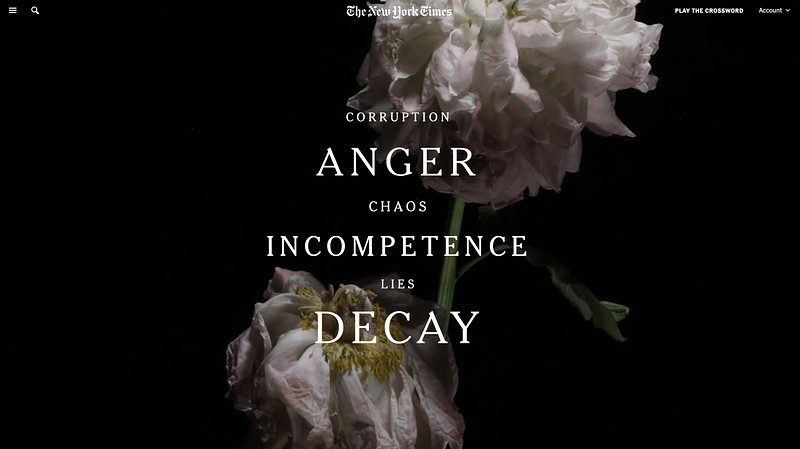
New York Times Editorial Page, 8 October 2020
The New York Times Editorial Board Calls For Trump To Voted Out Of Office, Sunday 18 October 2020

On Sunday, 18 October 2020, The New York Times editorial board took the unprecedented action of calling for the ouster on 3 November of Donald Trump.

The board made an editorial statement followed by links to five opinion pieces.

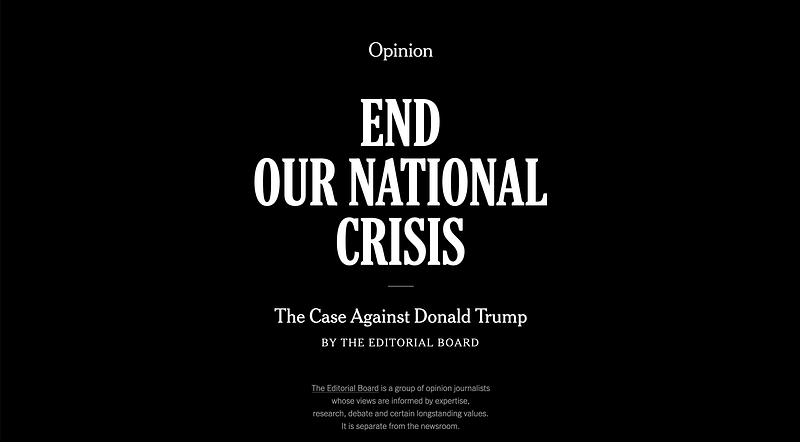
The Verdict Is In On Donald Trump | The New York Times Editorial Page, 18 October 2020

Donald Trump’s re-election campaign poses the greatest threat to American democracy since World War II.

Mr. Trump’s ruinous tenure already has gravely damaged the United States at home and around the world. He has abused the power of his office and denied the legitimacy of his political opponents, shattering the norms that have bound the nation together for generations. He has subsumed the public interest to the profitability of his business and political interests. He has shown a breathtaking disregard for the lives and liberties of Americans. He is a man unworthy of the office he holds.

The editorial board does not lightly indict a duly elected president. During Mr. Trump’s term, we have called out his racism and his xenophobia. We have critiqued his vandalism of the postwar consensus, a system of alliances and relationships around the globe that cost a great many lives to establish and maintain. We have, again and again, deplored his divisive rhetoric and his malicious attacks on fellow Americans. Yet when the Senate refused to convict the president for obvious abuses of power and obstruction, we counseled his political opponents to focus their outrage on defeating him at the ballot box.

Nov. 3 can be a turning point. This is an election about the country’s future, and what path its citizens wish to choose.

Read the Full Editorial

In The Self-Dealing Administration, Michelle Cottle, writes of Trump’s “unapologetic corruption.”

The lurid heart of Trumpist Washington lies within the grand, Romanesque-revival building at the corner of Pennsylvania Avenue and 12th Street, Northwest: the Trump International Hotel.

Under Mr. Trump, it now stands as both a monument to and a tool for advancing the endless spectacle of self-dealing and corruption that has come to define this president, his family and much of his administration.

She documents the extent to which not only Trump but also his large, extended family have turned the White House, indeed the entire administration into a series of “egregious self-enrichment projects.”

The Trump International Hotel daily hosts a”glut of lobbyists, lawmakers, foreign agents and other favor-seekers,” who spend lavishly knowing that the money will make it eventually to the Trump coffers and that that will please Trump and stroke his ego.

Others of Trump’s properties are involved in a “system of direct presidential influence-peddling unrivaled in modern American politics.” The Times has documented “over 200 companies, special-interest groups, and foreign governments that patronized Mr. Trump’s properties while reaping benefits from him and his administration.”

The Trump campaign and the Republican Party have been spending furiously (upwards of $4 million) at Trump properties in a direct funneling of campaign contributions to Trump business enterprises.

Mz. Cottle also recounts the massive spending of tax-payer dollars at Trump properties whenever he travels, including 530 nights at Mar-a-Lago and 950 nights at the president’s club in Bedminster, N.J. The public purse is out huge sums paid for airfare, lodging, and ground transportation for the Secret Service, embassy officials, and Trump family members who travel with him. The lodging is invariably at one of Trump’s properties worldwide.

Favors for cash also figure in this tale. China gave Ivanka seven trademarks for her lifestyle brand at the time Trump was making noises about saving ZTE, a major Chinese telecommunications company. After White House meetings between Jared Kushner and top executives from Citigroup and Apollo Global Management, both companies made large loans to Kushner Companies including $184 million from Apollo. The next month, the SEC dropped an investigation into Apollo.

Foreign states are not immune to the prospect of buying influence in Washington through Kushner.

China, Israel, Mexico and the United Arab Emirates — “have privatelyscience, discussed ways they can manipulate” Mr. Kushner “by taking advantage of his complex business arrangements, financial difficulties and lack of foreign policy experience.”

Mz. Cottle proceeds to enumerate many violations of campaign finance laws by former campaign manager Brad Parscale.

In an allusion to Trump’s 2016 campaign slogan, “drain the swamp,” Mz. Cottle concludes,

Forget draining the swamp; the president slapped his name on it and began charging admission.

In When Science Is Pushed Aside, Jeneen Interlandi tackles Trump’s egregious effects on the authority of and the public perceptions of trustworthiness in government when the president wages an unrelenting war on science, in particular on the CDC, FDA, and EPA. Trump’s “relentless and cynical campaign against the institutions most responsible for turning science into sound policy.” has badly imperiled their effectiveness and triggered a crisis of confidence in the integrity and honesty of the Executive.

In the past,

these institutions have set standards that the rest of the world still aspires to, for safe food and medicine, for clean air and water, and, until recently, for effective disease control. At their best, they stand as a bulwark against the apathy that can attend such difficult problems and as a beacon for human society’s highest ideals: intelligence, discernment, and moral action in the face of grave threats.

At their worst, as they are after four years of Trump’s presidency, the institutions have bodies disconnected from and at war with their heads. At each agency, the phalanx of career civil servants that are its life-blood finds itself increasingly in a defensive encampment against the cadre of presidential appointments at the agency’s head. The president’s men are engaged in an unforgiving campaign to dismantle the agency (EPA), to force it to grant approvals imprudently (FDA), and to suppress or alter objective data and facts (CDC).

In exquisite detail, Mz, Interlandi lays out the continuous assaults on these three agencies over the president’s term. She condemns him as a “president who muzzles credible scientists and amplifies charlatans” and who has

lied, again and again, about the severity of threats the country is now facing — be they from climate change or the pandemic — even as reams of evidence make those threats plain.

Mr. Trump’s disdain for science is so terrifying that two of the nation’s oldest scientific publications — Scientific American and the New England Journal of Medicine — have waded into the morass of electoral politics for the first time in their more-than-100-year histories. The Journal implored voters to fire the president come November, while Scientific American went a step further and endorsed Joe Biden.

In The Radicalizer in Chief, Jessee Wegman takes Trump to task for his “demagogy,” his “violent rhetoric, and its consequences,” for his “crude insults, trivial gripes and constant mockery of those who disagree with him,” and for his constant portrayal of himself “as another anti-government insurgent.” A portrayal one thinks he believes.

Laying out instance after instance of Trump’s incitements of hate groups to action, from the attempted kidnapping of Gretchen Whitmer to the massacre of 23 people in an El Paso Walmart, Wegman builds a cogent and eloquent indictment of Trump’s continued, egregious conduct. He notes the deleterious effect on society done by Trump’s speech.

[P]art of what the presidency is about is norm-setting. When a president establishes that it’s OK to make fun of people with disabilities, or to be racist, or to lie, or to assault women, you see that replicated in society.

This harm won’t end with Mr. Trump’s presidency. His toxic rhetoric has filtered down to elementary and secondary schools around the country, where children have been repeating the president’s most vile language for the past five years.

“They hear it. They think it’s OK. The president says it. … Why [shouldn’t] they?”

In Why They Loved Him, Farah Stockman addresses Trump’s “fake populism.”

Stockman writes of the many instances of American blue-collar workers losing their jobs to globalization, to the normalization of trade with China, to the flood of factory exoduses to Mexico that came with NAFTA, and to the “tyranny of global capitalism” which they saw as a “world order crafted by elites, for elites.”

Worse, the jobless were abandoned by the system. There was no effort to retrain them for the new jobs that appeared in the wake of the death of too many blue-collar jobs.

During the height of euphoria about free trade in the 1990s, philosopher Richard Rorty wrote presciently that

workers “will sooner or later realize that their government is not even trying to prevent wages from sinking or to prevent jobs from being exported.” At that point, he wrote, parts of the electorate “will decide that the system has failed and start looking around for a strongman to vote for — someone willing to assure them that, once he is elected, the smug bureaucrats, tricky lawyers, overpaid bond salesmen and postmodernist professors will no longer be calling the shots.

Trump was that strongman. To many of them, he still is. But for others of them, the realization that Trump lied, that he cared not a fig for their plight and that he instead “used blue-collar workers to get into the White House, only to hand over the keys to the one percent” has set in.

Now that Trump’s fake populism has been exposed for the lie that it always was, many of the non-college-educated, blue-collar workers are realizing whose side he’s on. The extent of their disaffection with and defection from Trump will determine the election

Finally, in The Foreign Policy That Wasn’t, Serge Schememann writes of Trump’s “incompetent statesmanship.” From Trump’s phone conversation with President Volodymyr Zelensky, to his failure to bring American troops home from around the globe, including Afghanistan, Syria, and Iraq, to his bizarre tête-à-têtes with North Korean despot Kim Jong un, Trump’s brand of failed international statesmanship leaves in its wake, a veritable cornucopia of

abandoned multilateral commitments [that] litter the halls of Washington, often for no reason other than that they were produced by previous presidents or somehow irked Mr. Trump.

From Vladimir Putin to Xi Jinping, from Recep Tayyip Erdogan to Crown Prince Mohammad bin Salman, there “doesn’t seem to be an illiberal leader Mr. Trump doesn’t admire.”

If Mr. Trump is re-elected, he will conclude that he has a mandate to continue in his dysfunctional statesmanship, and the world will have no choice but to conclude that the past four years were not an aberration, but the United States they now have to deal with.

Trump’s willful ignorance of the world (before meeting Russia’s Vladimir Putin in Helsinki he reportedly asked aides whether Finland was part of Russia) combined with his disdain for diplomacy, intelligence and experience (“My primary consultant is myself and I have a good instinct for this stuff”) have often made bad matters worse.

Trump’s willful ignorance of the world (before meeting Russia’s Vladimir Putin in Helsinki he reportedly asked aides whether Finland was part of Russia) combined with his disdain for diplomacy, intelligence and experience (“My primary consultant is myself and I have a good instinct for this stuff”) have often made bad matters worse.

There doesn’t seem to be an illiberal leader Mr. Trump doesn’t admire. The president of the Philippines, Rodrigo Duterte, who has led a campaign against drug dealers and users linked to thousands of extrajudicial killings, was doing an “unbelievable job on the drug problem.” Viktor Orban, the autocratic prime minister of Hungary, was “respected all over Europe.” Recep Tayyip Erdogan, the authoritarian president of Turkey who often telephones Mr. Trump, “has become a friend of mine.” When Crown Prince Mohammed bin Salman of Saudi Arabia became a global pariah over the murder of the journalist Jamal Khashoggi, Mr. Trump came to his rescue. “I saved his ass,” the president said, according to a book by Bob Woodward. “I was able to get Congress to leave him alone.”

Donald Trump
NYTimes
US Politics
Election 2020
Elections
Recommended from ReadMedium