
Coronavirus Is Widening The Gender Gap For Working Mothers
Mothers have disproportionately reduced work hours due to the coronavirus pandemic.
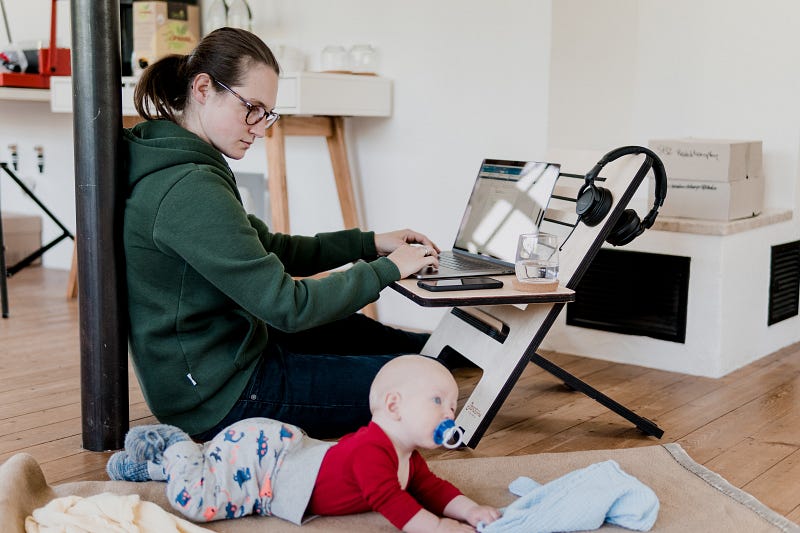
Despite hopes that the coronavirus pandemic might equalize the situation between men and women, it has only made things worse for working mothers. When changes in work schedules have to be made, mothers are taking the reductions. New research shows that the decrease in mothers’ paid work is exacerbating the gender gap, and could have long-term consequences.
“Our findings indicate mothers are bearing the brunt of the pandemic and may face long-term employment penalties as a consequence,” said Caitlyn Collins, assistant professor of sociology in Arts & Sciences and co-author of the study in a press release.
The pandemic is increasing the gender gap
The gender gap in work hours has increased during the pandemic. Data came from 60,000 households surveyed by the U.S. Current Population Survey. The researchers looked specifically in changes from February to April in dual-earner heterosexual married households.
In April mothers’ work hours fell four to five times more than fathers’ hours did. While fathers continued working roughly the same hours they had before, mothers reduced work hours by about two hours a week, or 5%.
The biggest impact on mothers’ ability to work came if they had young children who needed a lot of caregiving. Elementary school aged kids also needed a lot of help from parents during homeschooling.
But what about homes where both parents worked by telecommuting? Surprisingly, the gender gap was the same. Fathers continued to work 40 hours a week, while mothers reduced their hours.
“Even among households in which both parents are able to work from home and are directly exposed to childcare and housework demands, mothers are scaling back to meet these responsibilities to a greater extent than fathers. Ultimately, our analyses reveal that gender inequality in parents’ work hours has worsened during the pandemic,” Collins said.
Why does gender equity matter?
“Equality of opportunity is good economics,” the World Bank has said. If women participated in the economy equally to men, they would add $28 trillion or 26% to the global annual GDP by 2025, according to McKinsey. On the other hand, our existing gender gap is estimated to reduce the world GDP by 15%.
These numbers are estimates based on employment rates before the pandemic. Now, things are worse. 20.5 million American workers became unemployed in April, but 55% of those were women.
“There are a number of reasons why this has occurred,” Lori Sokol, executive director and editor-in-chief of Women’s eNews told Forbes, “including that women comprise a majority of primary caregivers and workers in the service industry, two areas that have been most impacted by Covid-19. But the financial impact is only half the story. Since a majority of frontline health workers are also women, they have been more apt to contract the virus, and suffer its health consequences.”
Women working less is a downward spiral
Inequity now has a way of snowballing into greater inequity later. It’s long been observed that even temporary decreases in a woman’s work engagement have negative effects on her career later. The impact of even that 5% reduction in hours on women’s careers may continue long after the pandemic.
“Scaling back work is part of a downward spiral that often leads to labor force exits — especially in cases where employers are inflexible with schedules or penalize employees unable to meet work expectations in the face of growing care demands,” Collins and her co-authors wrote.
Not only that, but the researchers were also concerned that employers who needed to look for ways to save money might do it “at the expense of mothers who have already weakened their labor market attachment.” And what about future promotions? Are they more likely to go to the men who continued working the same hours during the pandemic? It’s a consequence women have experienced on the “mommy track” before.
Why are women losing out?
The researchers considered the possibility that financial stress leads families to prioritize the primary earner, which is most often a father. Or perhaps crisis makes us fall back on the familiar, leading us to divide household labor according to traditional gender roles.
In the end, we can speculate about why women in America are disproportionately taking on the childcare and education of their children. But this is a well-established pattern in American culture where working mothers receive little of the societal support they do in other Western countries.
“Without a robust social safety to help support families when they fall on hard times-the sort that exists in different forms in every other western industrialized country-U.S. families are left on their own to adopt private solutions to their struggles. Unfortunately, in reality, ‘left on their own’ too often means ‘left to women,’” Collins told me in an email.
Crises can prompt dramatic changes in culture, but they can also reinforce traditional patterns.
Women’s work hours are not getting better soon.
There is no clear end is site to the gender based shift in work hours. Even as workplaces reopen and telecommuting decreases, the pandemic is radically impacting daycares and schools. With many schools going back at hybrid schedules that involve learning at home, many parents will simply be unable to be at work.
Preventing a mass exodus of mothers from the workforce must be a priority.
“Flexibility is key right now,” Collins said. “By easing work demands and allowing flexibility where possible in the coming months, employers can prevent long-term losses in women’s labor force participation. And fathers should be encouraged to provide more hours of care for their children, even if it means sacrificing paid work hours to do so.”
Need some parenting support? Get a copy of The Ultimate Parenting Checklist. These five bits of uncommon wisdom from a pediatrician will make your life as a parent much easier.
Originally published at https://www.forbes.com.


