
Coronavirus/CoVid-19/Pandemic/Health
Coronavirus In The Netherlands — Update 30 April 2020
The newest update from the Coronavirus crisis and pandemic in The Netherlands.
Rob van der Kolk of the National Consortium on Aids says in the briefing to The House of Representatives that the tools market has become a fighting market due to Coronavirus pandemic “Loads are literally stolen, cash is paid at the gates of the warehouses, and extortionate prices are being asked worldwide.” According to him, it has been a search for reliable manufacturers and suppliers of mouth masks. Van der Kolk: “There were four emails per minute with all kinds of offers from neighbors who also traded with China.” He also says: “Now There are thirteen reliable suppliers of the FFP2/3 mouth masks, five for surgical masks, twelve for insulating jackets, and four for examination gloves. Nearly 150 million FFP2/3 mouth masks have now been purchased. Just over four million of these were delivered. More than 73 million surgical masks have been ordered and 18 million have been delivered.”
Music venues and night clubs must remain closed until the 1st of September 2020. Yesterday, the Security Region Amsterdam-Amstelland determined in a new emergency command that they come under the identical scheme as events. The Coronavirus measurements were unclear for them because it was not obvious whether the division falls under catering or events. The catering business needs, in any case, stay closed until the 20th of May and events are forbidden until the 1st of September 2020. At the request of the central government, the new regulation includes a wider meaning of events. This now includes “any publicly accessible entertainment operation”. “This means that, in principle, entertainment activities, including in music venues and clubs, are prohibited,” said a statement. All 25 security regions are embracing the regulation so that there can be no uncertainty in the rest of the nation. It is permissible for the sector to make plans for reopening, taking into account the requirements to keep a distance of one and a half meters. In discussion with the State, it will then be investigated whether they can take effect before the 1st of September 2020.
Feike Sijbesma, the Coronavirus ambassador for The Netherlands — appointed by the Dutch government, explains in The House of Representatives that in the duration of jobs in the labs, everyone in the Netherlands could be tested with Coronavirus complaints today. But the problem is that the test material is not there yet. There is a shortage of good test material on the world market. Sijbesma: “About all other countries have the same problem. The manufacturers say ‘you are really not the only one in the Netherlands’.” Sijbesma thinks it is a positive development, given these circumstances, that the target groups have been increased to include primary school teachers and other specific professions. In any case, it makes no sense to test people who do not have clear Coronacirus complaints, because it is a snapshot. “Then you have to test it again the next day, and the next day,” says Sijbesma. He is jointly accountable for the purchase of test material and protective equipment. Tests are important for a number of reasons. Those who have been tested positive isolate themselves so as not to infect others. Besides, a test provides insight into the way in which the Coronavirus circulates, and the state can use that knowledge in policy-making. There are two types of tests. One means whether you are sick, the other whether you have had the virus. Sijbesma describes the conditions for good testing: “Not all tests have been approved and we do not approve of all available tests. In addition, the tests must be able to be taken by a doctor or another expert. Thirdly, you need material to administer those tests. And fourthly there are laboratories where you can deliver the test material. These laboratories all have different machines. That makes the process very complex.” The test volume has grown a bit in recent weeks, says Sijbesma. At the end of March, 3000 to 4000 tests could be done per day. At the end of April, it was 6,000 to 7,000 a day. In a week there will be tests for dentists, teachers, and other professions and the total will be 8000 per day. Sijbesma emphasizes that the laboratories in The Netherlands have enough capacity to test everyone with corona complaints. “But there is a shortage of good test material on the world market. About all countries have the same problem.”
The GGDs will test more from 6 May. Jan Woldman says this, on behalf of GGD GHOR Netherlands, in the briefing in the House of Representatives. These are primary education workers, employees of nurseries and out-of-school care, and professional childminders. Youth trainers who start exercising again with children can also be tested from that date. Next week, the GGD will come up with a plan for quickly expanding the number of employees for source and contact research. An RIVM guideline is being prepared for everyday caregivers so that they can also be tested as soon as possible. The GGDs do part of the tests in The Netherlands. In addition to patients, most hospitals also test their own employees. Woldman explains that in addition to testing, there should also be a capacity for source and contact research. This means that the GGD must have enough people who can trace an infected person with whom this person has had contact, in order to prevent further spread. “The capacity of testing and that source and contact research must continue to go hand in hand,” says Woldman.
An emergency fund from Maastricht University (UM) has so far paid almost 35,000 euros to students who have run into financial problems due to the Coronavirus crisis. Due to the crisis, many students have no side job and therefore no income. Foreign students, in particular, have proposed a request. “These are students with acute financial difficulties,” says Martin Paul, president of the university’s executive board at Dutch provincial TV station, 1Limburg: “For example, they run out of money to run errands or pay for their room.” Students can get an interest-free loan of up to 1500 euros. When someone graduates from Maastricht University, the loan is converted into a gift.
The Dutch government has had the chance to perform thousands of additional tests for the coronavirus every day for weeks but does not use it. 5000 tests per day can be taken for two months via a German laboratory. It would almost double the Dutch test capacity. The Diagnostics Task Force, which arranges scarce test materials on behalf of the Ministry of Health, confirms that the offer has been made, but does not yet mention the additional tests.
The one and a half meter society, according to research firm Locatus, should not cause many problems in the shopping streets. In 16 of 130 shopping areas surveyed, it can be difficult to keep a meter and a half away on Saturday afternoons. 500 to 550 people can pass per hour per street width. In the Amsterdam Kalverstraat, which is 8 meters wide, that is at least 4000 passers-by per hour. At the busiest point measured before the corona crisis, there were 6,700, making Kalverstraat one of the bottlenecks. Other places where, according to the agency, it was more crowded than what is currently acceptable are the Nieuwendijk in Amsterdam, De Klanderij in Enschede, Diezerstraat in Zwolle, Spuistraat in The Hague, Hoog Catharijne in Utrecht and Rechtestraat in Eindhoven. “We do not expect that with the relaxation of the lockdown measures everyone will immediately return to normal. It will remain a bit quieter in the shopping streets and we will enter the somewhat quieter summer period anyway. Also, foreign tourists will not yet come to us in large numbers country,”, says research director Gertjan Slob. “Municipalities, retailers’ associations and center managers will have to think carefully at critical places and times about how they will monitor and enforce this.”, he continues.
Some primary schools no longer allow preschoolers to enter for the summer holidays, Dutch newspaper Trouw writes. They find it difficult to get used to new pupils, because parents are not allowed to come in and the children have to do everything themselves, such as hanging their coat and going to the toilet. It is not known how many schools are involved, but a few parents have reported to the Parents and Education information point. They are in trouble because they have already canceled the childcare contract and cannot always renew it because of waiting lists. “The four-year-olds are welcome at school on May 11, as are all other students,” a PO Council spokesperson told the newspaper. He hopes that “parents and schools will find an appropriate solution so that the four-year-olds can attend a few hours of education a week.”
The KBO-PCOB senior organization is going to ask caregivers and other close relatives of nursing home residents what it does to them that they are not allowed to visit their loved ones. Next week, the Cabinet will decide on an adjusted visitation scheme for nursing homes. KBO-PCOB director Manon Vanderkaa said in the NOS Radio 1 News that the survey is intended “as input” for the minister. Experiences are important in the possible extension of the ban, says the elder union. According to her, there is a lot of talk about these people at the moment and rarely with. Now that there is a view of some visitor pilots in nursing homes, there is hope, according to the elderly association. Vanderkaa: “One of the biggest dramas of this corona crisis takes place behind the closed doors of nursing homes. People are lonely, anxious and miss their loved ones. But it is also hard work for family members and caregivers.”
In the near future, Dutch municipalities are in danger of running into financial difficulties due to the corona crisis. One in three municipalities failed to draw up a balanced budget before 2020, NRC reports. Based on the budget, more than a quarter of the municipalities already fell into the ‘risk category’ that is most at risk. The corona crisis is deteriorating the financial position of municipalities. They miss out on millions due to missed parking revenues, tourist taxes and deferred tax for entrepreneurs. The biggest gaps in the budgets of municipalities fall in social tasks, such as youth care, social assistance and the WMO, the support that ensures that older people can stay at home for longer. Nine municipalities could not get a single budget until 2023, or only after submitting a recovery plan. These are Borsele, Middelburg and Vlissingen in Zeeland, The Hague, Vlaardingen and Zwijndrecht in South Holland and Assen in Drenthe and Haaksbergen in Overijssel.
Supermarkets and drugstores sold significantly more in March than in the same period last year. Many people hoarded because of the corona crisis. Supermarkets recorded a turnover increase of 13.1 percent in that month. Retail sales in March were 2 percent higher than a year earlier, Statistics Netherlands reported. Electronics and DIY stores also performed well, recording the largest increase in turnover since 2005. Clothing and shoe stores performed poorly, and suffered the largest loss in turnover since 2005. The corona crisis therefore has a varying effect on the retail trade. For example, online stores benefited with a 29 percent increase in sales.
An excerpt from a NOS video in which Prime Minister Rutte is visiting a waste processing plant has reached Italy and Spain. An employee there calls to him that no money should be given to Italy and Spain.
Compared to last year, far fewer asylum applications were made in the Netherlands in March. Last month, there were 1,025 requests from people who first applied for asylum. In March 2019, this was almost twice as many. The number of applications in March was also lower than in January and February. According to the Central Bureau of Statistics, the decrease is due to international and national measures surrounding the corona crisis. On 15 March, the asylum procedure in the Netherlands was suspended due to corona. In the meantime, asylum seekers were received in the barracks in Zoutkamp (Groningen). Since last week it is again possible to apply for asylum and asylum seekers can move on to regular reception in AZCs if they do not have any symptoms of corona. A quarter of the asylum requests came from Syrians in the first three months of the year. They are followed by people from Algeria, Turkey, Nigeria and Morocco. The number of asylum requests from people of Moldovan nationality was practically zero in the first quarter. Last year, 320 Moldovans made an asylum application in the first three months.
Museum of Bags and Purses Hendrikje in the center of Amsterdam ends. The museum, which has been closed for a month and a half due to corona, does not have enough money to continue “long-term” after the crisis, according to a press statement. “Partly in view of current developments in society, there is insufficient prospects for the future.” The bag museum, named after founder Hendrikje Ivo, existed since 1996 and was initially located in Amstelveen. In 2007 it went to the Herengracht in Amsterdam. It attracted about 70,000 visitors a year and had about 5,000 bags in its collection. Museum director Manon Schaap, who took office a year ago, is disappointed. “I am very sad that I have to close the doors of this beautiful museum. Together with my team we were working to bring the vision regarding the bag, identity, fashion, fashion and society to life. Unfortunately, reality has overtaken us .”
The European Central Bank will support banks even more because of the corona crisis. From May, the ECB will lend extra cheap money to banks, with the aim of keeping lending to companies and consumers up to standard. Interest will be negative, so banks will have to repay less to the ECB than they borrow. Last month, the ECB decided to pump an extra 750 billion into the economy by buying up bonds from states and companies. The ECB now says that if necessary, the amount can also exceed that 750 billion.
At RIVM, 13,884 healthcare workers with corona were reported. It concerns care workers aged 18 to 69 years inside and outside the hospital. Of those, 458 were hospitalized, representing 3 percent of the total. Nine health workers have been reported to have died. Six of them already had health problems. This is not yet known for the other three, RIVM reports. It is not known whether the employees contracted the virus during or outside their work. Healthcare workers are tested more often than others.
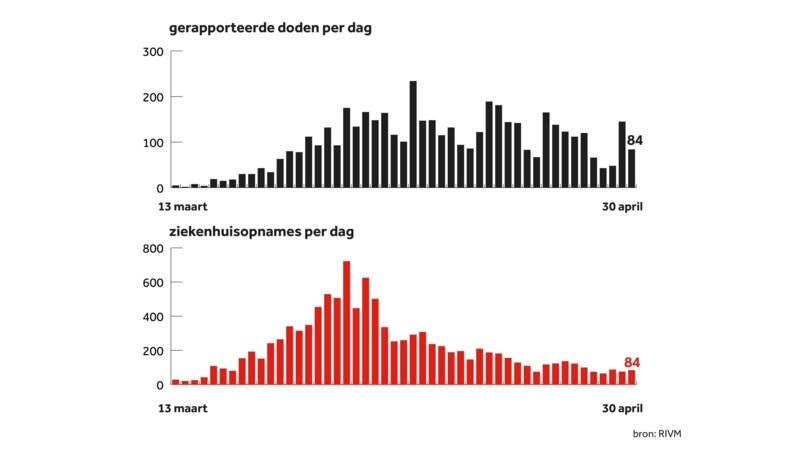
84 new corona patients have been or have been hospitalized. RIVM reports this. There are more than yesterday, when there were 76. The total number of corona patients who have been or have been hospitalized is 10,769. The death toll from the coronavirus has risen by 84, the RIVM reports. That is less than yesterday, when 145 deaths were reported. Not all patients died within the past 24 hours, there is a delay between the day of death and the day that death is reported. There is also a delay in the admission figures. As far as is known, a total of 4,795 people in the Netherlands have now died from the effects of the Coronavirus. This number is actually higher, because only tested patients are included if they die from the consequences of an infection. The number of newly reported infections is 514. In total there are now 39,316 cases of infection known. Because not everyone is tested, the actual number of infections is higher.
There are schools that, despite the urgent advice from Minister Slob of Education and Culture to teach all day, still opt for half lesson days. This is signaled by the organization Parents and Education, which now has 60 reports of this. “This leads to hassle for parents, for example because there is abruptly no connection with out-of-school care. We also see that children from one family have to be taken and brought on different days, so that parents are still unable to work.” Minister Slob prefers to see schools offering the students lessons (alternately) all day, but also wants to give schools the opportunity to deviate from this if they do not consider it feasible.
A KLM Boeing has landed at Schiphol for the first time with a cabin full of facemats. Passenger aircraft had before been used for medical freight, but now things were also on the seats and in the luggage boxes from Shanghai. The cabin has room for about 40 percent of the total freight capacity. The packages were tied to the chairs. 300,000 mouth masks were carried in the cabin, reports NH News. It also contained protective clothing. These types of flights may also come later from Beijing and Hong Kong.
Track cyclists have returned to their training on the track in the Omnisport in Apeldoorn. The National Training Center has been closed since March 15 due to the Coronavirus, but professional athletes are welcome again from today. Sports dome NOC*NSF adopted the rules proposed by cycling association KNWU. For example, a maximum of two riders can ride in the track at the same time and only one coach and a mechanic are allowed in the middle area, where everyone must keep a distance from each other.
The National Consortium Aids has opened a special ordering site for protective equipment. Ernst van Koesveld, director-general of Long-term Care at the Ministry of Health, Welfare and Sport invites health care providers and hospitals to order the items there and to stop looking for them: “We know that these resources are reliable.” Rob Van der Kolk of the National Consortium verifies this during the briefing in the House of Representatives: “I prefer our call center to be busy taking orders rather than explaining to suppliers again that we really have enough.” According to Van Koesveld, there are sufficient protective equipment for care systems, home care organizations and hospitals at the national distribution center. MPs are still regularly told that caregivers cannot get the proper masks, but according to him that is not necessary. Next week it will be announced how caregivers can order their medical aids. This may be done via a regional distribution.
The Netherlands has ensured to have additional supplies of the anesthetic agent Propofol, which is used for the ventilation of Coronavirus patients on ICUs. The National Coordination Center for Medicines (LGC) has thus averted imminent shortages. The lot comes from South Korea and is delivered to the Netherlands in three shipments. The first shipment arrived at Schiphol this morning. Because corona patients often have to be ventilated for weeks, stocks of propofol are under pressure worldwide. Last week, the LCG called on hospitals to adopt a propofol-sparing policy.
Physiotherapists can start treating more patients again, their professional organization says. They can “return to work after a self-imposed period of limited accessibility”. The condition is that they adhere to the hygiene measures and it is possible to keep as much distance from each other in their practices. The advice was issued with the approval of RIVM. Currently, according to the organizations, it is not yet possible to treat as many patients as before the corona crisis. People with serious complaints will be given priority and less necessary treatments will be done remotely. The care provider decides the order. Hearing screening for newborn babies can also be resumed, State Secretary Blokhuis writes to the House. The screening was temporarily halted on March 24 due to the corona crisis, as concerns were raised as to whether additional diagnostics and treatment were possible. The hearing examination is performed in the first week after birth at the same time as the heel prick. The State Secretary writes that the regular program can be resumed immediately.
Staff in primary education and childcare and after-school care can be tested from 6 May for complaints. For example, before the schools and childcare open again on 11 May, they can already determine whether they have been infected with the Coronavirus. Youth trainers can immediately have themselves tested for the corona virus in case of complaints. Caregivers of vulnerable people can be tested by the GGD with effect from 18 May if they have complaints. Currently, about 6,000 to 7,000 tests are taken per day from healthcare employees inside and outside hospitals who provide direct care to patients or clients. That fits well within the available capacity of 17,500 tests per day. Therefore there is room to test the new groups. RIVM has calculated that with the addition of the groups, the number of tests per day in May is expected to be around 8000.
Textile manufacturers are calling on the government to quickly come up with guidelines that mouth protection must meet. They expect high demand from contact professions such as hairdressers and physiotherapists. Manufacturers are concerned that they may start their production late and that valuable time is lost when reopening some sectors. Corien Beks of textile industry organization Modint says that the members are eagerly awaiting the sector protocols. “Once we know what’s in there, our manufacturers can get to work. We have members who manufacture and supply protective medical clothing. They understand these things. Now they are losing valuable production time.” Also corporate clothing designer Dyanne Beekman, who designs corporate clothing for McDonalds, is also thinking about the future of mouth protection. “I envision a kind of cotton caps, the filter of which can be replaced. That way, there are no mountains of caps to be thrown away and we have less chance of a shortage of raw materials in the future.”
The annual Sziget festival in the Hungarian capital Budapest has been canceled. The Hungarian government has extended the ban on large-scale events to August 15. The festival would take place from August 5 to 11. Half a million people visit the festival every year, including many Dutch people. “As difficult as that is, we believe this decision is best for the safety of all of you and everyone working at our festival. We can’t wait to see you again at The Island of Freedom next year,” the organization wrote of the festival on the website.
The number of corona patients in intensive care has been falling for more than two weeks, but that does not mean that the workload for IC doctors will decrease quickly. Diederik Gommers of the Dutch Association for Intensive Care said in Jinek that people are preparing behind the scenes for a possible next peak. Work is being done on scaling up beds, among other things. “We don’t know how it will develop further,” said Gommers. “That is the uncertainty.” The IC doctor takes into account a new peak in, for example, the winter period. Relaxation of the corona measures could also lead to an increase in required IC beds. Gommers kept a close eye on whether the situation before the virus outbreak will ever return. “Maybe all intensivists and ICU nurses have to get used to the fact that we keep working differently.”
Always check the (latest) facts with your country.
The numbers and stories are from yesterday or earlier this day. I haven’t seen new numbers so far, when there will be new numbers, rules and interesting situations here in The Netherlands, I will inform you.
Read more Coronavirus stories:
- Coronavirus In The Netherlands — Update 28 And 29 April 2020
- Coronavirus in The Netherlands — Update 27 April 2020
- Coronavirus In The Netherlands — Update 24 April 2020
- Coronavirus In The Netherlands — Update 22 April 2020
- Coronavirus In The Netherlands — Update 20 and 21 April 2020
- Coronavirus In The Netherlands — Update 19 April 2020
- Coronavirus In The Netherlands — Update 18 April 2020
- Coronavirus In The Netherlands — Update 17 April 2020
- Coronavirus In The Netherlands — Update 16 April 2020
- The Coronavirus In The Netherlands — Update 14 April 2020
- The Coronavirus In The Netherlands — Update 13 April 2020
- Coronavirus In The Netherlands — Update 12 April 2020
- Coronavirus In The Netherlands — Update 10 and 11 April 2020
- Realized The Weird Feeling Of This Time
- Coronavirus In The Netherlands — Update 7 April 2020
- Coronavirus In The Netherlands — Update 4, 5 and 6 April 2020
- Coronavirus in The Netherlands — Update 27 and 28 March 2020
- Coronavirus in The Netherlands — update 26 March 2020
- Coronavirus Stories and What Emotions do with us
- Coronavirus in The Netherlands — update 25 March 2020
- Coronavirus in The Netherlands — Update 22 and 23 March 2020
- Coronavirus: How To Live As Normal As Possible
- Coronavirus in The Netherlands — Update 21 March 2020
- The Coronavirus in The Netherlands
- Coronavirus — Get The Positive Thoughts and Focus
Agnes Laurens is a writer. She writes for the local newspaper. Agnes lives in Bunnik, The Netherlands, with her husband and three daughters. Writing is — aside from playing the violin — one of her passions since childhood. She is on Twitter and Instagram.
As soon as my Patreon page is ready to be launched, you’ll be the first one who will get notifications when you subscribe to my mailing list and subscribe to my Thoughts.


