
Corn Grows From Thin Air
why all the carbon in corn comes from the atmosphere

I come from a long line of farmers who feed the nation, forming the backbone of America. I vividly remember spending my childhood years riding with my dad in his combine as he harvested corn. But where exactly did this 8-foot stalk of corn come from? The obvious answer is from the soil. However, there is one not-so-obvious, but more intriguing answer. Corn grows from the ocean-of-air that surrounds us.
Moisture was all they needed
Before planting season, my dad used to test his seeds by sprouting them in a damp paper towel. In a few days, the seeds would sprout roots. This is interesting, this means the soil is not needed to sprout roots, only moisture is necessary. After testing the seeds, he would plant thousands of them a few inches below the soil in straight lines. A few weeks later, thousands of leaves would emerge from the soil in perfect rows.
The biological solar panel
The leaf is a very efficient biological solar panel turning CO2, water, and sunlight into sugars and oxygen, and this is where our story gets interesting. The leaves that emerge have little holes — stomata — that let CO2 from the air into the plant. Like a garden hose, the xylem brings water from the roots to the leaf. Last, the leaf contains a solar receptor — chlorophyll — which captures sunlight. This light provides the energy needed to rearrange atoms in the CO2 and water into oxygen, which is released back to the atmosphere, and sugar, which is the plant’s food. The sugars are then used in different downstream processes, allowing the plant to form other building blocks and grow. These processes require nutrients, such as nitrogen and phosphorus, which the roots get from the soil.
The roots of the plant hook into the soil to suck out the moisture, but the roots are not sucking up the soil itself. If they did, a sinkhole would form under every tree on the planet. So, are plants growing from the soil or the air? In my mind, the soil simply replaces the paper towel as a medium for moisture and nutrients.
A simple experiment showing plants take up CO2
A simple experiment, which would make a great science fair project, can show plants are actually taking up carbon from the atmosphere. The experiment would start with two pots: a control pot with only soil and a second identical pot of soil planted with seeds. Each day, you water each pot with the same amount of water. Then record the weight of each pot every day. While the pot without seeds might show minor changes, the major weight increase will be in the pot sown with seeds. The only explanation for the weight increase is that it must come from the atmosphere. Please let me know if you build a project around this idea, as I would be interested in seeing the results.
Earth is breathing
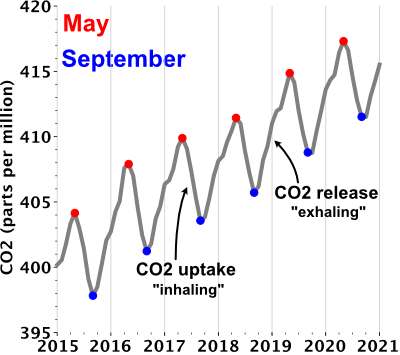
By now it should be clear that the carbon in a blade of grass, a tree, and a stalk of corn all came from the atmosphere. Our Earth inhales in the spring and summer and exhales in the fall and winter. These are the thoughts that go through my mind when I’m driving down a Minnesota country road during harvest season. That, and, “sweet corn sounds good for dinner.”
Editor: Dr. Rachana Maniyar
Thank you for reading and supporting Medium writers


