
Copyright and Social Media
Free to access ≠ free to use.
When we’re looking for images and content for our articles, we all know to abide by copyright law or risk the consequences. But if we don’t know what the rules are, we can end up breaking them — and many of us do. If we’re lucky, we just get asked to take the content down. But creators have a right to defend their creation, and they’re within their rights to sue you if you rip off their stuff. Things get shared on social media and elsewhere, and there are rules that still apply in what seems like an internet-enabled Wild West.
You cannot just take images and content off of social media feeds and use it in your own work.
Incredibly, there are journalists who have gone on record saying that this is absolutely fine. What’s more likely is their editors have told them they’ll likely get away with it. Sometimes it happens with no warning — there will be a story involving a member of the public, and their social media feed will be trawled for their drunken holiday snaps (especially if they’re on benefits) without their knowledge or permission. Other times, one of the tabloids spots a picture in a news feed, asks the owner of the photo if they can use it, the owner says no and the paper goes ahead and uses it anyway.
This is not on — and if it happens to you, you can demand payment or that they take it down. By the same token, if you use someone else’s photos without permission or a license, they can come after you. So don’t do it.
Some people think that once you post something on social media, it’s out there and free to use by anyone who sees it. If that were the case, social media providers wouldn’t need to have a contract with you as anyone would be doing whatever they wanted with everyone else’s content, in a massive free-for-all. But the internet does actually have rules, and countries have laws that you need to follow.
There is one exception to the rules for images on social media, and it should be used sparingly. If you are reporting on a story and it is in the public interest to use a photo from social media — missing person, wanted criminals, etc — then it’s possible (and reasonable) to argue fair use. Some tabloid papers (and even broadsheets) will stretch the idea of public interest until it’s meaningless, though, and that’s when it’s time to make a claim against them.
Copyright
In the UK, copyright exists the instant a new work is created. There is no copyright registration in the UK, and works do not need a copyright symbol or statement — although it may help if you needed to prove copyright in a court case. The owner of the copyright is usually the creator unless they have created the work for a business they are employed by — in which case the business holds the copyright. So if you post an original image on social media, the copyright either belongs to you or the organization you’re posting on behalf of.
If the image doesn’t belong to you, then you need to get permission or a license from the creator allowing you to reproduce it. If you do not have permission, then you’ve committed copyright theft. And if someone else uses that ‘borrowed’ image off of your social media feed, they have also committed copyright theft. Some users, however, are fully aware of this and take their chances based on whether it is worth the risk of lifting others’ content.
Social media platforms have terms in their contracts that allow them to reuse your content, but this doesn’t override existing copyright laws. When you sign these contracts, you retain copyright, but you grant the provider a non-exclusive and unlimited license to use your material. It sounds scary, but these licensing terms are necessary to allow social media to function in the way it’s meant to. Other users can re-share your content on the site, and the platform owner can use your material on its site in the running of their business.
This does not mean that content on social media has no copyright or that it is classed as “public domain”. The agreement you have made is between you and the social media provider only. It does not allow anyone to copy/paste your content into their work just because they saw it in their social media feed.
Embedding is different
Many sites, including Medium, offer the ability to embed content from other websites. There can be copyright issues with this, although it is rare — and when it does occur, the site owner will usually take action to remove the offending content. One example of this is if a pin is created on Pinterest by linking to an external image, the owner of the image may still flag it as an infringement of their copyright, and Pinterest will remove the image you linked to.
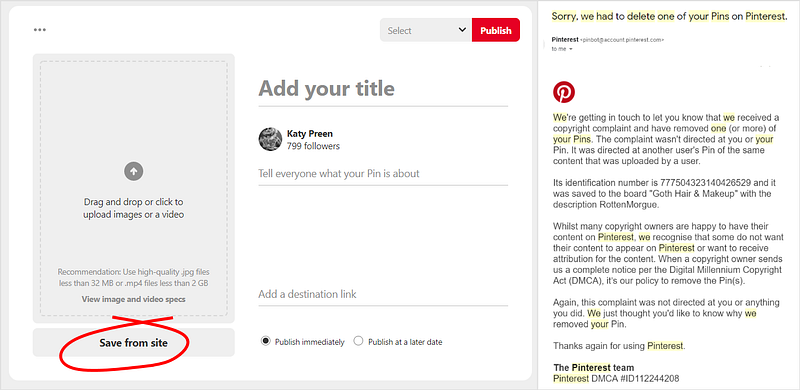
Similarly, you can’t just nick images off of Pinterest, or anywhere else. Just because an image is publicly available, it doesn’t mean anyone has a right to reproduce it. The owner still keeps their copyright. If you do use a copyrighted image like this, you may be contacted to take it down or pay compensation. Some people will do it anyway to see if they can get away with it, but if they steal the wrong person’s work it could cost them dear. It’s unethical to steal others’ work, and it’s a big risk. Don’t do it.
If you’re embedding a link using Medium, or embed.ly, or another service, or even in a frame using your own HTML code, 99% of the time you won’t need to worry. Embedding is a development of a simple hyperlink, a bit like using a frame to display an external website within a page of your website. Hyperlinks, inline links and framing generally do not transgress copyright because they merely provide a link to the original webpage displaying the content. But if the content you’re embedding has breached copyright law, then you too have breached copyright law. Be sure you know what you’re embedding!
You might think that copyright owners would be pleased with promotion of, and a link back, to their work — but this isn’t always the case. Some creators don’t want their material appearing on certain websites, and that’s reasonable. Readers in the UK often refuse permission for tabloid news sites like The Sun and Daily Mail to use photographs they have posted on social media — and publications ignore it and go ahead anyway.
They absolutely should not do this — and nor should you. This is a clear copyright infringement, and British newspapers are pushing their luck to try to avoid paying licencing fees. But it is one thing to want to be paid and credited for your work, and another to not want it to be published. If an outlet uses something that you’ve uploaded to social media on their site, you can invoice them (which if they’re the kind of company that just steals people’s pics off of social media, they will probably ignore). If it’s ignored, pursue it. You can take them to the small claims court, which is one part of the justice system easily accessible to ordinary people, and just doing this causes them an inordinate amount of hassle and bad press. They want to avoid this, so stand up for what’s yours and make them fold.
As noted above regarding embeds, if a newspaper embeds the whole tweet, and the original tweet does not violate copyright law (i.e. the tweeter had permission to upload their photo) then it likely would not be an issue. Does this mean we will see more articles featuring (legal) embeds rather than just their (illegally taken) images? Perhaps, but I think it will take a few more lawsuits for it to actually hit the companies that have a habit of doing this.
If you’re a member of a trade body, like the NUJ, they can advise you and help you get what you’re owed — and they take copyright infringement very seriously. More and more creators are wising up to the dirty tricks of media companies that hope creators will either not enforce their legal rights, or that they can scare them off with emails and letters that make it sound like they’ve done nothing wrong. But you are in the right — the law is on your side.
If someone uses your content without permission, and it’s worth more to you than licencing fees, it gets more complicated. You’ll need to take it to the civil court to get an injunction against them, if they refuse to remove your content from their publication. This can be expensive, and there are unscrupulous media companies that rely on this to take calculated risks in stealing others’ work. Remember that if you use content without permission, creators can take you to court — and they might have the funds to do so, in which case you’ve really screwed yourself.
Screenshots
This is a grey area. Screenshotting a tweet or post may be considered fair use, especially if the intent is to use it for commentary. But the trouble with fair use is that you might need to demonstrate it in court, because it is defined generally and implemented on a case-by-case basis. It is open to interpretation. A screen capture of a whole tweet, with a link back to the source, is unlikely to cause you any problems.
If you’re just screenshotting copyrighted images and then re-using them, that’s an obvious breach of copyright law. Please don’t be this silly.
You might want to use a screenshot of a tweet rather than an embed so that you still have the material in the event of the author deleting or restricting access to the tweet. This is often relevant to bloggers and political journalists commenting on bad ideas and decisions by influential people; sometimes these tweets are taken down in a damage-limitation exercise, rendering commentary obsolete or potentially libellous.
But if the tweet contains copyrighted material (and technically even the words within the 280-character limit are copyrighted material belonging to their author), your screenshot could violate laws on copyright.
Tweet / Post Content
Most tweets aren’t literary masterpieces, but they still belong to their author, who owns their copyright. Threads have been turned into blog posts by their creators, and even individual tweets can have significant meaning and money-making potential. At the moment, if someone steals the content of your tweet and tweets it as their own, we rely on the power of public shaming by other members of the Twitter community to get justice. As far as I know, no-one’s ever sued over this — but that doesn’t mean it can’t happen. Even the few sentences of a tweet are copyrighted material.
Someone in my network wrote a post on Facebook that was so good a national newspaper wanted to print it. The author gave them permission, and they published it with full credit to the author. Another publication took their content and republished it with a different author’s name on their website. This publication argued that because it was a Facebook post, it was in the “public domain”, and they could copy it and use it how they liked. This is not true, and the original author got this publication to take it down — court action was threatened and this was the point they realised the consequences of their theft were too great.
10 rules for avoiding copyright violations
- Don’t steal other people’s stuff — usually, you know when you’re breaking the rules. In edge cases, it’s more often that the one on trial knew that what they were doing was wrong, but they were testing a loophole in the law. It’s not that easy to accidentally fall foul of copyright law — and if in doubt seek legal advice.
- Ask permission — the worst that can happen is that they say no. And if they do, then abide by it. Many creators will happily allow you to use images with a credit, but you must ask them first. Otherwise, it’s theft.
- You’re usually safe when you embed links to external sites.
- If copyright status is unknown, assume it’s copyrighted until you know otherwise.
- Even tweets and posts are copyrighted, so don’t take their content and use it as your own.
- If someone uses your work without permission, you can sue them — but you can also be sued if you steal someone else’s work.
- If you’re claiming fair use, then you need to be able to defend it — hopefully not in a courtroom, but you never know. Just be sensible about it.
- Trade unions can help you assert and defend your copyright.
- There are millions of free-to-use images available — but if you can’t find what you need then you’ll have to ask nicely or buy a licence for what you want. Or you could take some photos yourself.
- Publicly available is NOT ‘public domain’ — images in the public domain are uncopyrighted. They are owned by the public and anyone can use them. If something is in the public domain, it may state it on the website — but if not then you will need to check. More information here.


