avatarNicole Hilbig

Summary

Copper is recognized as a natural and skin-friendly alternative to disinfectants, leveraging its antimicrobial properties to effectively eliminate pathogens upon contact.

Abstract

The article discusses the increasing use of disinfectants over the past two years and the potential harm to the skin's natural barrier due to overuse. It highlights copper, a metal that has been utilized since Roman times for its hygienic benefits, as a natural alternative. Scientific research has demonstrated that copper surfaces can kill many bacterial species, including Escherichia coli and Staphylococcus, by disrupting their cellular coating when in direct contact with copper ions. This discovery has led to the installation of copper alloy fixtures, such as door handles and light switches, in facilities with vulnerable populations like hospitals and retirement homes, to enhance hygiene and reduce the spread of pathogens.

Opinions

  • The article implies that the overuse of disinfectants can be detrimental to skin health.
  • Copper is presented as a historically proven, skin-friendly means of maintaining everyday hygiene.
  • Researchers' findings suggest that copper's antimicrobial surface is highly effective in neutralizing pathogens on the hands.
  • The author emphasizes the superiority of copper alloy surfaces over stainless steel in terms of killing bacteria and preventing the spread of disease.
  • The installation of copper alloy fixtures in public and healthcare settings is seen as a proactive measure to enhance hygiene practices.

Copper as a Natural Alternative for Disinfectants?
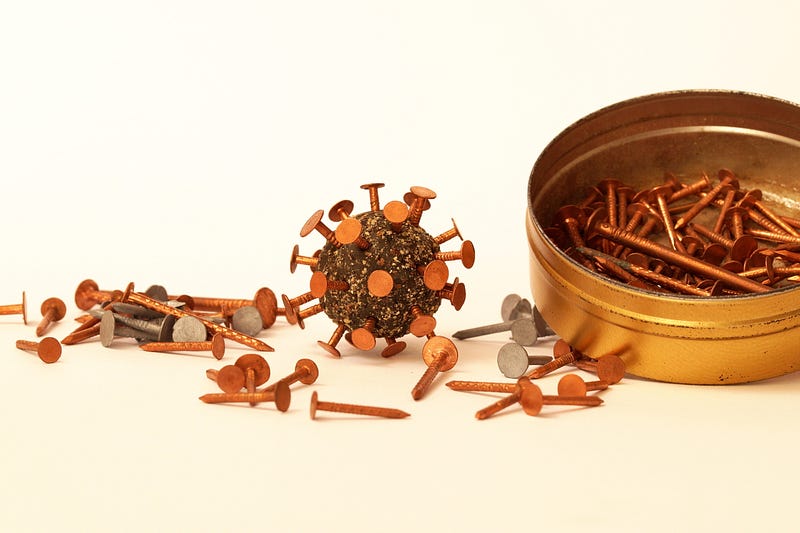
Image by ImagESine on Adobe Stock.

For two years now we’ve been using them more than ever: disinfectants. But overuse can damage the skin’s natural barrier.

There’s a metal that was already used by the Romans as a natural and skin-friendly means for everyday hygiene: copper.

Researchers have discovered that copper has an antimicrobial surface, so that pathogens on the hands can be rendered harmless. In direct contact with copper ions, the coatings of the pathogens come loose, causing them to die off after a short time.

„[…] many bacterial species, such as Escherichia coli, Staphylococcus, Salmonella, […] are efficiently killed on copper alloy surfaces. In contrast, on stainless steel, living cells could be recovered even after days.“

Today, door handles and light switches with a copper alloy are increasingly being installed, especially in buildings with vulnerable groups such as hospitals and retirement homes.

Did you know that?

Short Story
Inspiration
Health
Hygiene
Pandemic
Recommended from ReadMedium