avatarCarlos E. Perez

Free AI web copilot to create summaries, insights and extended knowledge, download it at here

6855

Abstract

isms that continue to exist today and have existed for eons. In fact, <a href="https://evolution.berkeley.edu/evolibrary/news/160505_treeoflife">new branches of life</a> (phyla) are being discovered all the time:</p><figure id="fb95"><img src="https://cdn-images-1.readmedium.com/v2/resize:fit:800/0*odCFYXH6eHDH000R.jpg"><figcaption><a href="https://evolution.berkeley.edu/evolibrary/news/160505_treeoflife">https://evolution.berkeley.edu/evolibrary/news/160505_treeoflife</a></figcaption></figure><p id="bdb8">The green section at the lower right (in the above diagram) is what we know as plants, animals, and fungi. Our biosphere is teeming with extreme diversity.</p><p id="2a86">Modular systems are more fragile than simpler systems. Species have over the eons have a propensity of going extinct. It is as if modularity is ultimately a non-viable and unsustainable experiment of evolution. It is as if this experiment is beating the odds and managing to persist, albeit for a brief period of time relative to the age of the universe. Modularity is just a glitch in the normal process. The cooperation that leads to modularity is an exploratory learning process. It is indeed surprising that in this exploratory process that more complex modular entities are created.</p><p id="8059">There is an alternative argument about the likelihood of complex life. The paper “<a href="https://drive.google.com/file/d/1UA4fozyF50CXEh-IjWZVVYzMDRMX1CLs/view">Information Theory, Predictability and the Emergence of Complex Life</a>” comes to the conclusion that “that the complexity of the guessers that can populate a given environment is determined by the complexity of the latter.” That is, prediction machines are more likely to survive in environments that match their complexity. It’s mysteriously kind of bootstrap environment where complexity begets complexity. It’s <a href="https://readmedium.com/the-strange-loop-in-alphago-zeros-self-play-6e3274fcdd9f">AlphaZero self-play</a> at evolutionary scales. Evolution is the ultimate meta-learning algorithm!</p><p id="214e">Evolution and therefore advanced forms of life would be just an anomaly and extremely unlikely if we were to use probability as our guide. But, unlikely does not imply impossible. In quantum mechanics, quantum tunneling is unlikely, but it does happen. This unlikely phenomenon is, in fact, the basis of our transistor and therefore the basis of computers and the internet. In short, even the quantum unlikely has brought forth a diversity of innovation.</p><p id="aa68">The massive advances in semiconductor and computer science are a consequence of modularity. The function of modularity is that it simplifies the design process in that you have modular parts that are designed for reusability. One can always design parts that are not modular and aren’t designed to easily integrate with anything. However, it is the modularity of technologies that accelerate innovation. When it becomes frictionless and permission-less to combine parts into a whole, then these become the catalysts of innovation.</p><p id="bae3">That is, an ecosystem that encourages rapid experimentation leads to greater innovation. The purpose of modularity is to reduce the effort of combining things. It is a cognitive construct that encapsulates complexity viewed from the exterior. It is a cognitive construct that supports adaptability originating from the interior. Innovation happens because experimentation can be done with less friction (as a <a href="https://readmedium.com/a-futuristic-deep-meta-learning-system-f8af641ad58b">consequence of loose coupling</a>). This also implies that evolutionary creates solutions that are very messy and not necessarily optimal or elegant. This reminds me of ‘<a href="https://www.jwz.org/doc/worse-is-better.html">worse is better</a>’ in language design. Evolution makes use of the components that are just good enough.</p><p id="60b4">So let’s go back to biological evolution and use what we just learned. Biological modularity exits because it facilitates the combination of organisms to create more innovative complex organisms. It doesn’t exist because it is more probable. Biological modularity exists because it is more reusable. Evolutionary progress happens as a consequence of complexity reduction in the form of reusable and adaptable components. <a href="https://readmedium.com/the-low-information-coupling-principle-and-multi-agent-deep-learning-32b5d581989">Modularity</a> is that attractive force that manifests itself in biology. Modularity is evolution’s memory.</p><p id="a465"><b>Further Reading</b></p><div id="4b20" class="link-block"> <a href="https://www.nature.com/articles/s41598-018-20426-w"> <div> <div> <h2>An optimal strategy to solve the Prisoner’s Dilemma</h2> <div><h3>Cooperation is a central mechanism for evolution. It consists of an individual paying a cost in order to benefit…</h3></div> <div><p>www.nature.com</p></div> </div> <div> <div style="background-image: url(https://miro.readmedium.com/v2/resize:fit:320/0*KdXLhrncD000m6uA)"></div> </div> </div> </a> </div><div id="662e" class="link-block"> <a href="https://arxiv.org/abs/1805.12215"> <div> <div> <h2>[1805.12215] Conjoining uncooperative societies facilitates evolution of cooperation</h2> <div><h3>Abstract: Social structure affects the emergence and maintenance of cooperation. Here we study the evolutionary…</h3></div> <div><p>arxiv.org</p></div> </div> <div> <div style="background-image: url(https://miro.readmedium.com/v2/resize:fit:320/)"></div> </div> </div> </a> </div><div id="1789" class="link-block"> <a href="https://arxiv.org/abs/1806.10166v1"> <div> <div> <h2>[1806.10166v1] Modular meta-learning</h2> <div><h3>Abstract: Many prediction problems, such as those that arise in the context of robotics, have a simplifying underlying…</h3></div> <div><p>arxiv.org</p></div> </div> <div> <div style="background-image: url(https://miro.readmedium.com/v2/resize:fit:320/)"></div> </div> </div> </a> </div><div id="08b7" class="link-block"> <a href="https://backreaction.blogspot.com/2018/06/how-nature-became-unnatural.html"> <div> <div> <h2>How nature became unnatural</h2> <div><h3>Naturalness is an old idea; it dates back at least to the 16th century and captures

Options

the intuition that a useful…</h3></div> <div><p>backreaction.blogspot.com</p></div> </div> <div> <div style="background-image: url(https://miro.readmedium.com/v2/resize:fit:320/0*aUJHksOxb-p0AcO_)"></div> </div> </div> </a> </div><div id="fcdd" class="link-block"> <a href="https://www.nature.com/articles/s41586-018-0277-x"> <div> <div> <h2>Evolution of cooperation in stochastic games</h2> <div><h3>Rent or Buy article Get time limited or full article access on ReadCube. All prices are NET prices. Subscribe to…</h3></div> <div><p>www.nature.com</p></div> </div> <div> <div style="background-image: url(https://miro.readmedium.com/v2/resize:fit:320/0*_AB48hFEZa3vWZuS)"></div> </div> </div> </a> </div><div id="10ec" class="link-block"> <a href="https://elifesciences.org/articles/34862"> <div> <div> <h2>Shearing in flow environment promotes evolution of social behavior in microbial populations</h2> <div><h3>Abstract How producers of public goods persist in microbial communities is a major question in evolutionary biology…</h3></div> <div><p>elifesciences.org</p></div> </div> <div> <div style="background-image: url(https://miro.readmedium.com/v2/resize:fit:320/0*Z5MDADGF6XQcws4h)"></div> </div> </div> </a> </div><div id="c7e0" class="link-block"> <a href="https://arxiv.org/abs/1806.05695"> <div> <div> <h2>[1806.05695] Evolving simple programs for playing Atari games</h2> <div><h3>Abstract: Cartesian Genetic Programming (CGP) has previously shown capabilities in image processing tasks by evolving…</h3></div> <div><p>arxiv.org</p></div> </div> <div> <div style="background-image: url(https://miro.readmedium.com/v2/resize:fit:320/)"></div> </div> </div> </a> </div><p id="206d"><a href="https://www.researchgate.net/publication/325999471_13_Misunderstandings_about_Natural_Selection">https://www.researchgate.net/publication/325999471_13_Misunderstandings_about_Natural_Selection</a></p><p id="ad32"><a href="https://pdfs.semanticscholar.org/cae6/5a7778ac1d49cb144ab5960a3c366d00f95b.pdf?_ga=2.148193079.1036724160.1532801459-701934385.1532801459">Multistability and metastability: understanding dynamic coordination in the brain</a></p><div id="0ff7" class="link-block"> <a href="https://julesh.com/2017/04/22/on-compositionality/"> <div> <div> <h2>On compositionality</h2> <div><h3>This post is copied (with some small modifications and additional comments) from section 0.4 of my Ph.D. thesis…</h3></div> <div><p>julesh.com</p></div> </div> <div> <div style="background-image: url(https://miro.readmedium.com/v2/resize:fit:320/)"></div> </div> </div> </a> </div><div id="5623" class="link-block"> <a href="https://arxiv.org/abs/1701.02389"> <div> <div> <h2>[1701.02389] Information theory, predictability, and the emergence of complex life</h2> <div><h3>Abstract: Despite the obvious advantage of simple life forms capable of fast replication, different levels of cognitive…</h3></div> <div><p>arxiv.org</p></div> </div> <div> <div style="background-image: url(https://miro.readmedium.com/v2/resize:fit:320/)"></div> </div> </div> </a> </div><div id="af62" class="link-block"> <a href="https://arxiv.org/abs/1704.05143"> <div> <div> <h2>[1704.05143] The Emergence of Canalization and Evolvability in an Open-Ended, Interactive…</h2> <div><h3>Abstract: Natural evolution has produced a tremendous diversity of functional organisms. Many believe an essential…</h3></div> <div><p>arxiv.org</p></div> </div> <div> <div style="background-image: url(https://miro.readmedium.com/v2/resize:fit:320/)"></div> </div> </div> </a> </div><p id="79f2"><a href="https://www.cell.com/neuron/fulltext/S0896-6273(18)30857-2">https://www.cell.com/neuron/fulltext/S0896-6273(18)30857-2</a></p><div id="6769" class="link-block"> <a href="https://blogs.gartner.com/nick_gall/2011/01/24/panarchitecture-architecting-a-network-of-resilient-renewal/"> <div> <div> <h2>Panarchitecture: Architecting a Network of Resilient Renewal — Nick Gall</h2> <div><h3>Just before the holidays, we published our second major note set on hybrid thinking, which I’ll post about in more…</h3></div> <div><p>blogs.gartner.com</p></div> </div> <div> <div style="background-image: url(https://miro.readmedium.com/v2/resize:fit:320/0*Lh2i3CQBV7XWiQK5)"></div> </div> </div> </a> </div><div id="387b" class="link-block"> <a href="https://arxiv.org/abs/1811.00612v1"> <div> <div> <h2>[1811.00612v1] Zipf’s, Heaps’ and Taylor’s laws are determined by the expansion into the adjacent…</h2> <div><h3>Abstract: Zipf’s, Heaps’ and Taylor’s laws are ubiquitous in many different systems where innovation processes are at…</h3></div> <div><p>arxiv.org</p></div> </div> <div> <div style="background-image: url(https://miro.readmedium.com/v2/resize:fit:320/)"></div> </div> </div> </a> </div><p id="ccc6">Learn more about Deep Learning:</p><figure id="705c"><img src="https://cdn-images-1.readmedium.com/v2/resize:fit:800/1*kLghw8y2ldRkO117bNQSwQ.png"><figcaption><b>Explore Deep Learning</b>: <a href="https://gumroad.com/products/IHDj">Artificial Intuition: The Improbable Deep Learning Revolution</a></figcaption></figure><p id="35c8">.</p><figure id="4d90"><img src="https://cdn-images-1.readmedium.com/v2/resize:fit:800/1*j9kar_3vwdJK8twhtmXC0g.png"><figcaption><b>Exploit Deep Learning</b>: <a href="https://deeplearningplaybook.com/">The Deep Learning AI Playbook</a></figcaption></figure></article></body>

Cooperation, Competition and the Emergence of Modularity
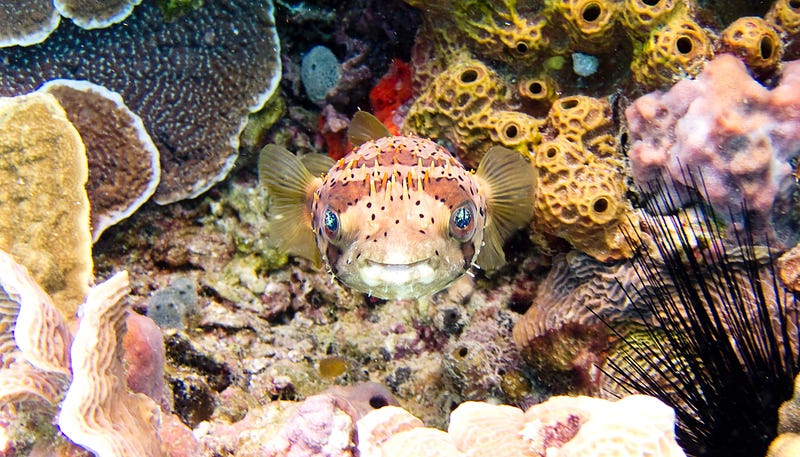
Photo by Vlad Tchompalov on Unsplash

“It’s something else. It has to do with organization, propagation of organization, work, and constraint construction. All of this has to be incorporated into some new theory of organization.” — Stuart Kauffman

Modularity is an essential artifact that exists in diverse ecosystems. How does it come into existence?

I don’t think we truly understand the process of evolution. If evolution did have a goal what is it? I don’t think it has a goal, but if this were the case then why does it create diversity and not uniformity? The Second Law of Thermodynamics drives towards randomness, where randomness is actually uniformity. Uniformity in the sense that you cannot distinguish one sample from another sample. It is not that the sample is similar to others, rather than the samples are equally random. Why does evolution drive in an opposite direction? With evolution, there is a richness in diversity in that a lot of stuff looks different, but not completely different. Every life form shares a common heritage. It’s not random, and it is not uniform.

What I am further perplexed about is: why does evolution evolve higher-level modular structures? Why does evolution evolve complex species? Why did evolution evolve you or even the parts that constitute you?

There is a related question that also arises in inanimate objects as found in physics. The universe is obviously non-uniform. Galaxies are formed, and all kinds of celestial objects exist within galaxies. If it weren’t for mass (blame the Higgs boson) and gravity (blame the hypothetical graviton) then these galaxies and everything in them wouldn’t exist. If you were looking for the forces that ‘bind the universe together’, that is the fundamental forces of nature (i.e. gravity, electromagnetism, strong nuclear and weak nuclear) you’ll find some forces that are exclusively attractive (gravity and strong), some exclusively repulsive (weak) and both (electromagnetism). The universe consists of forces that bind and forces that repulse. The conjecture (i.e., Dark Matter) is that the sum total of the forces that bind exceeds the one than repulses.

In evolution, are there analogies to attractor and repulsive forces? What keeps things together and what breaks things up? What keeps things separated and encapsulated? There are forces in biology that lead to its diversity. These aren’t fundamental forces but something equivalent in its consequences. Could we consider cooperation and competition as a high-level abstraction of these forces?

An animated object, one that is receiving a stimulus to the environment and interacting with its environment, can either cooperate or compete with other animate objects. That’s the two extremes of how they can interact with other entities. It is easy to develop an intuition of why a competitive environment is the default context. That is ‘survival of the fittest’ seems to make intuitive sense.

On the other hand, cooperation seems to be less intuitive in that it seems to require a level of sophistication that is hard to imagine for simple animate objects. Evolution, however, has evolved multi-cellular systems, where we have a diversity of cells cooperating together to create complex organizations. Why does evolution have the “intelligence” to create this kind of modularity? How does this kind of advanced complexity emerge?

I argue that evolution is also a learning process. Learning processes employ strategies that are a combination of either an optimization kind (sense-making) or an exploratory kind (sense breaking). The evolution of modularity, whether that be conceptual modularity or biological modularity implies an optimization process. That is a process that takes what currently exists and adds them together to create something newer and perhaps better. Exploration takes what currently exists, breaks them apart to create something newer and perhaps better — perhaps creating a new kind of modularity.

What are the benefits of modularity? Modularity is that organizational structure that encapsulates its members to act a single coordinate whole. It is the whole that is interacting with the environment, and its members are cogs in the machinery of the whole. Memory fundamentally requires modularity. That is, memory requires a mechanism to persist over time. This requires an attractive and repelling force (required for encapsulation). Therefore, modularity is what gives the evolution of its memory.

Elisabeth Sahtouris has proposed a fusion of Darwin’s competitive theory and Kropotkin’s cooperative theory of evolution:
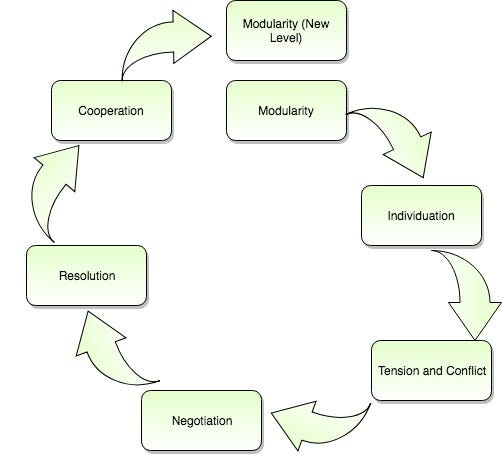
Where an evolutionary cycle of competition and cooperation leads towards more complex modularity structures. The interesting artifact of this model is in the transition between competition and cooperation (i.e., negotiation and resolution phases). This is where the costs of competition exceed the costs of cooperation. So, if evolution is a learning process, then it is a kind of learning process that involves a mechanism for switching between exploitation (competition) and exploration(cooperation). Furthermore, the notion of competition and cooperation can only make sense because of the presence of modularity.

One can get an intuitive sense of why a cooperative process may be less costly. Think of companies that acquire smaller companies with the goal of infusing newer capabilities or competing in newer markets. An acquisition strategy does make sense as a strategy for greater competitiveness. A strategy of cooperation can be perceived as a strategy of acquisition or a strategy of recruitment. In the complexity of biology, some entities avoid being acquired, and there are entities (like viruses) that survive by being acquired.

The quest for modularity, however, isn’t the dominant strategy in evolution. It is rather just a niche strategy. There are many less complex organisms that continue to exist today and have existed for eons. In fact, new branches of life (phyla) are being discovered all the time:
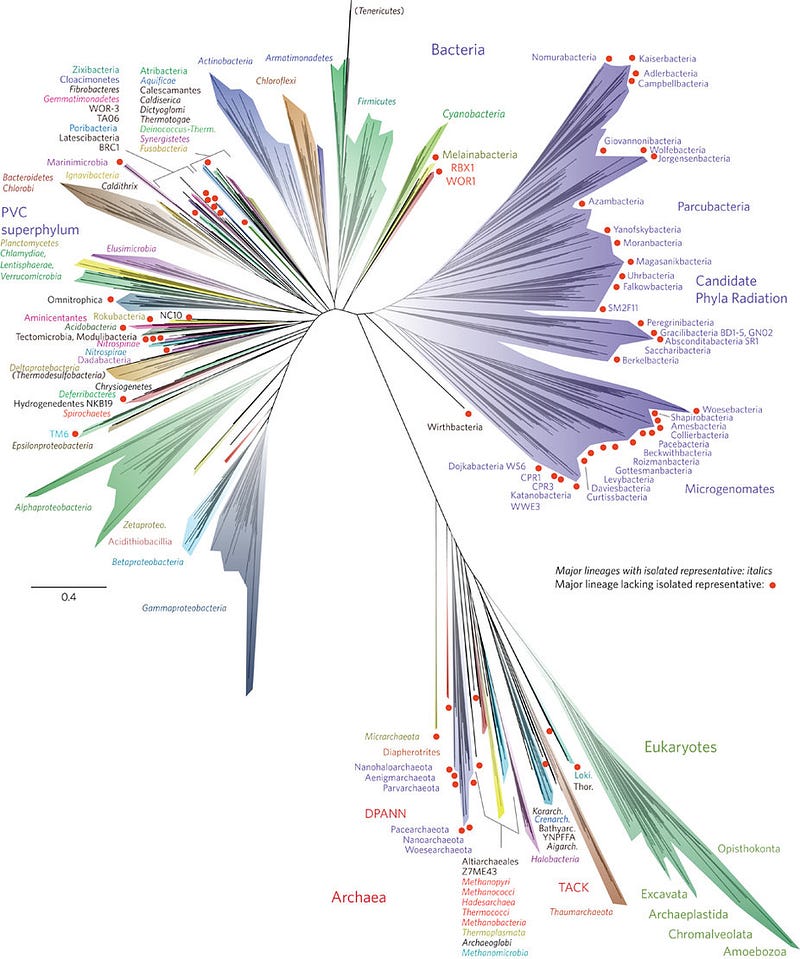
https://evolution.berkeley.edu/evolibrary/news/160505_treeoflife

The green section at the lower right (in the above diagram) is what we know as plants, animals, and fungi. Our biosphere is teeming with extreme diversity.

Modular systems are more fragile than simpler systems. Species have over the eons have a propensity of going extinct. It is as if modularity is ultimately a non-viable and unsustainable experiment of evolution. It is as if this experiment is beating the odds and managing to persist, albeit for a brief period of time relative to the age of the universe. Modularity is just a glitch in the normal process. The cooperation that leads to modularity is an exploratory learning process. It is indeed surprising that in this exploratory process that more complex modular entities are created.

There is an alternative argument about the likelihood of complex life. The paper “Information Theory, Predictability and the Emergence of Complex Life” comes to the conclusion that “that the complexity of the guessers that can populate a given environment is determined by the complexity of the latter.” That is, prediction machines are more likely to survive in environments that match their complexity. It’s mysteriously kind of bootstrap environment where complexity begets complexity. It’s AlphaZero self-play at evolutionary scales. Evolution is the ultimate meta-learning algorithm!

Evolution and therefore advanced forms of life would be just an anomaly and extremely unlikely if we were to use probability as our guide. But, unlikely does not imply impossible. In quantum mechanics, quantum tunneling is unlikely, but it does happen. This unlikely phenomenon is, in fact, the basis of our transistor and therefore the basis of computers and the internet. In short, even the quantum unlikely has brought forth a diversity of innovation.

The massive advances in semiconductor and computer science are a consequence of modularity. The function of modularity is that it simplifies the design process in that you have modular parts that are designed for reusability. One can always design parts that are not modular and aren’t designed to easily integrate with anything. However, it is the modularity of technologies that accelerate innovation. When it becomes frictionless and permission-less to combine parts into a whole, then these become the catalysts of innovation.

That is, an ecosystem that encourages rapid experimentation leads to greater innovation. The purpose of modularity is to reduce the effort of combining things. It is a cognitive construct that encapsulates complexity viewed from the exterior. It is a cognitive construct that supports adaptability originating from the interior. Innovation happens because experimentation can be done with less friction (as a consequence of loose coupling). This also implies that evolutionary creates solutions that are very messy and not necessarily optimal or elegant. This reminds me of ‘worse is better’ in language design. Evolution makes use of the components that are just good enough.

So let’s go back to biological evolution and use what we just learned. Biological modularity exits because it facilitates the combination of organisms to create more innovative complex organisms. It doesn’t exist because it is more probable. Biological modularity exists because it is more reusable. Evolutionary progress happens as a consequence of complexity reduction in the form of reusable and adaptable components. Modularity is that attractive force that manifests itself in biology. Modularity is evolution’s memory.

Further Reading

https://www.researchgate.net/publication/325999471_13_Misunderstandings_about_Natural_Selection

Multistability and metastability: understanding dynamic coordination in the brain

https://www.cell.com/neuron/fulltext/S0896-6273(18)30857-2

Learn more about Deep Learning:

Explore Deep Learning: Artificial Intuition: The Improbable Deep Learning Revolution

.

Exploit Deep Learning: The Deep Learning AI Playbook
Science
Evolution
Artificial Intelligence
Recommended from ReadMedium