
LEGENDS OF THE FALL
Cool Picture Books About Autumn
Is your family ready for cooler days after the summer heat? Savor the joys of fall with these crowd-pleasers
Have this summer’s heat waves left your family yearning for cooler days?
A great picture book can bring the joys of autumn home for children who are eager to see pumpkins and changing leaves. It can also give all of you a richer perspective on the vibrant colors of the season.
You might try these crowd-pleasers from major-award-winning authors.
‘The Little Yellow Leaf’ by Carin Berger (HarperCollins, 2008)
Honors: A New York Times ‘Best Illustrated Children’s Book’ of the year and other awards
A yellow oak leaf is “not ready” to fall from an autumn tree in this winning fable by a much-honored children’s author and illustrator. The yellow leaf bides its time until early winter, when it finds a scarlet leaf on the bough and the two agree to leave together.
When — and how — will the reluctant leaf find the courage to leap into the unknown? Berger invests her simple plot keen suspense.
Her book also works as parable about teamwork, or how a friend’s encouragement can make the difference when you’re facing a change. In that sense, it resembles such classics as The Story of Ferdinand and Mike Mulligan and His Steam Shovel, which tell good stories that have a second layer of meaning: They are parables about nonviolence and growing old, respectively.
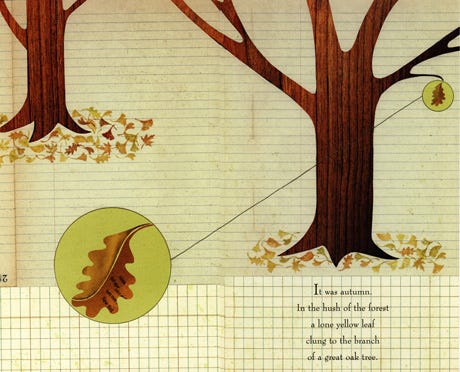
Throughout the book, Berger shows a fine and subtle sense of color in her mixed media artwork, which includes elegant cut-paper collages made from everyday items. One memorable illustration consists of a two-page image of the sun made from thousands of tiny hand-cut squares and rectangles, each unique, laid out in a parquet design.
Berger’s raw materials show the beauty of recycled objects, and the text — apart from its high artistic merits — might help children adjust to unfamiliar events, such as starting a new fall activity.
‘In the Middle of Fall’ by Kevin Henkes, illustrated by Laura Dronzek (HarperCollins, 2017)
Honors: Henkes won the Caldecott Medal for his illustrations for Kitten’s First Full Moon and the Children’s Literature Legacy Award for his body of work, both from the American Library Association
Superstar Henkes is known for amusing picture books about two sister-and-brother mice, including Lilly’s Purple Plastic Purse and Julius, the Baby of the World. His tone is more subdued in this handsome book, one of four in his series about the seasons, all illustrated by his gifted wife.
Some books about autumn, worthy as they are, say nothing of the winter that will follow. That may confuse children just learning about the seasons, leaving them with the idea that there are only summer and fall.
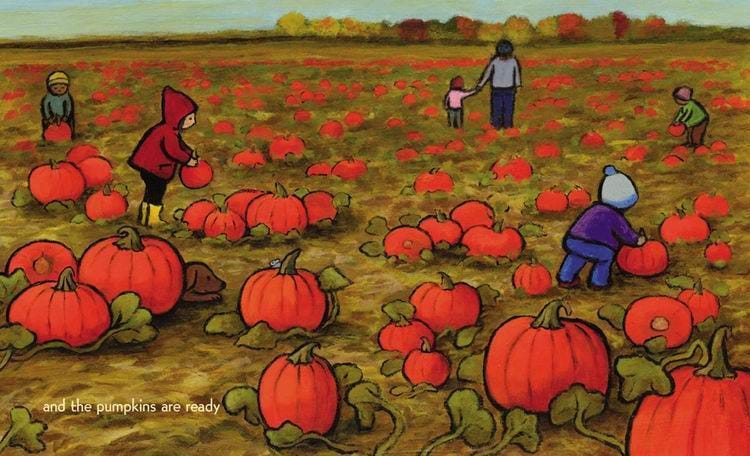
A signal virtue of this book is that it ends by urging its young readers to remember the days when “the pumpkins are ready” and the apples hang on the trees “like ornaments” because soon “the sky will be white and empty — / ready to fill up with snow.”
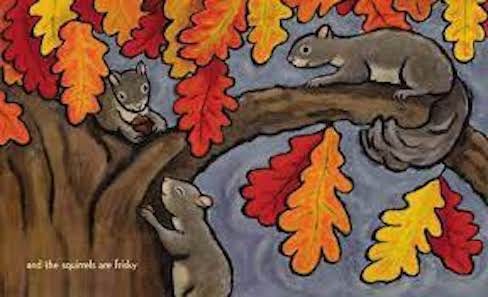
Henkes’ text consists of just two sentences, spread out like a prose poem, over 32 pages. But Dronzek’s images add a strong context. Her full-page and two-page pictures show scenes of fall signatures such as gray skies, wind-tossed leaves, a nut-clutching squirrel, and brown- and pale-skinned children picking apples and pumpkins.
An especially nice touch: The front endpapers show gusting leaves and the back ones, falling snowflakes.
‘Pumpkin Soup’ by Helen Cooper (Macmillan, 1999)
Honors: Pumpkin Soup won the Kate Greenaway Award in Britain, which Cooper had earlier won for The Boy Who Wouldn’t Go to Bed.
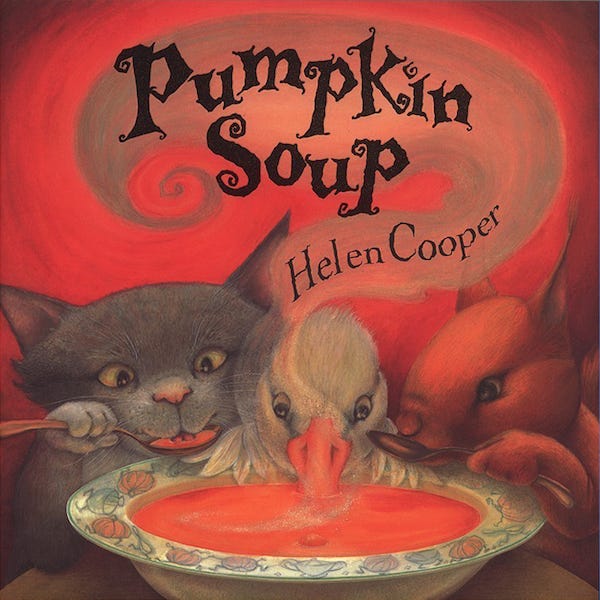
Deep in the moonlit woods, three animal friends live in a cozy gourd-like cabin where they sing or play instruments when they aren’t making pumpkin soup, “The best you ever tasted.” Cat slices the pumpkin, Squirrel stirs the water, and Duck adds the vital salt.
Then Duck decides it’s his turn to do Squirrel’s job. When Squirrel objects, a “rumpus” erupts, briefer than that of Where the Wild Things Are, but nonetheless likely to delight children who remember the word from Sendak’s classic. A furious Duck waddles away, protesting, “You never let me help with anything.”
Without his knack for adding the salt, the soup is a mess, and the other two creatures are sad without Duck, whom they set out to find. They worry that he’s hurt or made new friends, but when they return home, they see a tearful Duck, who has missed them, too, in the cabin. Squirrel lets Duck stir the pot, Duck teaches Squirrel how to measure the salt, and “the soup was still the best you ever tasted.”
Pumpkin Soup holds implicit lessons about sharing, taking turns, and honoring your friends, and it has a simple pumpkin soup recipe at the end. But the endearing and lushly detailed pictures are what make this book an international favorite. Cooper might have won the Greenaway Award just for the facial expressions of Cat, who remains credibly feline while showing joy, fear, sorrow, confusion, and other emotions.
@JaniceHarayda is an award-winning critic and journalist who has been a writer and editor for Glamour, the book columnist for Ohio’s largest newspaper, and a vice president of the National Book Critics Circle.
You might like my review of another picture book with a “rumpus”: