
Food
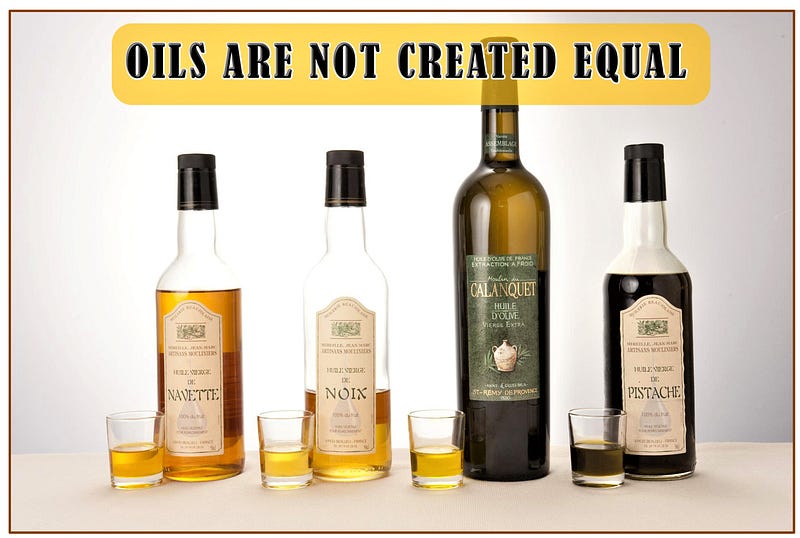
Cooking Oils Are Not Created Equal
There are so many cooking oils on the market these days. It’s hard to know which one is best for your recipe.
It’s About the Final Goal
Oil stops food from sticking to a pan, but it has a far greater role. The type of oil that we choose for a dish can affect its consistency, taste, and texture.
Every oil has a unique chemical composition that influences whether it’s better in a recipe with or without heat.
Oils react differently to heat intensity.
You might find one is great for grilling but awful on a salad. The reverse is true, too. So, choosing the correct oil for your dish can make all the difference.
Understanding Culinary Oils
Culinary oils are derived from a variety of plant sources. These could be seeds, nuts, or fruit. Depending on the source, oils can be very flavorful, and some have nutritional benefits.
Some are refined (clarified, purified) while others have been left in a raw state.
Refined Oils
Refined oils are often over-processed and may be stripped of any nutritional value, flavor, or smell. The extraction process often uses high heat and chemicals.
An advantage is that they are more shelf stable.
Some plant materials won’t release their oils without heat. Soybeans are an example of this. If minimal steam heat is used without chemicals, it may allow the oil to retain more of its nutrients.
Unrefined Oils
Unrefined oils may be referred to as raw, virgin, or cold-pressed oils. They are not processed with heat but may be filtered to remove any impurities. Since their extraction method is so mild, they will keep most of their nutritional value.
They are not as shelf stable as refined oils.
Another advantage of low to no heat extraction is that the unrefined oils will hold on to the flavor of their originating plant.
What Is Oil Smoke Point?
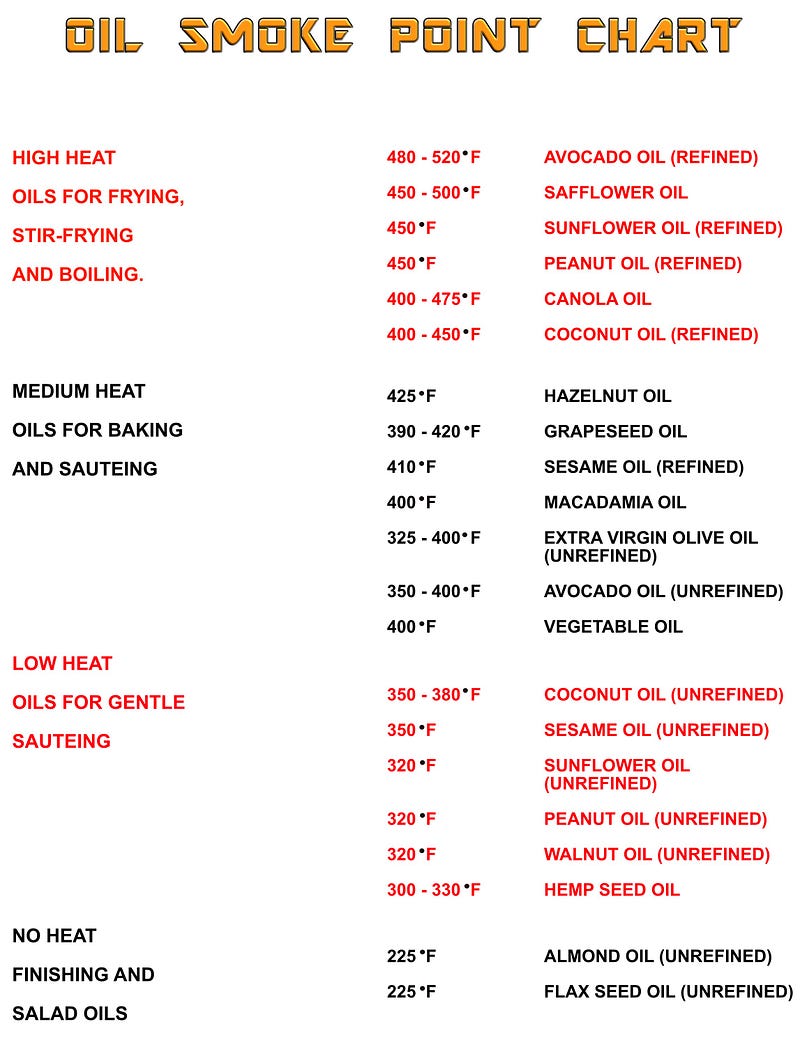
The smoke point of an oil is when it reaches its heat limit. This is also called burning point and refers to when it starts smoking and the oil loses its nutritional value.
Heat limits vary greatly between different oils and ranges from 250˚F to 520˚F.
When oil reaches its burning point, it starts breaking down and this is often when food will have a burnt taste.
Refined oils will tolerate more heat than unrefined oils. So, it’s important to consider what you’re end goal is when choosing an oil for a recipe.
Some argue that oils with a smoke point below 300˚F should never be heated. They are more suited to salads or dips.
Oil Smoke Point Chart
Knowledge is Power
I understand that most of us won’t bother memorizing smoke points of our favorite oils, but knowing the basics about what may be a better choice is always helpful.
Goodness only knows, I need all the help I can get in the kitchen. I can probably draw a delicious plate of food better than cooking one!
Join Medium and Support Writers
Please consider joining Medium for $5 a month to get full access to all the incredible writers on the platform. Your membership supports writers like myself to continue doing what we love most. To write and entertain.
Click here to join via my referral link.


