
Cooking in Our Genes
A look at generational inclinations
ChristyWrites just published another delightful article, Food Is Love, that got me thinking about how the love of food and cooking passes down through families. So I decided to take a peek at the kitchens in my family tree.
The farthest I can go back is my maternal grandparent’s kitchen in their apartment in the old town part of Heidelberg, Germany. It was actually my grandfather’s kitchen since he did most of the cooking. He had a very strong passion for cooking and I think I may have inherited that from him since no one else in my family tree had the same passion.
Opa, as we called him, only spoke German and vehemently refused to learn any English words. We American kids only spoke American but when Opa spoke he was very animated and loud with all manner of hand gestures accompanying every word. We usually got the gist of what he was saying.
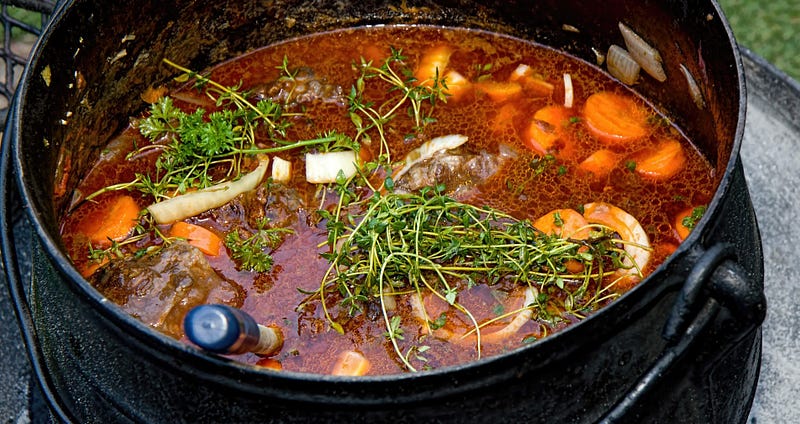
One of the first things Opa would do in the morning was to make a pot of soup. It was, of course, made from scratch with only fresh ingredients — and always with copious amounts of fresh parsley. The pot of soup would simmer on the stove all morning so consequently his apartment would always smell of soup, even long after the soup had been consumed. I loved walking into my grandfather’s apartment because I was always immediately greeted by that heavenly smell.
There were no grocery stores in Heidelberg in the 1960s. Purchasing food was an excursion through the ancient cobblestone streets. To get bread Opa went to the Bakery. To get meat he went to the butcher. For fresh fruits and vegetables he went to the farmer’s market. He often took me along and I was only too eager to go. The merchants would always give kids free samples.
Opa shopped with his nose. He never bought anything without first smelling it. He would grab a hunk of cheese, close his eyes, then take a deep whiff of it. Then he would stick it under my nose for me to smell it. (It was almost like he was training a dog.) Of course, back then food did not come in cans or shrink-wrapped plastic. Back then you could actually smell food before buying it. (He could smell a loaf of bread and instantly know exactly how long it had been since it came out of the oven.)
But it was not just at the markets where Opa procured the food he cooked. He had a little garden plot outside of town that he tended and to which he often took my brother and me. At certain times of the year most of the vegetables that were cooked in his kitchen came from his garden. And he would also take us boys for walks through the forests in the hills above Heidelberg where he would forage for wild mushrooms. This was great fun and his mushroom soup was incredibly delicious and had a very earthy aroma that instantly made me hungry.
My grandfather’s intense love and passion for cooking seemed to skip a generation. His daughter, my mother, did one hundred percent of the cooking for our family and, while she perfected the art of feeding a family of six on less than two dollars, she cooked without the joy and passion that Opa had. To her, cooking was a chore, a burden and a punishment for having so many kids.
Luckily, she also tended a garden in our backyard in Texas. I often snuck out there to nibble of fruits and veggies. But her thumb was not nearly as green as her father’s thumb. Her primary motivation for gardening was saving money.
Going grocery shopping with her was a horrifying nightmare. She was a speed shopper, pushing her shopping cart at unsafe speeds (she drove her car the same way). Everyone had to get out of her way. And she never, ever bought anything unless it was on sale or unless she had a coupon for it. She would have her grocery list ready along with all the corresponding coupons and she knew exactly where all the items were in the grocery store so she could get her grocery shopping done at breakneck speeds. And then when she got to the check out line she would get extremely upset if there was much of a line.
And she never once smelled anything that she bought.
Mother had a rule about her kitchen. Males were not allowed in the kitchen except to wash or dry dishes or peel potatoes. Growing up, I washed and dried a lot of dishes (Mother hated washing dishes) and I peeled one hell of a lot of potatoes (nowadays I just wash potatoes and eat them with their skins).
I wanted to know more about cooking, though. But whenever I asked my mother how she made something she would harshly reply, “You’re a boy. Boys aren’t supposed to know how to cook.”
“But what about Opa? He cooks.”
“That’s different.”
That was all she said. She never explained what she meant by that. Eventually, after I left home, I learned that I was different, too.
It was not just males that were not allowed in her kitchen. There were also certain foods that were prohibited from entering her home, chief of which was garlic. My mother believed garlic was evil and that it increased a person’s sex drive — the last thing she wanted for her kids. I did not taste garlic for the first time until I was seventeen years old! (Now I’m a garlic freak who rarely ever goes a day without it.)
Another banned item was hot chile peppers. She never cooked anything that even came close to being hot and spicy. Her food was essentially bland with little to no seasonings. Since we NEVER ate out (too expensive) her food was the only food we ever ate so we kids ate it up as though it was the tastiest food in the world. We had nothing to compare it to so we loved it.
My mother was an extreme racist. She hated all people who were not white and she shared her racism liberally with us kids. This racism extended to her cooking choices as well. She vehemently refused to serve any Mexican food or learn how to prepare it. For the time that we were living in Texas this was just unthinkable and cruel. And she vehemently refused to learn how to cook and serve any Oriental food. (Oh yeah, ginger was another item banned from her kitchen since it was an Oriental spice. She even refused to make gingerbread cookies at Christmas because they called for ginger.) And we certainly never had any soul food. We only ate “white food.” (If she were still alive today she would no doubt be a huge Donald Trump fan.)
I was sixteen years old the first time I ever ate pizza. I was seventeen years old the first time I ate Chinese food. I was in my twenties the first time I ever ate Cajun food. A resentment started growing towards my mother as I realized how much wonderful food she had deprived me of. But once I was out on my own I forgot about that and proceeded to learn everything that I could about cooking. And I set out to try every different kind of food I could find from every part of the world. I bought and read cookbooks and I tried to learn as much as I could. A passion for food and cooking exploded within me.
I became just like my grandfather.
And that brings me to my daughter. I was 29 when she was born so I had a little over a decade of cooking under my belt. My passion for food and cooking was already well developed. And that is a good thing because the wife knew almost nothing about cooking and she did not like cooking. She had no passion for it.
So for the duration of the marriage I did approximately 99% of all the cooking. Once every year or two the wife would start feeling guilty for never cooking so she would proclaim that she was going to make a meal for the family. I always shuddered after she made these proclamations. She would always make spaghetti because it was the only thing she knew how to cook. It never tasted quite right and the pasta was always way overcooked. But I offered nothing but praise.
Then after the meal I would go into the kitchen and see that it looked like a tornado had gone through it. There would be food on the ceiling and on the floor. There would be tomato sauce on the walls. The counter-tops would be strewn with debris and the kitchen sink would be stacked two feet high with dirty dishes and pots and pans. I certainly did not complain. I gladly cleaned up the mess knowing that I would not have to clean such a huge mess again for another year or two.
During all that time cooking for my little family I was very consciously intent on NOT being like my mother. I shopped slowly and carefully to find the healthiest and freshest foods to cook for my family. And I continuously expanded my repertoire of foreign and ethnic foods. I wanted my daughter to experience as many different kinds of food as possible. And I always tried to maintain joyful thoughts while cooking since the food we cook picks up on our vibrations. That was easy since I loved cooking (and cleaning) so much.
But I also tried to bring my daughter into the cooking process, especially later on in her teen years. To my dismay, she showed no interest in cooking whatsoever. She was just like her mother. And even though I never forced her to wash dishes she someone managed to develop a full-blown hatred of washing dishes. I utterly failed to convey to her the exquisite joy to be experienced in dish-washing. More importantly, I failed to inspire in her a passion for cooking.
Now my daughter is middle-aged with kids of her own. About ever month or two she will call me up and ask me how I made some dish that I used to make when she was a kid that she really liked. It tickles me pink every time she asks me about food or for some recipe. I realize that at least some of the love that I poured into the food I cooked actually seeped through. It finally turned out that she does indeed have a passion for food but sadly she has little passion for cooking despite the fact that she does around 95% of all the cooking for her family.
As for my daughter’s daughters, it’s still too early to tell if they will ever develop a passion for food and cooking. But I have witnessed that my daughter will let them help her in the kitchen, especially when it’s time to bake cookies and cupcakes. So there is hope.
So as far as genetics go it seems that the love and passion for food and cooking only truly comes out in the males of my genetic line. Of course that’s not the case with my brother. He’s more like our father. I don’t ever recall seeing my father cook a single thing. His wife even had to toast his bread for him. He was only too happy to stay forever out of the kitchen.
As for my father’s side of the family, I don’t recall ever meeting any of them that had a love and passion for food and cooking. Of course, I had much less experience with them. About all I can remember is that they were all potato freaks. It seemed every meal was centered on some kind of potato entree.
Sadly, my maternal grandfather was the only one in my family tree who possessed the joy and passion of food and cooking.
It has been around a decade and a half since I have cooked for other people. Now I only cook for myself. It is a little sad to not have anyone to cook for beside myself. After all, if you are going to put out love it would be good to have someone to receive that love, right? But I happily love myself.
A couple of years ago a young twenty-something acquaintance came over to my apartment to retrieve a book I told him I would lend him. He stepped into my kitchen, looked around then said, “I see that you eat out all the time.”
“What?! I almost never eat out. Why would you say that?”
“Well, for one thing your kitchen is immaculately clean and for another I see that you don’t even have a microwave. How do you eat without a microwave?”
“How do I eat without a microwave oven? Are you serious?! I eat the same way that people have been eating for tens of thousands of years. I cook!”
He looked at me as though I was certifiably insane. The joy and passion of cooking is being lost on the newer generations for whom cooking means throwing something into the microwave and zapping it. Where the hell is the joy and passion in that?
Apparently, I am just an old fool stuck in ancient ways. No, I do not own a microwave oven — and never will. And no, I do not have an automatic dish-washer. If I did I would never use it. Why would I deprive myself of the exquisite joy and meditative peace of washing dishes? Why would I nuke my food and deprive myself of the incredible joy of cooking?
It is, of course, not genetics that will insure that the joy and passion for food and cooking continues into the future. It is up to old fools such as myself talking about it. It seems hopeless considering that modern social convention emphasizes convenience over joy and passion. When young adults have grown up eating only loveless nuked food they have no idea that anything else exists — just like I never knew of the existence of pizza as a child.
All we can do is talk about it and hope that a tiny spark of curiosity is ignited within the younger generations. Maybe, just maybe, that spark will lead to the re-birth of a passion for real food and real cooking. (And real dish-washing.) I fear that it may be lost forever to future generations. Archaeologists of the future might unearth stoves and cooking pots and wonder what the heck they were used for.
Meanwhile, I’ve got a pot of home-made soup simmering on the stove and smelling up my apartment and it’s time for lunch.
Copyright by White Feather. All Rights Reserved.


