
Control your vertigo — the unspoken rule for defending design decisions
How to keep UX maturity when discussing something that you stand for, and not slam the door after another useless meeting.

A group of 8–10 people (most of them are men who have never taken any communication classes) is locked in a room for 3 hours. AC is working, but it’s getting hot nonetheless. An argument seems inevitable.
On a projector is a concept my content design team developed.
Let’s take a real-life example. The website's Arabian localization is not displayed correctly. It’s set up to read from left to right, but it needs to be the opposite to match how Arabic is read. We’re sure that we need to adjust the website’s layout to mirror this properly.
We think that:
- these changes are vital and must have priority
- the current interface is plain disrespectful
Surprisingly, there are people who oppose this.
They are quick to dismiss the changes as too expensive — which is far from the truth — and they’re pushing their own ideas. Ideas that, honestly, not only look terrible but also threaten to undo everything we’ve worked so hard to achieve. Locked in a room with morons — a Sartre-like nightmare.
At the end of a meeting, everyone is convinced their idea is still best, and the other guys are just idiots. Each fixated on the other’s words, determined not to resolve the argument but to win it.
Another useless meeting where no good decisions were made. Useless meetings waste time and $100 million a year for big companies.
In a high-stress, “high load” environment — where decisions are made in haste and politeness is thrown out the window — I quickly realized something:
I was armed with the belief that data is the best way to convince someone. That turned out to be false.
Everyone has brought their own data to the meeting: user feedback, UX studies, budget numbers, development estimation, and design elements that are to be re-used in the UI.
People started swinging their data like Neanderthal — a club. It seemed unreal to negotiate anything in favor of content design.
Data as a tool of persuasion was useless unless the communication process was first established. So, I had to learn how to communicate first. I needed to break the wall of ego and make people listen. So the meeting isn’t useless.
Vertigo drains you of energy and leads to underperformance

Vertigo, as explained in “Negotiating the Nonnegotiable,” is about getting so caught up in a conflict or a difficult situation that you lose perspective.
This syndrome evokes a series of obstacles:
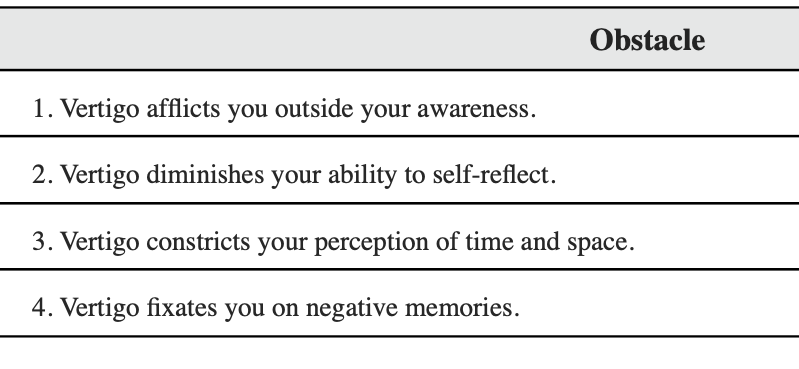
- You probably barely realize it. In meetings, vertigo sneaks up on you, and before you know it, you’re so invested in your own viewpoint that you can’t see where someone else is coming from.
- You lose the ability to self-reflect. All toxic professional environments are born from this aspect of vertigo. Although it fades into the background, it can continue to poison relationships and cloud emotional space between you and others.
- You lose track of time. Meetings are useless if you don’t have clear action points by the end. And you won’t have them if time flies.
- After the meeting, you’re locked onto the negative stuff. Vertigo hooks you onto those bad vibes, and all the good stuff — like positive feedback or things that actually went well — just fades away.
You continue to feel rational and levelheaded; it is the world around you that seems to be spinning out of control, not the world within you.
When egos get too large for a meeting room
If you never get emotional about your work, maybe it’s not for you. According to Daniel Shapiro, emotionally charged conflicts are born when our egos (or identities) collide:
Your identity comprises the full spectrum of persistent and fleeting characteristics that define you. These characteristics integrate to make you one: a unified whole that includes your body and mind, your neurological apparatus and position in society, your unconscious processes and conscious thoughts, and your enduring sense of existence, as well as your passing observations. —
In design, what we create is a reflection of who we are; our work is filled with our personal touch, our choices, and our creativity. Work often feels like an extension of ourselves. This is why it’s hard to negotiate in UX — the egos often get too large for a meeting room. Productive conversations turn into to defensive ones very quickly.
The strategy to deal with vertigo

You stereotype the other party. Not only does vertigo diminish your ability to reflect on your own behavior, but it also reduces your ability to see others clearly.
Beating vertigo is all about staying grounded and applying the strategy:
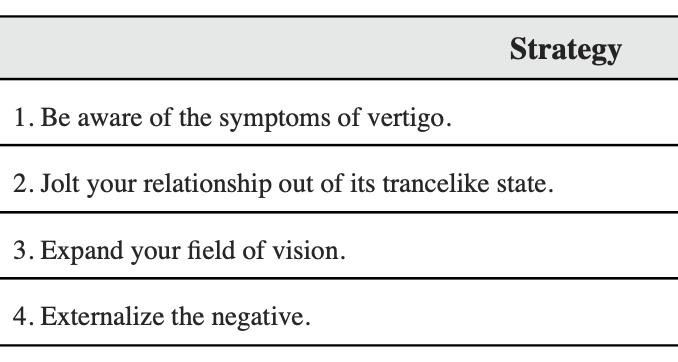
- At the end of the day, treat a job like a job. Recognize when you’re too attached and unwilling to consider alternative perspectives.
- In UX, a trancelike relationship means getting locked into a particular way of thinking. To jolt out of this, invent new ways of communication with your team. The lower the company’s UX maturity, the more basic, UX-related background information communications with other teams should include. Try asynchronous and synchronous communication activities from this article.
- Zoom out to see the whole picture. Map out user journeys, consider different user scenarios, and validate them against real-world data. Forget your ego.
- Externalizing the negative means detaching yourself from the criticism and viewing it objectively as data (hello, sticky notes).
Other methods that help me not to slam the door
Acknowledge your emotions. You’re not a robot.
Recognize and slow down your reactivity. If you’re a bit like me (and quick to make disgusted faces on Zoom before checking if the camera is on), try a play-pretend mindset. It’s one of my favorite things in meetings — I pretend to be an ultra-professional. I’m not just masking my immediate reactions; it’s more about channeling a version of yourself that handles situations with a cool head.
Do not create a divide. Avoiding a ‘us vs. them’ mentality is essential in communication. Don’t make enemies out of your colleagues.
Get a hobby. Like blogging, for example. I recently bought myself a deck of cards with Spanish kings and their families — I like to shuffle them — it’s extremely soothing. And I get to remember who’s who in history.
So, this is it. One psychology lesson a day keeps an angry stakeholder away.


