
Contact-Tracing apps around the world
The differences and challenges we face worldwide and on a small scale
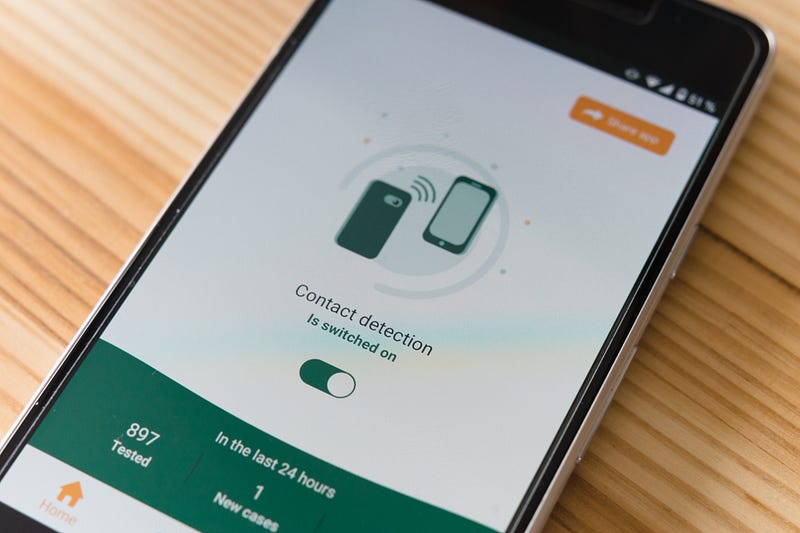
Now that countries are slowly opening up their borders, the question becomes: how can we trace the virus effectively? The first wave is getting behind us and many countries in the world are looking at the application of COVID-19 tracing apps, all with different approaches. In this article I give a small overview of countries that have contact-tracing app implemented and where the differences and challenges lay in these approaches.
United States
First of all, let’s take a look at the USA. In early polls it was found that more than half of American citizens who have smartphones (82% of the American population) were unwilling to use a COVID-19 tracking app. This is mostly due to the mistrust people have in big tech companies, such as Google who co-designed contact-tracing technology together with Apple.
As of June 10th, only three states have confirmed plans to use the technology. A lot of wariness and little trust, which is bad for the app itself because for general effectiveness to take place a country needs at least a 60% adoption rate.
Let's take a look at some cases where contact-tracing apps are already adopted for a longer period. Is it successful? And is there a sense of criticism as well towards these apps?
Singapore
One of the first places where a corona app was implemented was Singapore. The app is called “Tracetogehter” and has over 1.6 million downloads. With a population of 5.6 million that close to 30% of the population. That is by far not enough for it to be effective. Like in the US, there are a lot of privacy concerns in Singapore and the app drains your phone’s battery.
To up these numbers and to gain more users, the government has recently issued wearable tokens. It works the same way as the app, it exchanges Bluetooth signals between devices that are close to each other for a period of time. It won’t drain phone batteries so the hope is that this token will make the contact-tracing more effective with more users.
Israel
The contact-tracing app in Israel is called “HaMagen” (English: The Shield). 1.5 million people (20%) have voluntarily downloaded the app and it works over WiFi and GPS data. Not much has been said about the effectiveness of this app, but given the previous cases, the usage needs to increase as well.
There has been controversy about the involvement of the Israeli security agency “Shin Bet”, which had access to all of its citizen's movements through surveillance technology in the app. Normally this agency is responsible for the safety of the country by tracking down criminals and terrorists. Due to the controversy, this feature has now been halted.
South Korea

South Korea is one of the few countries where contact-tracing apps are indeed popular among citizens, despite the deep invasion of privacy (it is also mandatory for everyone to participate).
In South Korea, there are two different kinds of apps. An app made by the government meant to track the whereabouts of quarantined people and a lot of different commercially made apps that can track the movements of infected people. If you’ve been near someone that was infected, you get a text message. With no possibility to opt-out, this leads to tens of text messages each day, which drive a lot of people insane.
These apps use the most data out of the before-mentioned apps in Singapore and Israel. Where those apps limit themselves with only Bluetooth or GPS data, the South Korean apps use location info from credit card transactions, GPS data, and CCTV footage. These are very privacy invasive apps, e.g. routes that infected people have taken are published online, but the apps work and are effective.
Europe
These are some diverse cases all around the world in which you can see quite different approaches to the use of technology and privacy issues. You can also see a lot of diversity in approaches on a much smaller scale in Europe. In most of the European countries, such as Germany and Ireland, you see that the decentralized method of tracking is preferred whereas in the United Kingdom and in France they prefer a centralized method.
What is the difference I hear you thinking? Well with the centralized approach, the app takes data from the user’s phone and stores it on a central server. With the decentralized method, your data remains on your phone, so everyone has more control over their own data. The contact-tracing technology of Apple and Google use this decentralized method.
You can imagine, these different approaches can lead to problems once people start travelling again. For example, Ireland prefers the decentralized approach and the UK prefers a centralized approach, so if someone travels from Ireland into Northern-Island the apps are impossible to cooperate with each other.
Other effectiveness problems?
This is, of course, a very complex and technical issue, but there are more problems with the functionality of these apps. For example, many apps make use of Bluetooth technology. Is this really the most efficient technology available for the purpose of contact-tracing?
What if my neighbour has tested positive on corona but I have never walked past him during home isolation, but our walls are thin enough for the Bluetooth signal to register our distance? Now my phone will think I have been in close contact with my neighbour for a long time, but in reality, we both barely left our houses and we never had a long enough conversation while standing close to each other.
I argue that GPS is the better fit for determining the distance between two phones. The app only needs to know the location where the contact happened, very limited info with no further location tracking. So when this limited implementation will be upheld, privacy issues remain absent and you can verify whether the contact has been in the same room or building.
There are more questions related to Bluetooth vs. GPS / Centralized vs. Decentralized. If you have an Android phone, Bluetooth tracking in a centralized way is no problem. But if you have an iPhone, you always need to have your COVID-19 app open in order for the app to work. Another reason to choose for the GPS approach instead of the Bluetooth approach.
And what if this is all over? The technology will always exist and is in the hands of governments, agendas change. How can we trust that these apps will only be used for COVID-19 purposes? There are also already reports that the Syrian government is using malware in their contact-tracing apps. And the privacy related questions all around the world are not misplaced. Doom thinking is dangerous, but remaining cautious, critical and vigilant towards your government can’t hurt.