
Consumer Behaviour: The Psychology Behind Consumption
Why do people purchase certain products and brands?

A business should have a pretty good understanding of its target consumers, how they think, and the reasons for how they behave.
If not, it isn't easy to give them exactly what they want.
The study of consumer behaviour improves decision-making, removing some of the guesswork.
This article explores consumer behaviour's foundations to make better choices with their marketing to attract more of their target customers.
What is consumer behaviour?
Consumer behaviour is the study of consumption. It aims to understand better consumer actions and processes used in their purchase decisions, the usage of products and services, and how we dispose of them.
Exploring how consumers' emotions, attitudes and preferences affect buying behaviour, consumer behaviour draws upon ideas from several fields, including psychology, sociology, anthropology, biology, marketing and economics.
“[Consumer behaviour is] all activities associated with the purchase, use and disposal of goods and services, including the consumer’s emotional, mental and behavioural responses that precede or follow these activities.” (Kardes, Cronley, & Cline, 2010)
A consumer could be an individual, group or organisations.
Studying consumption investigates characteristics such as demographics, personality, lifestyle, and behavioural variables such as usage rates or occasion. Businesses aim to understand the process and underlying motives when satisfying their needs and want.
Through a better understanding of what causes consumers to buy certain goods and services, marketers can better determine the marketplace's needs and accordingly alter marketing to suit them.
Consumer behaviour is the who, what, when, where, and how of consumption.
The consumer is not necessarily the purchaser. From the information provider to the decision-maker, the user, the payer or the disposer, consumers play numerous roles.
Roles also vary depending on the circumstances — for example, within a family, the Mother could be the purchaser, the children consume the items, and the mother also disposes of them.
An early model of understanding consumer behaviour was introduced by Belk (1975), based on a stimulus, organism and response. The stimulus is an object and a situation, a person (consumer) is the organism and the reaction to their behaviour (consumption).
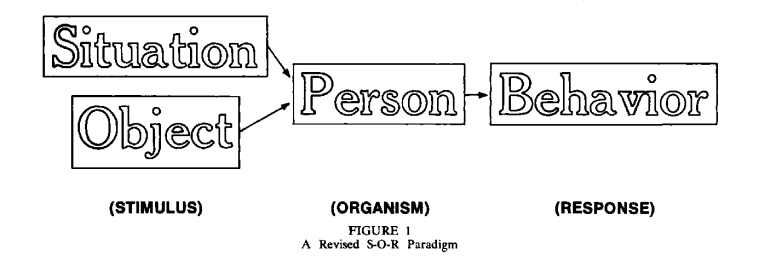
Factors that influence consumer behaviour
Consumer behaviour is not static. It changes over a period and depends on the nature of the products. Societal trends change, but also does an individual over their lifetime.
Equally, all consumers do not behave in the same manner. Some people spend outside their means, and others are quite frugal even if they do not need it.
For many individuals, knowledge of consumer behaviour enhances their ability to consume more wisely.
Given the time and energy we devote to consuming, we should aim to be better at it and have at least a basic understanding of how marketers try and influence our behaviour.
“Most of us spend more time buying and consuming than we do working or sleeping. We consume products such as cars and fuel, services such as haircuts and home repairs, and entertainment such as television and concerts.” (Hawkins & Mothersbaugh, 2010)
Some of the factors influencing consumer behaviour are:
- Marketing factors such as product design, pricing, promotion, packaging, positioning and distribution
- Personal factors such as age, gender, education, and upbringing
- Psychological factors such as buying motives, perceptions and attitudes
- Situational factors such as physical surroundings, social surroundings and time factor
- Social factors such as social status, reference groups, social media and family
- Cultural factors such as religion and ethnicity
- Lifestyle factors such as status, income and identity
- Geographical factors such as region, country and urban or rural
In a household, the whole family is influence and may become involved at various stages of the decision process, performing distinct roles.
For example, the mother is often the decision-maker, Dad, the purchaser, but the children essential influencers.
The different roles played in consumption are:
- The Initiator — the person who proposes a brand (or product) for consideration (something in return)
- The Influencer — someone who recommends a given brand
- The Decider — the person who makes the ultimate purchase decision
- The Purchaser — who orders or physically buys the product/service
- The User — the person/people who use or consumes the product
Some purchase decisions involve long, detailed processes that include extensive information searches to select between competing alternatives.
Other purchase decisions, such as impulse buys or habitual purchases, are made instantaneously with little or no time or effort spent on information search.
All of this illustrates the many complexities of understanding consumer behaviour.
Marketing and consumer behaviour
One of the biggest challenges for businesses is to stay relevant to their target market. They must ask questions about their customers, such as:
- Why do they buy and use certain products?
- What do they buy, when do they buy it and how often?
- What are their likes, dislikes and expectations?
- Why do they decide to buy one product and not another?
- Do consumers behave differently individually and in groups?
Consumer behaviour gives us a better understanding of what motivates consumers to make purchases and the most valued benefits.

Knowing what consumers value most will improve the decision-making of businesses when creating more effective marketing campaigns. Ideally, to sell more! Marketing needs to be strategic to be at its most effective.
“Marketers spend billions of dollars attempting to influence what, when, and how you and I consume. Marketers not only spend billions attempting to influence our behaviour but also spend hundreds of millions of dollars studying our behaviour.” (Hawkins & Mothersbaugh, 2010)
Procter & Gamble adding the word “repeat” to their shampoo's instructions in the 1980s is part of marketing folk law — not because it was required, but because it sold more shampoo.
Not only is consumer behaviour relevant to marketing strategy, but it is also essential to research and development, management, sales and advertising.
Remember, marketing is not just advertising.
Marketing begins with marketing research, which gives us a better understanding of how consumers/customers behave.
This understanding influences the product or service itself, as we want it to fit the customers’ needs best.
The better a product or service fits a market's needs, the easier it becomes to sell. The more people in this market with the same needs, the more profitable that market is.
However, it is not an exact science. Consumer behaviour is difficult to predict.
Applying the principles learnt from consumer behaviour knowledge requires human judgment; therefore, it is not an objective fixed set of rules.
Therefore, marketers must have a good general understanding of consumer behaviour and how consumption works.
Consumption is the ultimate goal for marketers, referred to as a behavioural response. But marketing also aims to elicit emotional (affective) responses and mental (or cognitive) responses, influencing a consumer’s thought processes.
“Consumer behaviour is of most importance to marketers in business studies as the main aim is to create and retain customers” (Kumar, 2004).
The benefits of understanding consumer behaviour
Understanding consumer behaviour habits of the target market enables marketers to take appropriate marketing decisions concerning the following factors:
- Product design — If a company fails to understand a consumer's reaction towards a product, there are high chances of product failure.
- Pricing — what price is the target market most likely to purchase? Is this profitable?
- Promotion — where is the best place to reach the target market? Facebook? They might spend a lot of time reading car magazines. That would be an excellent place to put an ad.
- Targeting — a group of consumers with similar behaviours. Each group of consumers are different; their needs and wants are different from other groups. Consumer differentiation will help to tailor your strategies to the needs of varying customer groups.
- Packaging — what type and style of packaging will be most attractive to customers? Does it matter?
- Positioning — communicating a brand’s point of difference compared to its competitors to the target market.
- Branding — monitoring other brands in the customer’s consideration set to optimise planning.
- Place of distribution — what location or type of store to sell a product or service?
- Customer retention — retaining customers is cheaper than attracting new ones, so understanding what customers want is critical to retention.
- Predict changing trends and behaviours — consumer behaviour changes, especially with fast-evolving technology. A consumer behaviour analysis will indicate a shifting direction so firms can align their marketing efforts accordingly.
- Innovating new products and staying relevant — many new products and services end up in failure, ranging from 33% to 90% based on the industry. Understanding customers helps businesses to design offerings that better fit the needs of their target customers.
The buyer decision process
The buyer decision process (or customer buying process) helps marketers understand better the decision-making process from first knowing about a product to then making the purchase decision.
The process consists of 5 distinct stages: problem or need recognition, information search, evaluation of alternatives, purchase, and post-purchase behaviour/evaluation.
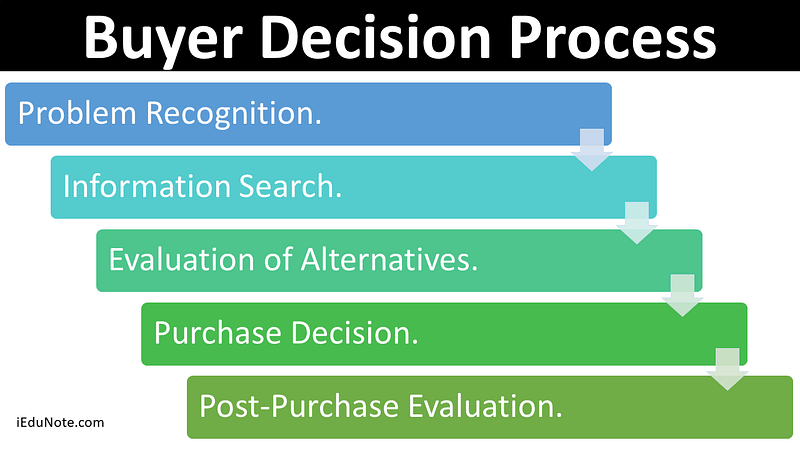
Problem recognition
The buyer decision process begins with the problem recognition stage, occurring when the consumer identifies a need or want. The strength of their needs drives the decision process, and the consumer decides they need a product or service to satisfy this desire.
Triggers of problem recognition include:
- Out-of-Stock/Natural Depletion — e.g. when you run out of toilet paper
- Regular purchase — e.g. purchasing a bottle of wine each week with the groceries
- Dissatisfaction — e.g. not happy with their current internet service provider and changing to a new one
- New needs/wants — as a family grows, they purchase a bigger vehicle.
- Related product — purchasing on product triggers the need for accessories, spare parts or complementary products such as buying the latest X-Box gaming console and upgrading the TV, games to go with it, and extra controllers.
- Marketing-induced — advertising triggers the recognition of a problem or needs that consumers did not realise they had. E.g., my internet IS slow. Yes, I do need faster internet!
Information search
The information search phase aims to identify a list of options representing realistic buying options. Consumers search their internal memory and use external sources for information about choices that will potentially satisfy their needs.
In an internal search, the consumer scans their memory for suitable brands.
The evoked set are preferred brands, typically to around 3- 5 alternatives.
Businesses use marketing to increase their brand awareness with their target customers, and therefore the likelihood it becomes a preferred brand.
If a business understands its target market’s behaviours, it makes decision-making a more objective process.
External sources of search include the internet, such as social media or product comparison websites, shopping around and talking to friends/family.
Information search and the next phase of evaluation can occur throughout the entire decision process.
Evaluation of alternatives
Consumers engage in a series of rational evaluations of the alternative options available to them. During this evaluation phase, consumers consider a small number of options that could be viable choices.
Being aware a brand exists does not necessarily mean consumers will consider it a viable option.
Realistic purchase options are known as the consideration set. Each consumer will have distinctive characteristics they are looking for, searching for the best value and fit for their needs.
Different evaluation criteria are used depending on each unique buying situation, consumers assessing and then ranking the relative merits of other options available.
Consumers with low knowledge about a product category tend to evaluate a brand based on functional characteristics.
Towards the end of the evaluation stage, consumers form a purchase intention.
Purchase decision
Once consumer evaluates alternatives, they make the decision and proceed through to the actual purchase. Companies use techniques to improve conversion rates, such as a strong call-to-action in advertising to increase their purchasing chances.
“Buy now while stocks last!”
Calls to action encourage an immediate sale.
Some customers might know all along where they want to purchase. Others might spend an extended period researching information about the different options available before they make their decision.
Post-purchase evaluation
This process is not complete until after consuming the product or service, and the consumer engages in a post-purchase evaluation.
Consumers compare their experience with the product or service and the perceived value with their expectations formed during information search and evaluation.
This process is called expectancy disconfirmation and is a strong driver of satisfaction.
Factors evaluated include price, functionality, and quality.
This evaluation influences a consumer’s next purchase decision for that good or service. If consumers feel some uncertainty or regret towards their choice, they are unlikely to choose that brand again.
Consumer motivations
An underlying motivation drives a consumer to act and purchase. These motivations fit under the problem recognition phase discussed above.
This motivation can be either positive or negative. A positive reason could be a pleasure — having dinner at a nice restaurant or a night in the town.
A negative motivation could be avoiding unpleasantness, such as purchasing toothpaste to minimise tooth decay, getting toothaches, and visiting a dentist.
Abraham Maslow’s well-known Hierarchy of needs model is one way to help understand the motivation.
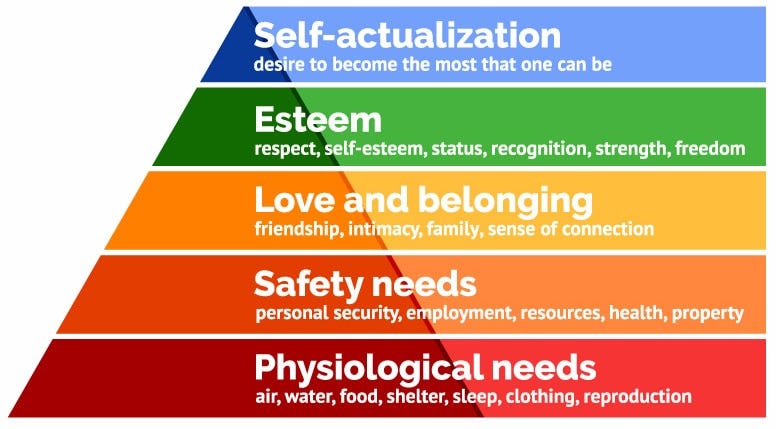
Although it is not a marketing model, academics and practitioners apply the Hierarchy of Needs across the social sciences. This model can help marketers to understand the unique needs and levels of motivation of customers.
It contains five levels of needs, organised accordingly to the level of importance. Lower-order needs are most important, and consumers typically use most of their time, energy, and finances to satisfy these.
Only then can they move on to the higher-order needs, and become meaningful.
- Physiological is a human’s basic level of needs such as food, water and sleep. We need these to survive.
- Safety is the need for physical protection, shelter and security. Purchasing a house or paying rent.
- Belonging to the need for love, friendship and a desire for group acceptance. A man buys his new wife an expensive ring when they get married.
- Esteem is the need for status, recognition and self-respect. Purchasing the latest BMW car or a designer handbag and shoes.
- Self-actualisation is the desire for self-fulfilment, such as personal growth or artistic expression. You might over to the other side of the world to see a motivational speaker such as Tony Robbins at a conference.
Thank you for reading. I hope you enjoyed the content on consumer behaviour and learnt something new.
As you can see, there is a lot of psychology behind the reasons why people buy. The better a business understands this process, the best it can serve the customers in its market.
This article has explored some of the critical components and theory of consumer behaviour — but it is a vast topic, so this only scratches the surface.
Learning more about the psychology of consumption should be ongoing for any serious marketer.
If you liked the content, you might enjoy this article about five marketing models every marketer should understand.
Read More Medium Articles
Non-Medium members can only read 3 articles a month.
Become a Medium Member for unlimited access to my content and articles from thousands of other writers, for just $5 a month.
Subscribe to be notified when I publish new content.


