
Constitutional Contradictions: Trump & the 14th Amendment
Consider this a plea for all Americans to vote next year.
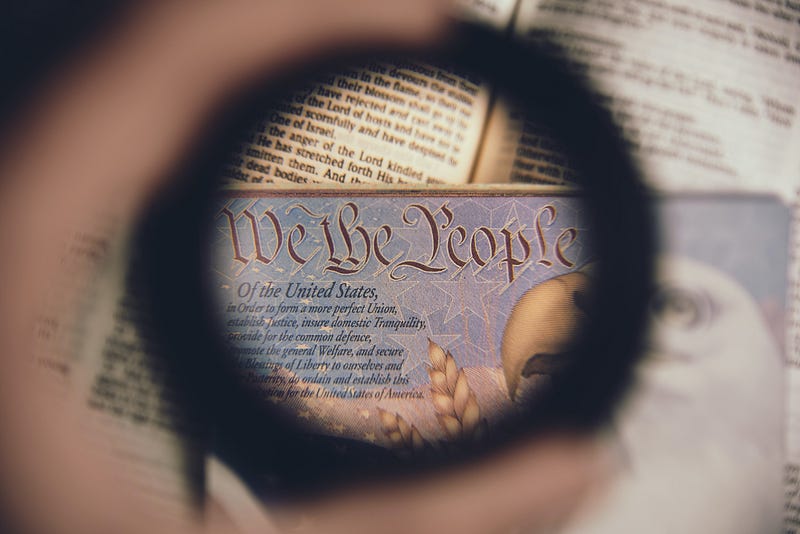
The American Civil War has sometimes been referred to as the Second American Revolution: an event so significant that the republic that emerged from it was fundamentally different from the one that preceded it. Embodying that change were three constitutional amendments: the 13th, 14th, and 15th. They were controversial at the time because they were passed while the defeated states of the Confederacy had not been readmitted to Congress, and they were driven by the need to establish the rights of the formerly enslaved. One of them — the 14th — is back in the news because it contains a clause that prohibits anyone who has served as a federal officer, but subsequently engaged in insurrection, from ever holding federal office again. This is currently being invoked to challenge Donald Trump’s efforts to secure a second term as president.
Judges in Michigan and Minnesota have ruled that Trump should remain on the ballot in the Republican primary election in their respective states. In Colorado, however, the state Supreme Court has ruled that he cannot be included because his conduct to block the transfer of power after his 2020 election defeat, culminating in the attack on the Capitol to disrupt the ratification of Electoral College votes, amounted to insurrection. Now, the Secretary of State in Maine, the officer in charge of electoral management in that state, has also announced that Trump’s conduct warrants exclusion and he will not be on Maine’s ballot.
Well ahead in the race for the Republican nomination, Trump has predictably responded by denouncing the decision as a partisan move that, without irony, he calls ‘a threat to democracy.’ Illustrating the political calculations involved, the Democratic governor of California has actually pressed his officials to allow Trump to remain on the ballot since it is becoming clear that his exclusion is cementing his hold on the Republican nomination. He has been able to raise more money from his followers and his allies in the Republican Party have even threatened to remove Joe Biden from state ballots in retaliation. His rhetoric of being a victim of the system resonates strongly with his followers and is amplified by legal efforts to prevent him from being the nominee.
The final arbiter in all such constitutional cases is the U.S. Supreme Court, which will have to rule on the correct interpretation of the 14th Amendment that must be applied uniformly across all states of the union. After all, the Constitution cannot mean one thing in Maine and another in Minnesota.
In doing so, the justices are likely to dwell on the complexities of the 14th Amendment, adopted in 1868. Its third clause was certainly intended to punish Confederate leaders and prevent their return to power at the national level. However, its first section, equally intended to establish the rights in law of the former slaves, or freedmen (women were not included at this point), contains an affirmation of the rights listed in the Bill of Rights that form the first ten amendments to the Constitution. The latter were passed to secure its ratification, and approved by the states in 1791. Clearly and rightly fearful that the previously enslaved might not be treated fairly by their former masters, the 14th Amendment spelt out that as citizens the freedmen were protected. The relevant section reads:
No State shall make or enforce any law which shall abridge the privileges or immunities of citizens of the United States; nor shall any State deprive any person of life, liberty, or property, without due process of law; nor deny to any person within its jurisdiction the equal protection of the laws.
What some historians have seen as the Rights Revolution of the 1960s, which dismantled segregation by law, was firmly rooted in this, the 14th Amendment.
However, this section by stressing the important principle of due process of law equally offers a strong argument in favour of Donald Trump remaining on the ballot. The principle that state action is curtailed by the processes of law is a key part of the rights protected guaranteed by the 5th Amendment. In previous decisions, the Supreme Court has ruled that the actions of the federal government are restrained by the 5th Amendment and that the 14th Amendment crucially extends or incorporates that restriction with regard to official actions at the state level as well. The government cannot just act. It has to ensure that its actions are subject to the proper processes of law.
At its most basic, therefore, Trump’s counter argument against those who insist that his January 6 conduct warrants his expulsion from the 2024 contest is that it is a penalty imposed without due process. The articles of impeachment against President Trump in his second impeachment trial charged that his actions broke his oath of office, but they failed to secure the required 67 votes out of 100 (a 2/3rd majority) in the Senate. Since the trial took place after the expiration of Trump’s term, it was also argued at the time that it was redundant to remove him from office (the penalty for impeachment which then opens the way for prosecution in the courts.) Since the constitutional procedure for punishing a president, while in office, is impeachment, Trump can accurately argue that he was acquitted.
Equally significantly, despite the multiple federal charges brought by the Special Prosecutor Jack Smith, Trump has not been charged under the Insurrection Act. In short, he has been neither charged nor found guilty of insurrection through due process. To exclude him from the ballot in any state is therefore a form of state action that is forbidden by the Constitution. I fully expect the Supreme Court to follow this logic, given its membership and the many precedents.
Thus, the law is on Donald Trump’s side, even while his public pronouncements regularly suggest that he himself does not want to be bound by its limits. His opponents therefore need to refocus on winning the election. The coalition that elected Biden in 2020 must be revitalized and a far better job made of the task of communicating his achievements in his first term. Given the level of partisanship and the likelihood that turnout will struggle to reach the 66% it broke four years ago, this will be a formidable challenge, not least because it is clear that the Republican apparatus in key states is ready to use a wide range of tactics to manage the election in ways that deny the vote to key elements of the Biden coalition. The 2020 election was not stolen, but there is a grave risk of that happening in 2024. In short, somehow Americans need to vote for the long-term good rather than short-term assessments of who will get the price of gas down quickest. In a world riddled with war and environmental crises, four more years of Trump whose own agenda is vengeance and lifting curbs on the petrochemical industry may be more than the Earth can bear.


